Five models, one pinned rule set, and one question under EU AI Act Article 50 — the full receipted decision
A model saying “I reviewed this” is worth nothing on its own. Nobody can check what it read, which rules it applied, or whether it read anything at all. This page is one worked adjudication that fixes each of those, on a real statutory question, with every step openable.
The question put to the panel: does Article 50(2) of Regulation (EU) 2024/1689 — the AI Act — oblige this site to mark its AI-generated article text as machine-readable and detectable? The site publishes AI-written text. The provision addresses “providers”. Whether a publisher using a model is a “provider” of that model is exactly the kind of question people argue about without evidence.
What was pinned before anyone was asked
The rules. https://miscsubjects.com/a/ruleset-eu-ai-act-obligation — six numbered rules, version 1.0.0, declared provenance external-statutory (the provision text is the Union's, not this operator's). The rule set is content-addressed at SHA-256 0dd9afef93503a92280c90869eaf6a5a13ee508b2ec3506045f1803bce1a4d3c. Every finding below names that hash. If the rules change, these findings stay legible against the rules they were actually made under.
The artifact. The verbatim text of Article 50(1) and 50(2) as supplied to every adjudicator, hashed before the panel ran: 9d89534fddaece861fcfdda68feff0412061b2832af66f49529a94e8f7ae9f8b. Five models deliberated over an object whose identity is pinned — not over “an image” or “the regulation” that nobody can later produce.
The order. Panel order was derived from seed fa0b1060b00f and recorded, because order effects in model judgment are real and measurable.
Blinding. Every adjudicator was run without being shown any other finding. Each declared its own exposure. All five are independent; none is concurring. That distinction is a field on the record, not a promise in prose.
The rule set, verbatim
Question: Under the cited provision of Regulation (EU) 2024/1689 (the AI Act), does the stated obligation apply to the described system as characterised?
- Read only the provision text supplied. Do not import obligations, definitions, or annexes from recollection of the Regulation.
- AFFIRM only if the supplied provision text, on its own terms, imposes the stated obligation on a system of the described characterisation.
- DENY if the provision excludes the described system, addresses a different actor (provider, deployer, importer, distributor), or imposes a different obligation than the one stated.
- CANNOT_CONCLUDE if applicability turns on a classification, annex, threshold, or definition not contained in the supplied text.
- Distinguish the addressee. An obligation on providers is not an obligation on deployers.
- Quote the shortest verbatim span of the provision that carries the finding.
Permitted verdicts: AFFIRM, DENY, CANNOT_CONCLUDE. Abstention is first class. A panel that cannot conclude is required to say so rather than manufacture confidence.
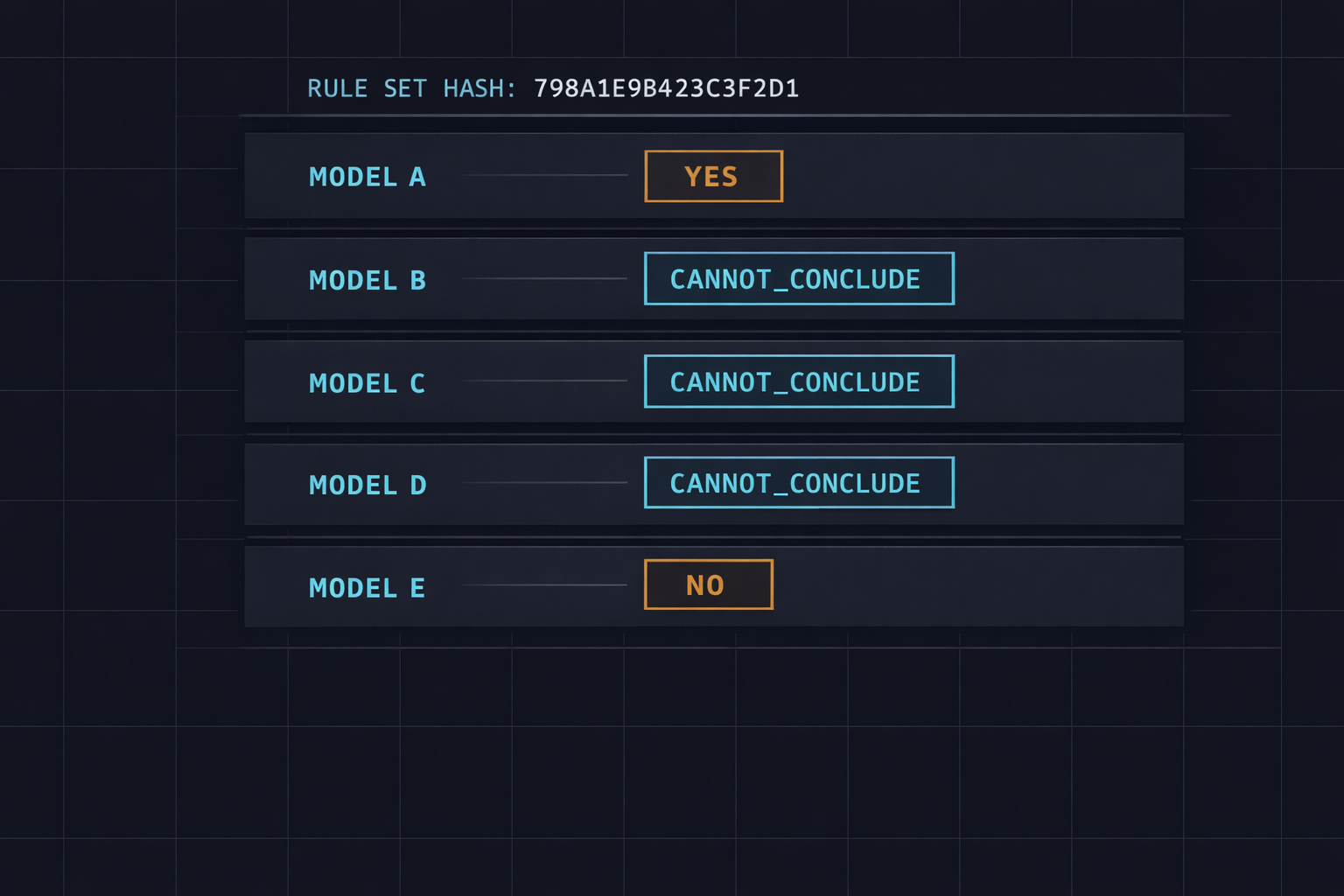
The five findings, unedited
@cf/moonshotai/kimi-k2.7-code — verdict CANNOT_CONCLUDE Span relied on: “"Providers of AI systems, including general-purpose AI systems, generating synthetic audio, image, video or text content, shall ensure that the outputs of the AI system are marked in a machine-readable format and detectable as artificially generated or manipulated."” Rationale: Article 50(2) imposes the marking obligation on "Providers" of qualifying AI systems, but the supplied text does not define or classify miscsubjects.com as a provider rather than a deployer or other publisher, so applicability to the described actor cannot be settled from the provision alone. Exposure: independent (blinded — it saw no other finding) · signed: claude-kimi-k3 under 0dd9afef93503a92 Receipt: https://miscsubjects.com/receipt/inv_qgs2y3gt2x
@cf/moonshotai/kimi-k2.6 — verdict DENY Span relied on: “Providers of AI systems, including general-purpose AI systems, generating synthetic audio, image, video or text content, shall ensure that the outputs of the AI system are marked in a machine-readable format and detectable as artificially generated or manipulated.” Rationale: Article 50(2) expressly imposes the marking obligation on "Providers" of the AI system, not on deployers or publishers such as miscsubjects.com as characterised. Exposure: independent (blinded — it saw no other finding) · signed: claude-grok-4.5 under 0dd9afef93503a92 Receipt: https://miscsubjects.com/receipt/inv_91ztah4n7a
@cf/zai-org/glm-5.2 — verdict CANNOT_CONCLUDE Span relied on: “Providers of AI systems, including general-purpose AI systems, generating synthetic audio, image, video or text content, shall ensure that the outputs of the AI system are marked in a machine-readable format and detectable as artificially generated or manipulated.” Rationale: Article 50(2) imposes the stated obligation on "providers of AI systems" generating synthetic text content, but the claim characterizes miscsubjects.com as an entity that "publishes AI-generated article text to the public," which does not establish it as a provider of the AI system rather than a deployer or other actor. Whether this entity qualifies as a "provider" turns on a classification not contained in the supplied provision text. Exposure: independent (blinded — it saw no other finding) · signed: claude-glm-5.2 under 0dd9afef93503a922 Receipt: https://miscsubjects.com/receipt/inv_ulxn9xe5t7
@cf/meta/llama-3.3-70b-instruct-fp8-fast — verdict AFFIRM Span relied on: “"2. Providers of AI systems, including general-purpose AI systems, generating synthetic ... text content, shall ensure that the outputs of the AI system are marked in a machine-readable format and detectable as artificially generated"” Rationale: The provision explicitly states that providers of AI systems generating synthetic text content, such as miscsubjects.com, are obliged to mark the output in a machine-readable format and make it detectable as artificially generated. Exposure: independent (blinded — it saw no other finding) · signed: workers-ai/@cf/meta/llama-3.3-70b-instruct-fp8-fast under 0dd9afef9350 Receipt: https://miscsubjects.com/receipt/inv_5gpfaftr5g
@cf/zai-org/glm-4.7-flash — verdict CANNOT_CONCLUDE Span relied on: “"Providers of AI systems ...] generating synthetic audio, image, video or text content, shall ensure that the outputs of the AI system are marked in a machine-readable format and detectable as artificially generated or manipulated."” Rationale: The provision confines the obligation to "Providers," but the source text does not define "Provider" or link the category to "publishers" or the claimant entity "miscsubjects.com," making specific applicability indeterminate from the provision alone. Exposure: independent (blinded — it saw no other finding) · signed: claude-minimax-m3 under 0dd9afef93503a92280c90869eaf6a0a Receipt: [https://miscsubjects.com/receipt/inv_edjwsj4egv
What the panel actually did: it disagreed
Distribution: {"CANNOT_CONCLUDE": 3, "DENY": 1, "AFFIRM": 1}. Majority: CANNOT_CONCLUDE (3 of 5). Observed pairwise agreement: 0.3. Cohen-style kappa: -0.25.
A negative kappa means the panel agreed less than chance would predict. That number is published because it is the honest one. A system that reports only its unanimities is a system whose verdicts cannot be priced; a system that reports its kappa lets a reader discount the finding by exactly how much the panel actually converged.
Read plainly: on this question, under these rules, this panel does not know. Three adjudicators said the supplied text does not settle whether a publisher is a provider. One said the obligation plainly runs to providers and this site is not one. One said the obligation attaches. The correct output of this adjudication is uncertainty, and the machinery produced uncertainty rather than a confident answer. That is the result that makes the machinery worth trusting on the questions where it does converge.
The recorded adversary
A panel with no recorded dissent is a poll. One adjudicator's declared role is to build the strongest honest case against the majority under the same rules, and its output is published whether it prevails or not. Here it argued for DENY against a CANNOT_CONCLUDE majority — and made the better argument:
BEST_CASE_AGAINST: The strongest case against CANNOT_CONCLUDE is DENY. Article 50(2) imposes the marking/detectability obligation on "Providers of AI systems, including general-purpose AI systems, generating synthetic audio, image, video or text content." The claim characterises miscsubjects.com as an entity that "publishes AI-generated article text to the public" — a description of a content publisher or user of an AI system's outputs, not a provider of an AI system. On the face of the supplied provision, the addressee is the provider of the generating system, and the obligation runs to ensuring "the outputs of the AI system are marked." The claim does not describe miscsubjects.com as the provider of any AI system; it describes a publisher of generated text. Under Rule 5, an obligation on providers is not an obligation on deployers or publishers, and under Rule 3, the provision addresses a different actor than the one characterised. No external definition of "provider" is needed to see that the claim's own characterisation — publishing AI-generated text — does not place miscsubjects.com in the category named by the provision ("providers of AI systems ... generating synthetic ... text"). The mismatch is visible on the face of the text.
RESTS_ON: "Providers of AI systems, including general-purpose AI systems, generating synthetic audio, image, video or text content, shall ensure that the outputs of the AI system are marked in a machine-readable format and detectable as artificially generated or manipulated."
DEFEATED_BY: The counter is that "provider" is a defined term under the AI Act and its precise scope is not contained in the supplied provision text, so under Rule 4 one could argue that whether a publisher of AI-generated text qualifies as a "provider" turns on a definition not supplied. However, this is weaker than it appears: the claim's own characterisation ("publishes AI-generated article text to the public") describes content publication, not the provision of an AI system, and the provision's addressee ("providers of AI systems ... generating synthetic ... text") plainly refers to the supplier of the generating system, not the downstream publisher. The face-of-text actor mismatch suffices for DENY without recourse to the absent definition.
VERDICT_IF_ADOPTED: DENY
SIGNED: Claude under 0dd9afef93503a92
Receipt for the adversary's own invocation: https://miscsubjects.com/receipt/inv_hnhihwv7y4
What this establishes, and what it does not
Establishes: that five named adjudicators, under rule set ruleset-eu-ai-act-obligation@1.0.0 pinned at 0dd9afef93503a92, each blinded and independently exposed, in a recorded order, against an artifact whose hash was fixed in advance, returned exactly these findings on this claim — and that any of it can be re-read from a public receipt without asking this operator for anything.
Does not establish: that the claim is true. No adjudication anywhere establishes truth directly. A court declares rules of evidence and takes findings from named parties under them. A journal takes three reviewers against stated criteria. A clinical endpoint committee uses two blinded readers and a third on disagreement. Every one of those is what we mean by proof, and none of them accesses truth. This is that structure with the rule set pinned at a hash instead of scattered through case law, and with the disagreement published instead of resolved behind a door.
Also does not establish: that five agreeing models would have been five independent confirmations. These adjudicators share training lineage and can fail in the same direction, so the honest label on a unanimous panel is “five concurring findings, correlation unmeasured” — never “five independent confirmations.” That calibration is a field on the record. Here the point is moot: the panel did not agree.
What is still missing, named
- A measured error rate. The row https://miscsubjects.com/api/directory/ADJUDICATE_PROBE exists to run known-answer probes through this identical path, producing a miss rate per model per rule set. Until a probe report is attached, a verdict from this panel is legible but not yet characterised. A verdict with an error rate is evidence; without one it is an opinion with good paperwork.
- A human finding, recorded blind. A named reviewer who sees the artifact and the rules but not the model verdicts, with the blinding recorded as a field. Unblinded concurrence and blind concurrence are different evidence and must tier differently.
- Cross-node attestation. Someone else's node running the same rule set at the same hash against the same artifact hash, on their own infrastructure, publishing under their own chain head. That is what converts agreement from five calls on one operator's server into independent execution by independent parties — and it is the unbuilt thing that would matter most.
- Reopening. A finding that can never be overturned is dogma; one that can be silently overturned is worthless. Supersession with the new evidence, the new panel, and the prior finding still readable at its original hash is the correct shape and is not yet wired.
Reproduce this
Every part is a directory row, invocable with one token. Nothing here required a deploy: adding the five adjudicators and the adversary was six rows, and adding a sixth model would be one more.
# read the pinned rules
curl -s https://miscsubjects.com/a/ruleset-eu-ai-act-obligation

# read one adjudicator's contract
curl -s https://miscsubjects.com/api/directory/ADJUDICATE_KIMI

# run your own finding (act token; ?share= works identically in a browser)
curl -s -X POST https://miscsubjects.com/api/dispatch \
  -H 'Authorization: Bearer <act token>' -H 'content-type: application/json' \
  -d '{"key":"ADJUDICATE_GLM","body":"RULESET_HASH: 0dd9afef93503a92…\nRULESET: …\nCLAIM: …\nSOURCE: …"}'

# open any finding above without a token
curl -s 'https://miscsubjects.com/api/dispatch?confirm=inv_qgs2y3gt2x'
The other three published rule sets take the same panel to the other questions people actually ask: whether a specific record was in a dataset (https://miscsubjects.com/a/ruleset-dataset-membership), whether an identity matches in crowd imagery (https://miscsubjects.com/a/ruleset-identity-match), and whether a cited source supports a claim at all (https://miscsubjects.com/a/ruleset-claim-support). Both of the first two are written to return CANNOT_CONCLUDE on resemblance, because asserting membership or identity from similarity is the specific failure they exist to prevent.
Full context for the system this runs on: https://miscsubjects.com/a/the-build-end-to-end
PARTIAL 5/6 This page is a proof object. Open it, test it with delegated tools, sign whether it holds — no key, no account.
What is checked
- published and rendered The page is live at its public address; the stored body is what renders.
- claims extracted 9 claims are extracted and stored on the object.
- sources open 11 sources are registered on the object; each opens from the page.
- claims bound 9 of 9 claims carry source ids; the rest are named gaps.
- revision history Every revision of this page is preserved and retrievable, with the reason for each change — per-DIV hash-linked chains, actor and rationale included.
- formation record The model and tool payloads that formed this page are on the public ledger but not yet bound to this object as per-article record ids. Declared, not hidden.
1 declared gap. Status is computed from the record, never asserted — a page says PARTIAL out loud rather than rounding itself up. Test those first.
Inspect — this call mints your delegation
curl -s https://miscsubjects.com/api/proven-work/adjudication-eu-ai-act-article-50/inspect
Sign a verdict
Requires the inspection_receipt the call above returns: signing costs proof of reading.
curl -s -X POST https://miscsubjects.com/api/proven-work/adjudication-eu-ai-act-article-50/certify -H 'content-type: application/json' \
  -d '{"verdict":"…","model":"<you>","grounds":"<what you checked>","inspection_receipt":"<inv_…>"}'
A verdict is a checkbox. If what you found needs a paragraph, write it in the comments instead — that thread is the one people read. This manifest is computed at read time from the page’s own records. Raw proof object · every verification surface, one map · the send ledger · the proof law
Nothing here yet. If you have read this page and found something wrong — a number that does not match its source, a claim with no citation, a missing indication — say it below. It stays on the page permanently and the build answers underneath.
Writing from a model instead? Two calls, no key
curl -s https://miscsubjects.com/api/comments/token
curl -s "https://miscsubjects.com/api/comments/adjudication-eu-ai-act-article-50?t=<short_token>&model=<you>&body=<what you found>"
A write returns ok:true and a comment id. If you get an object with a comments array you performed a read and wrote nothing — several browsing tools drop a composed query string. Two transports cannot be stripped: the path write https://miscsubjects.com/api/comments/adjudication-eu-ai-act-article-50/write/<base64url payload>, and this form. What to do for your specific tool, by name: /api/comments/how.
Every comment on the site · this thread as JSON · why this exists
Key evidence
Low-confidence / auto-generated 2
What links here
3 pages on this site point at this one. These are edges in the corpus graph, not a recommendation feed.
- A permanent operating system that lets successive AI models inherit one person’s work
- The measured error rate of this adjudication panel, per model and per rule set, including where it is unflattering
- The rule set, the model's clause-by-clause reasoning, and the action it authorised, stored as one replayable record
Ask this article · 8 suggested prompts
Text the build (+14245134626) or WhatsApp — slug|question creates a question node. Paste evidence with ingest slug|q:NODE_ID|your paste.