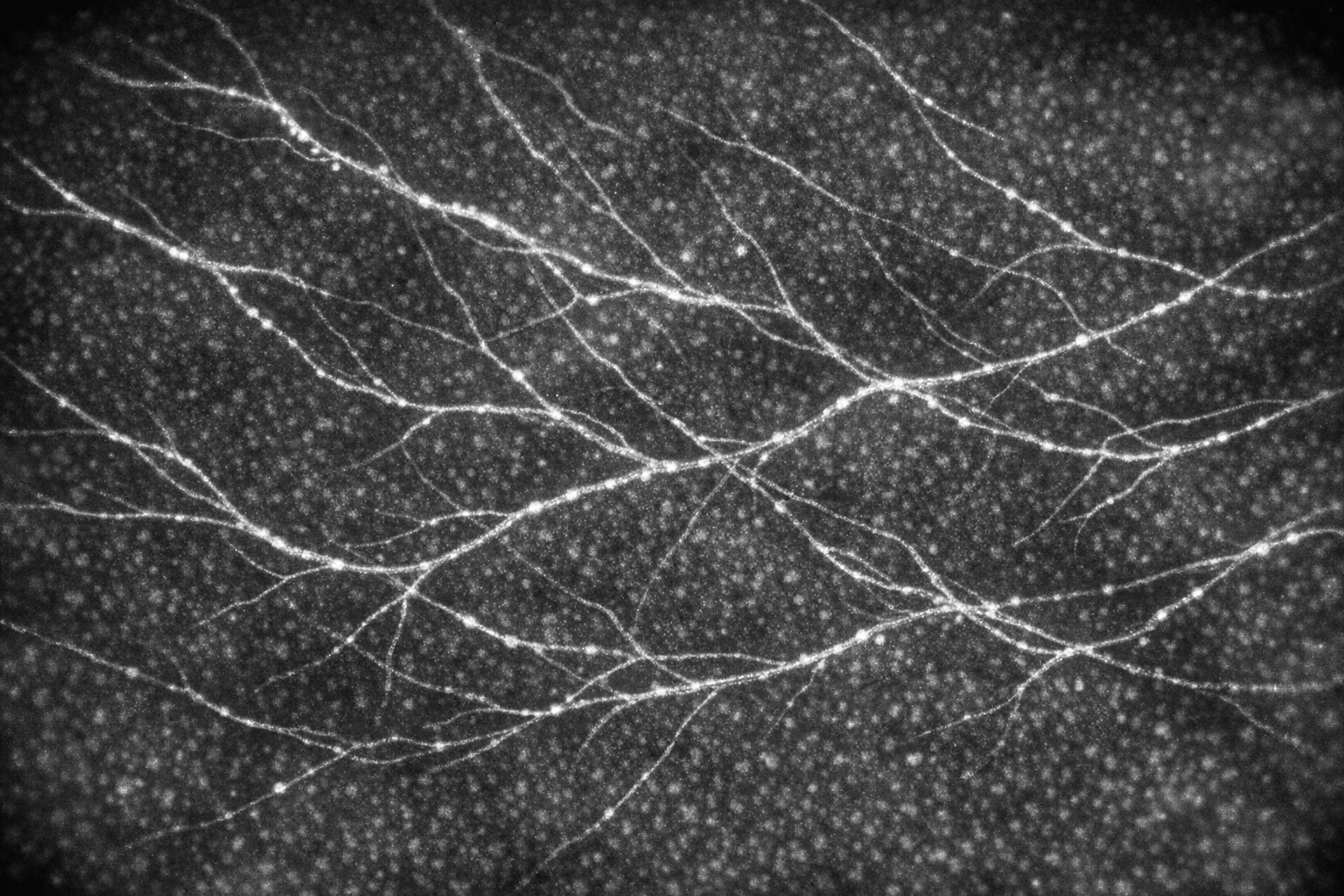
ARA-290 (cibinetide): a fragment of erythropoietin that acts on nerves, not on blood
The definitive ARA-290 (cibinetide) reference: the innate-repair-receptor mechanism, randomized human evidence of actual nerve regeneration, the 4mg/day dosing and half-life paradox, the non-erythropoietic safety proof, why there's no real supply, and the disc nerve-pain fit.
Six randomised, placebo-controlled trials have put this compound into people and measured what happened. Three hit the thing they set out to change. Three missed.
The number most people need first: the trials gave 4 mg a day. Public reports of self-use run 250 to 1,000 mcg a day — four to sixteen times less, and below the lowest arm of the only dose-ranging trial ever run, which itself missed at 1 mg. Whatever the trials showed, almost nobody is taking that dose. Nothing else written up on this site has that record. This is the one compound here whose evidence starts in people rather than in rats.
One disclosure, because it should change how you read the rest. The operator of this site has a commercial interest in compounds described here. That is a reason to weigh what is on this page against the sources it cites rather than against its tone, and every claim below carries the source that supports it for exactly that reason. The compound is ARA-290, also written cibinetide. It is eleven amino acids in a row, copied off one face of a hormone your kidneys already make — erythropoietin, the hormone that tells bone marrow to build red blood cells. That hormone does a second job as well: it keeps injured cells from dying and helps damaged nerves grow back. The two jobs run through two different docking points on the cell. ARA-290 was cut out of the parent molecule to hit the repair one and miss the blood one. It does not raise your red cell count and it does not carry erythropoietin's clotting risk.
If you have burning feet, numb toes, electric jabs in the legs at night, or skin so sensitive that a bedsheet hurts, this is the compound in this library with the most human data behind it. What follows is what was given, to whom, at what dose, what moved and what did not, where the measurements stop, and the arithmetic that decides whether the dose you can actually buy is anywhere near the dose that was tested. That last answer is short: it is not. What people take sits four to sixteen times below anything a trial has ever given.
Two jobs, one hormone, and a peptide cut to do only one of them
The reasoning that produced ARA-290 runs in five steps, and each step is a published result rather than a guess.
Erythropoietin tells bone marrow to make red blood cells. It does that by clamping two identical erythropoietin docking points together. This is the effect that makes the hormone a doping agent and a stroke risk.
Erythropoietin also keeps injured tissue alive and helps it rebuild. That was seen in stroke, in kidney damage, in heart damage and in nerve damage, decades before anyone knew why.
The two effects are not the same signal. Brines and Cerami showed that the repair effect runs through a different docking point entirely: one erythropoietin subunit joined to a second protein called CD131. They named the pair the innate repair receptor.
Because the two docking points are built differently, the two effects can be pulled apart by design. A molecule shaped to fit the repair pair, but too small to clamp the blood pair, would rebuild tissue without touching the marrow.
The part of erythropoietin that faces outward and does the repair binding is called the helix B surface. An eleven-residue peptide that reproduces that surface, with its front end looped shut so enzymes cannot chew it, is ARA-290 — also written pHBSP.
What that produces is not a weaker dose of erythropoietin. It is a different molecule that physically cannot reach the docking point erythropoietin uses to thicken your blood.
What is dying back, and what would have to grow for it to stop hurting
Small-fibre nerve damage is a degeneration story with a specific shape, and the whole case for this compound is that it acts on one particular link in it.
What is breaking down. The nerve endings that carry pain, temperature and sweating signals are the thinnest fibres in the body — unmyelinated C fibres and thinly wrapped A-delta fibres. They end in your skin, in your cornea, in the lining of your gut. They are the furthest thing from the cell body that keeps them alive, so they are the first to die back when anything goes wrong upstream.
What makes it break down faster. Two drivers, and they are different diseases. In sarcoidosis, immune cells clump into granulomas and the inflammation eats the fibres. In diabetes, high blood sugar starves and poisons them from the inside. Both drivers keep working while the fibre is trying to survive, which is why removing the driver matters more than any repair signal.
What the pain actually is. As fibres die back, the ones left behind fire without being touched. That is why the pain is burning, electric and worse at night rather than sharp and located. The pain is not a measure of how much nerve you have left. It can rise while fibres are still dying and fall while fibres are still gone.
What would have to grow. New fibre, sprouting from the surviving stump outward, re-entering the skin. That is a slow, expensive process for a cell, and it is switched off by the same inflammation that caused the damage. Two things have to happen: the surviving cell has to not die, and it has to be given the signal to extend.
What this compound does to that chain, and how strongly the evidence holds at each step. It switches on a repair receptor that only assembles on damaged cells — shown directly in cells and animals, strong. Switching it on stops injured cells killing themselves and quiets the immune cells around them, dropping IL-6, IL-12 and TNF-alpha — shown in cells and animals, strong. Quieting that inflammation lets fibres regrow — shown in people, in two randomised trials, by counting fibres, moderate. Regrown fibres make the pain better — shown once, weakly, and missed twice. That last link is the weak one and it is the one you care about.
The repair docking point is not sitting on healthy cells waiting to be switched on. The erythropoietin subunit and the CD131 subunit sit apart until injury, inflammation or metabolic stress brings both to the cell surface at the same time. Only then does the pair exist. Only then is there anything for ARA-290 to bind.
Daniel Culver of the Cleveland Clinic, who ran the largest trial, described the assembly to a room of patients in plain terms: a subunit "comes out of the inside of the cell and comes up and joined its partner, joins the beta common receptor here on the surface the cell and it makes this dimer, this two-headed receptor."
Two things follow from that, and both are practical.
The drug does something where there is damage and nothing where there is not. That is the mechanical reason its safety record across the trials is as clean as it is — there is no receptor for it to act on in healthy tissue.
And the size of any effect is capped by how much damaged tissue is putting the receptor out. A person with nothing wrong should expect to feel nothing at all. That is not a disclaimer; it is what the trials found. Eleven of the diabetic subjects in the 2015 trial had normal corneal nerve counts at the start. They had nothing to repair, and their numbers did not move.
Six trials in people: three hit, three missed
Every registered or published human study of ARA-290 and cibinetide, with the result stated the way the trial stated it.
Trial
Registration
n
Who was enrolled
Dose and route
Length
What it set out to change
Result
Heij 2012 pilot, Leiden
Reported in Mol Med 2012; no NCT number
22 (12 active / 10 placebo)
Sarcoidosis with small-fibre nerve symptoms
2 mg into a vein, three times weekly
4 weeks
Safety; change in the small-fibre symptom score
Hit. Symptom score −11.5 ± 3.04 against −2.9 ± 3.34 on placebo, p < 0.05. Pain and fatigue scores improved equally in both arms — no separation
Dahan 2013, Leiden
Investigator-run, single centre
38 (21 active / 17 placebo)
Sarcoidosis with confirmed loss of small nerve fibres
4 mg under the skin, daily
28 days
Change in the number of nerve fibres in skin or cornea at day 28
Split. Corneal fibre count rose significantly. Fibres in a lower-leg skin sample rose 0.38 ± 0.48 per mm, 7.2% above their own starting point, not significant. Symptoms, temperature sensing and 6-minute walk all improved
Culver 2017 Phase 2b, Cleveland Clinic and Leiden
NCT02039687
64, 16 per arm
Sarcoidosis with lost small nerve fibres and nerve pain
1, 4 or 8 mg under the skin, daily
28 days
Change in corneal nerve fibre area at day 28
Hit at one dose only. Above placebo: 109 µm² at 1 mg (not significant), 697 µm² at 4 mg (p = 0.012), 431 µm² at 8 mg (not significant). Newly sprouting fibres in skin, tagged with GAP-43, rose in the 4 mg arm, p = 0.035. Pain in the moderate-to-severe subgroup: p = 0.157, missed
Brines 2015, Leiden / Karolinska / Manchester
NTR3858
49 enrolled, 48 analysed, 24 per arm
Type 2 diabetes with painful nerve damage in the feet and legs
4 mg under the skin, daily, self-injected
28 days dosing, 56 days follow-up
Side effects and blood work; change in HbA1c; change in symptom scores
Hit. HbA1c −0.16% at day 28 and −0.21% at day 56, against −0.01% and +0.21% on placebo, p = 0.002. The PainDetect score improved significantly. Corneal fibre count +2.6 ± 1.0 per mm² in the subgroup that started abnormal (n = 18, p = 0.02) against +0.7 on placebo
Cerit 2015, Leiden
NCT02070783
36 healthy volunteers
Healthy adults, in a task that predicts antidepressant action
2 mg, single dose
One dose, read at one week
Brain response to fearful against happy faces; reading emotional expressions
Missed. Some shift in emotional processing, nothing in mood or symptoms. The authors wrote that the effects "do not unequivocally support an antidepressant-like profile"
A seventh trial was registered and never reported: NCT01933529, a Karolinska study in prediabetes and type 2 diabetes, planned for 24 people, still listed as status unknown against a finish date of December 2015.
Across all six trials, about 132 people have received the real drug rather than placebo. The longest anyone has taken it under observation is 12 weeks, and that was the trial that failed.
Three of the four wins came out of one disease
Three of the four positive results sit inside a single condition, which changes how far you can read them across to anything else.
In sarcoidosis, the small-fibre damage is driven by the immune system. Clumps of inflammatory cells damage the thin fibres that carry pain, temperature and sweating signals. Unlike diabetes, the damage is often not worst at the far end of the limb — it comes in patches rather than the glove-and-stocking pattern. About half of sarcoidosis patients with small-fibre damage carry the inflammatory protein signature of the far-end-worst form.
The people enrolled were not mild cases. In the Phase 2b, more than 80% were already on painkillers, about two-thirds were on nerve-pain drugs, most were taking around two drugs a day for it, and, in Culver's words, "usually not achieving very good benefits." Their skin fibre counts at the start were roughly half those of healthy people the same age and sex.
The diabetes trial is the one win outside sarcoidosis, and its nerve result was a subgroup result. Eleven of the diabetic subjects already had corneal nerve counts within one standard deviation of normal — they had nothing measurable to repair. The +2.6 fibres/mm² gain belongs to the 18 subjects who were genuinely abnormal to start with.
They counted the nerves in a microscope instead of asking how it felt
What makes this data set unusually believable is not the pain scores. It is where they pointed the camera.
Your cornea has more nerve endings per square millimetre than anywhere else on your body, and they sit a few hundred microns under a clear window. A confocal microscope photographs that mesh in a conscious patient in a few minutes — no numbing, no cutting, no biopsy. Software then counts the fibres per square millimetre, the branch points, the total length, and the number the Phase 2b used: corneal nerve fibre area, meaning how much of the picture is nerve.
What that buys you, against the alternatives:
Against a pain questionnaire. Pain scores moved in every arm of every trial. Culver's summary of the Phase 2b was that "every single group had improvements including the placebo." A photographed count of nerve fibres does not respond to hope.
Against a skin biopsy. Counting fibres in a punch of skin is the reference method, but it needs holes cut in you at several time points, is read in a handful of specialist labs, and in this drug's own trials was the measure that failed to separate from placebo twice. The corneal picture picks up regrowth better.
Against a nerve conduction test. Those read the big insulated fibres. Small-fibre disease is invisible to them, which is why so many people with burning feet are told their nerve test was normal.
The Phase 2b then did the thing that turns a stand-in measurement into a real one. It checked whether the eye moved with the rest of the body. Change in corneal nerve fibre area tracked change in newly sprouting GAP-43-tagged fibres in skin, ρ = 0.575, p = 0.025, and change in how far people could walk in six minutes, ρ = 0.645, p = 0.009. The eye, the skin and the legs moved together.
Culver stated the limit of that logic himself, and it is the honest caveat on the entire programme: "heaven forbid that you're measuring something that affects a surrogate endpoint but it doesn't have anything to do with the clinically meaningful endpoint, because then you might end up with a medication that is beneficial to something we measure but not beneficial to how you feel, function or survive."
He reported the durability problem just as plainly. Twenty-eight days of injections produced a measurable gain at day 28, and then: "By day 56 some of that goes back to the baseline... it looks like 28 days is probably not going to be enough to maintain a durable benefit."
If your problem is sciatica from a disc, you have a different injury from everyone in these trials. Here is exactly what carries across and what does not.
Feature
Sarcoid small-fibre damage (trial population)
Diabetic nerve damage (trial population)
A nerve root squeezed by a disc
What started it
The immune system, clumping into granulomas
High blood sugar
Mechanical squeezing, plus chemical burn from the soft centre of the disc leaking onto the root
Which fibres
Thin unmyelinated C and A-delta
Thin fibres first, thick ones later
Thick insulated motor and sensory fibres of the root, plus thin ones
Where it is felt
Often patchy, not worst at the far end
Far-end-worst, glove and stocking
Along one or two nerve root bands
Inflammation in the picture
Central to the disease
Present
Present — disc material against a root sets off TNF-alpha, IL-1beta and immune cells in the spinal cord
Is something still physically pressing
No
No
Yes, and it stays there
ARA-290 evidence
Three trials, two positive main results
One positive trial, subgroup result on nerve counts
None
The row that carries across is the inflammation row. Root pain is not purely a squeezing problem: contact between disc material and a nerve root sets off an inflammatory cascade in the spinal cord, and the immune cells there are a large part of what keeps the pain going. That is exactly the target ARA-290 was shown to hit in a mechanical nerve injury. In rats whose nerve was cut in the spared-nerve-injury model, ARA-290 at 3–60 µg/kg on days 1, 3, 6, 8 and 10 reduced pain from light touch and from cold out to 20 weeks, and the animals given 30 µg/kg showed no rise in spinal immune cell activity at all.
Spared nerve injury is a surgical, mechanical cut — closer to a squeezed root than either trial population is. That is the strongest bridge available, and it is a rat.
The row that does not carry across is the squeezing row, and it was put as a question by someone reading the same evidence:
Nothing in the ARA-290 record touches ongoing pressure. The peptide does not widen the gap the nerve is passing through, does not shrink a bulge, and does not change a joint. Every trial population had an injury with no mechanical cause left to remove. If something is still pressing on your root, you have a driver this drug cannot reach.
Searching the trial registry for the spine returns nothing. ClinicalTrials.gov holds four studies under "cibinetide" and four under "ARA-290", and they are the same four: sarcoidosis, type 2 diabetes, depression, swelling at the back of the eye. No sciatica trial. No disc trial. No trial in a pinched nerve root of any kind.
The tested dose is about twelve vials a month, and almost nobody takes it
The number that governs everything practical about this compound is 4 mg a day.
It came out of a crossover study of how the body absorbs and clears it, run inside the Dahan 2013 trial. Blood levels above 1.3 ng/mL were treated as the working range, and the total exposure above that line was 65 ng/mL×min for 2 mg into a vein, 23 for 2 mg under the skin, 59 for 4 mg under the skin and 249 for 6 mg under the skin. Only the 6 mg dose was significantly different from the others. The 4 mg subcutaneous dose was picked because it reproduces the into-a-vein exposure that had already worked, in a form you can inject at home.
A separate run in healthy volunteers gives the shape of the curve. Four milligrams under the skin peaks at about 3 ng/mL in the blood — roughly 2.4 nmol/L — and is half gone in about 20 minutes. Injected into a vein, it is half gone in about 2 minutes.
A drug that clears in twenty minutes, injected once a day, looks like a contradiction. It is not. Binding the repair receptor starts a gene programme inside the cell, and that programme keeps running for days after the peptide itself is gone. Collino and colleagues titled their review of exactly this "flipping the molecular switch", and it is why effects in animals last weeks after five injections.
Then the arithmetic that decides whether any of this is within reach.
A 28-day course at 4 mg a day is 112 mg of peptide. Research-grade ARA-290 is sold in 5 mg and 10 mg vials. So one trial-equivalent month is eleven to twelve 10 mg vials, or twenty-three 5 mg vials.
Nobody buys that. The doses described in public reports run 250 to 1,000 mcg a day — a quarter of a milligram to one milligram, against the four milligrams every successful trial used. That is four to sixteen times less. Say it as bluntly as it deserves: the dose people take has never been tested in a person for anything, and it sits below the lowest arm of the only dose-ranging trial ever run, which itself missed at 1 mg.
Mixing a vial, in numbers a syringe can read
The trials injected 4 mg in 0.5 mL. That is 8 mg per mL, and it is worth copying because it fills exactly half an insulin syringe.
The arithmetic, one step at a time:
Take a 10 mg vial. 10 mg is 10,000 mcg.
Add 1.25 mL of bacteriostatic water, slowly, running it down the inside wall of the vial. Do not shake. Swirl until it is clear.
Concentration = 10,000 mcg ÷ 1.25 mL = 8,000 mcg/mL.
A U-100 insulin syringe holds 1 mL across 100 marks, so one mark is 0.01 mL.
Mcg per mark = 8,000 mcg/mL × 0.01 mL = 80 mcg per mark.
The 4 mg trial dose = 4,000 mcg ÷ 80 = 50 marks = 0.5 mL, the exact volume injected in the diabetes trial.
Other fills, same arithmetic:
Vial
Bacteriostatic water
Concentration
Mcg per mark
Marks for 4 mg
Marks for 1 mg
Marks for 500 mcg
Marks for 250 mcg
5 mg (5,000 mcg)
1.0 mL
5,000 mcg/mL
50
80
20
10
5
5 mg (5,000 mcg)
2.5 mL
2,000 mcg/mL
20
200, two injections
50
25
12.5
10 mg (10,000 mcg)
1.25 mL
8,000 mcg/mL
80
50
12.5
6.25
3.1
10 mg (10,000 mcg)
2.0 mL
5,000 mcg/mL
50
80
20
10
5
10 mg (10,000 mcg)
2.5 mL
4,000 mcg/mL
40
100, a full syringe
25
12.5
6.25
For sub-milligram doses, use the weaker fills. At 8,000 mcg/mL a 250 mcg dose is three marks on the barrel, and three marks is not a measurement, it is a guess.
The rest of the regimen, as the trials actually ran it:
Where it went. Under the skin. Diabetes-trial subjects injected their own front thigh, moving the spot each day. The sarcoidosis trial used upper leg or lower belly and reported no stinging and no irritation at the site.
How often. Once a day. The only human schedule that was not once a day was the 2 mg into-a-vein pilot at three times weekly, and it was dropped because you cannot run a vein line at home.
How long. 28 days in five of the six trials, 12 weeks in the sixth. There is no human data on any schedule longer than 12 weeks.
How long until anything moved. Symptom scores separated from placebo by week 4 in the pilot. Corneal nerve fibre area separated at day 28. Both drifted back toward the starting point by day 56 once the injections stopped.
What it was mixed in. The trial formulation was 20 mmol/L sodium phosphate buffer at pH 6.5 with 1% sucrose and 4% D-mannitol — a buffered, sugar-stabilised solution, not plain water.
Once water goes in you have four weeks
State
Temperature
How long it is good for
Sealed dry vial
2–8 °C, out of the light
Months, to the manufacturer's date; −20 °C for long holding
Mixed with bacteriostatic water
2–8 °C
About four weeks, set by the 0.9% benzyl alcohol preservative
Mixed with plain sterile water
2–8 °C
One session. No preservative, no second needle entry
Mixed, left on the counter
20–25 °C
Treat it as spoiled
Mixed, then frozen
−20 °C
Do not. Freezing and thawing clumps short peptides
At 4 mg a day a mixed 10 mg vial lasts two and a half days, so the four-week clock never bites at trial dosing. At 250–500 mcg a day the clock is the thing that decides how the vial gets split, and most of the vial will expire before you use it.
One death, four serious events, and no change in the blood counts
The safety claim that matters here is narrow and specific: ARA-290 does not act on the blood-building docking point, so it should not raise red cell production. The trials tested that, and it held.
Dahan 2013, n = 38. "No medically significant deviations were noted in the general blood chemistry or hematology assessments." No serious events during dosing or across 12 weeks of follow-up. No pain or irritation at the injection site. One person on ARA-290 had a moderate event: 14 kg of weight loss over several months. The placebo arm had three moderate events — diarrhoea, irritability, light-headedness.
Brines 2015, n = 48. No meaningful drug-related change in red cells, platelets or white cells. Four serious events happened in the ARA-290 arm. Two were judged unlikely to be related. Two were judged possibly related: one subject on daily furosemide developed worsening borderline kidney failure and stopped at day 15, and one subject was hospitalised for poor blood supply to a leg two weeks after the last dose and then died of a heart attack, which the safety committee judged unrelated to treatment. Non-serious events ran 64 in the ARA-290 arm against 66 on placebo.
Culver 2017 Phase 2b, n = 64. One person had a serious event that led to stopping the drug, judged "possibly related at all". No deaths. Culver's reading: "there's no clear-cut serious or even not very serious adverse effects that occur very frequently with the medication", qualified in the same breath by "we're analysing small numbers of patients here so we'll need a larger trial to really answer the question."
Lois 2020, n = 9. "No serious adverse events/reactions or anti-cibinetide antibodies were seen" across 12 weeks, the longest human exposure on record.
Heij 2012, n = 22. "No safety concerns were raised by clinical or laboratory assessments."
Whether the immune system reacts to it — meaning whether the body starts making antibodies against the injected peptide — was tested in the diabetes trial and in the eye trial. Neither found any. For an injected peptide that is a real question, and it has now been answered twice, at small numbers.
State the limits exactly. About 132 people have had the real drug. Nobody has taken it beyond 12 weeks under observation. The mechanism is switching on a survive-and-repair signal, which is a reason for caution if you have an active cancer, and no trial has looked at that. And the one death on record happened in a diabetic group averaging 63 years old, where a heart attack two weeks after the last injection is what the underlying disease produces anyway — which is why it was judged unrelated, and why 48 people can neither rule it in nor rule it out.
Two regulators gave it orphan status, then the company shut
Date
Authority
Action
Condition
7 October 2013
European Commission / EMA
Orphan designation EU/3/13/1191
Treatment of sarcoidosis
28 October 2014
FDA
Fast Track designation
Small-fibre nerve damage in sarcoidosis
5 July 2016
FDA
Orphan Drug designation
Treatment of sarcoidosis
29 August 2016
European Commission / EMA
Orphan designation EU/3/16/1721
Preventing graft loss in pancreatic islet transplant
May 2017
Cleveland Clinic and Leiden
Phase 2b published; main result met at 4 mg
Small-fibre nerve damage in sarcoidosis
2016–2017
Belfast Health and Social Care Trust
Eye trial run, then stopped at n = 9
Swelling at the back of the eye from diabetes
April 2019
EMA
Orphan sponsorship moved to Araim Pharmaceuticals Europe Limited, Ireland
Orphan designation and Fast Track are not approvals. Culver told the patient audience exactly what was still missing: "a phase 2b trial does not equal approval of a medication you must have a phase three trial and sometimes two phase three trials in order for the FDA to approve a medication for commercial distribution." He added, in the same breath, "I don't know if a phase three Cibinetide trial will happen."
It did not. No Phase 3 was ever started, in any condition. Araim Pharmaceuticals, of Tarrytown, New York, stopped operating, and the four registry entries now read completed, terminated or status unknown. Cibinetide is approved nowhere, for anything.
That leaves no pharmaceutical supply at all. What circulates is research-grade material, and an eleven-residue peptide with a looped front end is not the easiest thing to make correctly. A third-party purity run and a mass-spectrometry identity check on the specific batch is the only evidence that a vial holds what the label says.
Five public accounts of ARA-290 are catalogued on this page. Three are first-person reports from someone who took it. Two describe improvement. One is a person eight weeks into a course with no result yet. None report nothing happening. None report harm. The remaining two accounts are a sceptic asking a question and a reader quoting the trial numbers back.
Three is not a denominator. Say that plainly rather than dressing it up: for BPC-157 and KPV there are dozens of first-person reports and they can be counted into a rate. Here there are three, and a rate built on three people is noise. Everything below is labelled anecdotal and is here for one reason — it is the only record of what this compound does at doses and durations no trial ran.
That account describes 500 mcg under the skin into the outer hip near the pain, about six hours of tiredness afterward, and then: "I went from 3 weeks of being unable to put on pants or get in the car without stabbing pain, to zero pain." The same writer settled on roughly 400 mcg a day across four months — a tenth of the trial dose, for four times the longest trial.
The public accounts agree on one thing and are silent on another. They agree that burning, tingling and sensitivity in the feet and legs are what got better. They are silent on nerve root pain: nobody is reporting a resolved pinched root, and nobody is reporting any kind of controlled comparison.
One report belongs here because it came from inside a trial rather than off a forum. Culver, quoting a Phase 2b participant: "Hey I just went to the mall all afternoon and I haven't done that for many, many years. I'm able to do much more than I was ever able to do." That person's 6-minute walk distance was one of the numbers that moved with the corneal nerve count.
Where it sits next to the other compounds here
BPC-157 and TB-500 have animal evidence in tendon, ligament and muscle, and no controlled human trial in any of those tissues. ARA-290 is the mirror image: almost nothing preclinical in muscle or tendon, and the only randomised, placebo-controlled human trials in this whole group, every one of them aimed at nerve.
So the division of labour in a disc protocol is clean. The others are aimed at the tissue around the nerve. This one is aimed at the nerve. The framework is laid out on the disc-stack, herniated-disc and degenerative-disc-disease pages.
What is settled, what missed, and what nobody has measured
Status
Statement
Settled
An eleven-amino-acid peptide reproducing one face of erythropoietin, which switches on the EPOR/CD131 repair receptor and not the blood-building one
Settled
In small-fibre nerve damage from sarcoidosis, 4 mg a day under the skin for 28 days raised corneal nerve fibre area 697 µm² above placebo, p = 0.012, in a randomised trial of 64 people
Settled
The same dose raised the count of newly sprouting GAP-43-tagged fibres in skin, p = 0.035, and those changes moved with 6-minute walk distance
Settled
In type 2 diabetes, 4 mg a day for 28 days improved HbA1c against placebo, p = 0.002, and improved the PainDetect symptom score significantly
Settled
No meaningful change in red cells, platelets or white cells in any trial that measured them
Settled
Half gone in about 20 minutes under the skin and about 2 minutes into a vein, with the biological effect lasting days
Settled
Orphan designation in the US and EU, Fast Track in the US, and no approval anywhere
Missed
The count of nerve fibres in a skin sample did not separate from placebo in either sarcoidosis trial that measured it
Missed
Pain in the moderate-to-severe subgroup of the Phase 2b, p = 0.157
Missed
Swelling at the back of the eye from diabetes — no change in vision or retinal thickness at 12 weeks, trial stopped at n = 9
Missed
Antidepressant activity in a healthy-volunteer model
Untested
Any effect on sciatica, root pain or a nerve compressed by a disc. No trial has been run
Untested
Whether gains hold after the injections stop — the day-56 numbers show they partly reverse
Untested
Whether sub-milligram doses, which is what circulates, do anything at all
Unknown
Safety past 12 weeks, in anyone
Unknown
What it does in an active cancer, given that the target is a survive-and-repair receptor
Unknown
Whether a research-grade vial holds correctly made peptide, without a purity and mass-spectrometry run on that batch
Cibinetide is not an approved drug in any country and has no pharmaceutical supply. Nothing here is a dosing or treatment recommendation.
The sibling objects for this page, each one inspectable on its own terms:
X - @0xTrenbolone, 10 July 2026 - anecdotal, cites the trial record“phase 2b rct, n=64, sarcoidosis-associated small fiber neuropathy: 4mg/day cibinetide raised corneal nerve fiber area vs placebo (p=0.012) over 28 days, correlating with less pain and better 6-minute walk distance.”
{
"schema":"https://miscsubjects.com/schemas/jarticle.json",
"status":"published",
"slug":"ara-290",
"title":"ARA-290 (cibinetide): a fragment of erythropoietin that acts on nerves, not on blood",
"kind":"essay",
"summary":"The definitive ARA-290 (cibinetide) reference: the innate-repair-receptor mechanism, randomized human evidence of actual nerve regeneration, the 4mg/day dosing and half-life paradox, the non-erythropoietic safety proof, why there's no real supply, and the disc nerve-pain fit.",
"created":"2026-06-29 08:23:19",
"body": [
"Six randomised, placebo-controlled trials have put this compound into people and measured what happened. Three hit the thing they set out to change. Three missed.\n\n> **The number most people need first: the trials gave 4 mg a day. Public reports of self-use run 250 to 1,000 mcg a day — four to sixteen times less, and below the lowest arm of the only dose-ranging trial ever run, which itself missed at 1 mg. Whatever the trials showed, almost nobody is taking that dose.** Nothing else written up on this site has that record. This is the one compound here whose evidence starts in people rather than in rats.\n\nOne disclosure, because it should change how you read the rest. The operator of this site has a commercial interest in compounds described here. That is a reason to weigh what is on this page against the sources it cites rather than against its tone, and every claim below carries the source that supports it for exactly that reason.\nThe compound is ARA-290, also written cibinetide. It is eleven amino acids in a row, copied off one face of a hormone your kidneys already make — erythropoietin, the hormone that tells bone marrow to build red blood cells. That hormone does a second job as well: it keeps injured cells from dying and helps damaged nerves grow back. The two jobs run through two different docking points on the cell. ARA-290 was cut out of the parent molecule to hit the repair one and miss the blood one. It does not raise your red cell count and it does not carry erythropoietin's clotting risk.\n\nIf you have burning feet, numb toes, electric jabs in the legs at night, or skin so sensitive that a bedsheet hurts, this is the compound in this library with the most human data behind it. What follows is what was given, to whom, at what dose, what moved and what did not, where the measurements stop, and the arithmetic that decides whether the dose you can actually buy is anywhere near the dose that was tested. That last answer is short: it is not. What people take sits four to sixteen times below anything a trial has ever given.",
{
"type":"source",
"id":"s25"
},
"## Two jobs, one hormone, and a peptide cut to do only one of them\n\nThe reasoning that produced ARA-290 runs in five steps, and each step is a published result rather than a guess.\n\n1. Erythropoietin tells bone marrow to make red blood cells. It does that by clamping two identical erythropoietin docking points together. This is the effect that makes the hormone a doping agent and a stroke risk.\n2. Erythropoietin also keeps injured tissue alive and helps it rebuild. That was seen in stroke, in kidney damage, in heart damage and in nerve damage, decades before anyone knew why.\n3. The two effects are not the same signal. Brines and Cerami showed that the repair effect runs through a different docking point entirely: one erythropoietin subunit joined to a second protein called CD131. They named the pair the innate repair receptor.",
{
"type":"source",
"id":"s8"
},
"4. Because the two docking points are built differently, the two effects can be pulled apart by design. A molecule shaped to fit the repair pair, but too small to clamp the blood pair, would rebuild tissue without touching the marrow.\n5. The part of erythropoietin that faces outward and does the repair binding is called the helix B surface. An eleven-residue peptide that reproduces that surface, with its front end looped shut so enzymes cannot chew it, is ARA-290 — also written pHBSP.",
{
"type":"source",
"id":"s9"
},
"What that produces is not a weaker dose of erythropoietin. It is a different molecule that physically cannot reach the docking point erythropoietin uses to thicken your blood.\n\n## What is dying back, and what would have to grow for it to stop hurting\n\nSmall-fibre nerve damage is a degeneration story with a specific shape, and the whole case for this compound is that it acts on one particular link in it.\n\n**What is breaking down.** The nerve endings that carry pain, temperature and sweating signals are the thinnest fibres in the body — unmyelinated C fibres and thinly wrapped A-delta fibres. They end in your skin, in your cornea, in the lining of your gut. They are the furthest thing from the cell body that keeps them alive, so they are the first to die back when anything goes wrong upstream.\n\n**What makes it break down faster.** Two drivers, and they are different diseases. In sarcoidosis, immune cells clump into granulomas and the inflammation eats the fibres. In diabetes, high blood sugar starves and poisons them from the inside. Both drivers keep working while the fibre is trying to survive, which is why removing the driver matters more than any repair signal.\n\n**What the pain actually is.** As fibres die back, the ones left behind fire without being touched. That is why the pain is burning, electric and worse at night rather than sharp and located. The pain is not a measure of how much nerve you have left. It can rise while fibres are still dying and fall while fibres are still gone.\n\n**What would have to grow.** New fibre, sprouting from the surviving stump outward, re-entering the skin. That is a slow, expensive process for a cell, and it is switched off by the same inflammation that caused the damage. Two things have to happen: the surviving cell has to not die, and it has to be given the signal to extend.\n\n**What this compound does to that chain, and how strongly the evidence holds at each step.** It switches on a repair receptor that only assembles on damaged cells — shown directly in cells and animals, strong. Switching it on stops injured cells killing themselves and quiets the immune cells around them, dropping IL-6, IL-12 and TNF-alpha — shown in cells and animals, strong. Quieting that inflammation lets fibres regrow — shown in people, in two randomised trials, by counting fibres, moderate. Regrown fibres make the pain better — shown once, weakly, and missed twice. That last link is the weak one and it is the one you care about.",
{
"type":"source",
"id":"s6"
},
"## The receptor only exists where there is damage\n\nThe repair docking point is not sitting on healthy cells waiting to be switched on. The erythropoietin subunit and the CD131 subunit sit apart until injury, inflammation or metabolic stress brings both to the cell surface at the same time. Only then does the pair exist. Only then is there anything for ARA-290 to bind.\n\nDaniel Culver of the Cleveland Clinic, who ran the largest trial, described the assembly to a room of patients in plain terms: a subunit \"comes out of the inside of the cell and comes up and joined its partner, joins the beta common receptor here on the surface the cell and it makes this dimer, this two-headed receptor.\"",
{
"type":"source",
"id":"s28"
},
"Two things follow from that, and both are practical.\n\nThe drug does something where there is damage and nothing where there is not. That is the mechanical reason its safety record across the trials is as clean as it is — there is no receptor for it to act on in healthy tissue.\n\nAnd the size of any effect is capped by how much damaged tissue is putting the receptor out. A person with nothing wrong should expect to feel nothing at all. That is not a disclaimer; it is what the trials found. Eleven of the diabetic subjects in the 2015 trial had normal corneal nerve counts at the start. They had nothing to repair, and their numbers did not move.\n\n## Six trials in people: three hit, three missed\n\nEvery registered or published human study of ARA-290 and cibinetide, with the result stated the way the trial stated it.\n\n| Trial | Registration | n | Who was enrolled | Dose and route | Length | What it set out to change | Result |\n|---|---|---|---|---|---|---|---|\n| Heij 2012 pilot, Leiden | Reported in Mol Med 2012; no NCT number | 22 (12 active / 10 placebo) | Sarcoidosis with small-fibre nerve symptoms | 2 mg into a vein, three times weekly | 4 weeks | Safety; change in the small-fibre symptom score | **Hit.** Symptom score −11.5 ± 3.04 against −2.9 ± 3.34 on placebo, p < 0.05. Pain and fatigue scores improved equally in both arms — no separation |\n| Dahan 2013, Leiden | Investigator-run, single centre | 38 (21 active / 17 placebo) | Sarcoidosis with confirmed loss of small nerve fibres | 4 mg under the skin, daily | 28 days | Change in the number of nerve fibres in skin or cornea at day 28 | **Split.** Corneal fibre count rose significantly. Fibres in a lower-leg skin sample rose 0.38 ± 0.48 per mm, 7.2% above their own starting point, not significant. Symptoms, temperature sensing and 6-minute walk all improved |\n| Culver 2017 Phase 2b, Cleveland Clinic and Leiden | NCT02039687 | 64, 16 per arm | Sarcoidosis with lost small nerve fibres and nerve pain | 1, 4 or 8 mg under the skin, daily | 28 days | Change in corneal nerve fibre area at day 28 | **Hit at one dose only.** Above placebo: 109 µm² at 1 mg (not significant), 697 µm² at 4 mg (p = 0.012), 431 µm² at 8 mg (not significant). Newly sprouting fibres in skin, tagged with GAP-43, rose in the 4 mg arm, p = 0.035. Pain in the moderate-to-severe subgroup: p = 0.157, missed |\n| Brines 2015, Leiden / Karolinska / Manchester | NTR3858 | 49 enrolled, 48 analysed, 24 per arm | Type 2 diabetes with painful nerve damage in the feet and legs | 4 mg under the skin, daily, self-injected | 28 days dosing, 56 days follow-up | Side effects and blood work; change in HbA1c; change in symptom scores | **Hit.** HbA1c −0.16% at day 28 and −0.21% at day 56, against −0.01% and +0.21% on placebo, p = 0.002. The PainDetect score improved significantly. Corneal fibre count +2.6 ± 1.0 per mm² in the subgroup that started abnormal (n = 18, p = 0.02) against +0.7 on placebo |\n| Cerit 2015, Leiden | NCT02070783 | 36 healthy volunteers | Healthy adults, in a task that predicts antidepressant action | 2 mg, single dose | One dose, read at one week | Brain response to fearful against happy faces; reading emotional expressions | **Missed.** Some shift in emotional processing, nothing in mood or symptoms. The authors wrote that the effects \"do not unequivocally support an antidepressant-like profile\" |\n| Lois 2020, Queen's University Belfast | NCT06626971 / EudraCT 2015-001940-12 / ISRCTN16962255 | 9 recruited, 8 finished | Swelling at the back of the eye from diabetes, retinal thickness above 400 µm | 4 mg under the skin, daily, self-injected | 12 weeks | Change in best-corrected vision and retinal thickness at week 12 | **Missed, then stopped early.** Vision −2.9 ± 5.0 letters, retinal thickness +10 ± 94.6 µm, retinal sensitivity −0.53 ± 1.9 dB, tear production −0.13 ± 7.7 mm. The vision questionnaire score rose 2.7 ± 3.1 |",
{
"type":"source",
"id":"s1"
},
{
"type":"source",
"id":"s2"
},
{
"type":"source",
"id":"s17"
},
{
"type":"source",
"id":"s3"
},
{
"type":"source",
"id":"s23"
},
{
"type":"source",
"id":"s21"
},
{
"type":"source",
"id":"s22"
},
{
"type":"source",
"id":"s20"
},
"A seventh trial was registered and never reported: NCT01933529, a Karolinska study in prediabetes and type 2 diabetes, planned for 24 people, still listed as status unknown against a finish date of December 2015.",
{
"type":"source",
"id":"s24"
},
"Across all six trials, about 132 people have received the real drug rather than placebo. The longest anyone has taken it under observation is 12 weeks, and that was the trial that failed.\n\n## Three of the four wins came out of one disease\n\nThree of the four positive results sit inside a single condition, which changes how far you can read them across to anything else.\n\nIn sarcoidosis, the small-fibre damage is driven by the immune system. Clumps of inflammatory cells damage the thin fibres that carry pain, temperature and sweating signals. Unlike diabetes, the damage is often not worst at the far end of the limb — it comes in patches rather than the glove-and-stocking pattern. About half of sarcoidosis patients with small-fibre damage carry the inflammatory protein signature of the far-end-worst form.\n\nThe people enrolled were not mild cases. In the Phase 2b, more than 80% were already on painkillers, about two-thirds were on nerve-pain drugs, most were taking around two drugs a day for it, and, in Culver's words, \"usually not achieving very good benefits.\" Their skin fibre counts at the start were roughly half those of healthy people the same age and sex.\n\nThe diabetes trial is the one win outside sarcoidosis, and its nerve result was a subgroup result. Eleven of the diabetic subjects already had corneal nerve counts within one standard deviation of normal — they had nothing measurable to repair. The +2.6 fibres/mm² gain belongs to the 18 subjects who were genuinely abnormal to start with.",
{
"type":"source",
"id":"s4"
},
"## They counted the nerves in a microscope instead of asking how it felt\n\nWhat makes this data set unusually believable is not the pain scores. It is where they pointed the camera.\n\nYour cornea has more nerve endings per square millimetre than anywhere else on your body, and they sit a few hundred microns under a clear window. A confocal microscope photographs that mesh in a conscious patient in a few minutes — no numbing, no cutting, no biopsy. Software then counts the fibres per square millimetre, the branch points, the total length, and the number the Phase 2b used: corneal nerve fibre area, meaning how much of the picture is nerve.\n\nWhat that buys you, against the alternatives:\n\n- **Against a pain questionnaire.** Pain scores moved in every arm of every trial. Culver's summary of the Phase 2b was that \"every single group had improvements including the placebo.\" A photographed count of nerve fibres does not respond to hope.\n- **Against a skin biopsy.** Counting fibres in a punch of skin is the reference method, but it needs holes cut in you at several time points, is read in a handful of specialist labs, and in this drug's own trials was the measure that failed to separate from placebo twice. The corneal picture picks up regrowth better.\n- **Against a nerve conduction test.** Those read the big insulated fibres. Small-fibre disease is invisible to them, which is why so many people with burning feet are told their nerve test was normal.",
{
"type":"source",
"id":"s19"
},
"The Phase 2b then did the thing that turns a stand-in measurement into a real one. It checked whether the eye moved with the rest of the body. Change in corneal nerve fibre area tracked change in newly sprouting GAP-43-tagged fibres in skin, ρ = 0.575, p = 0.025, and change in how far people could walk in six minutes, ρ = 0.645, p = 0.009. The eye, the skin and the legs moved together.\n\nCulver stated the limit of that logic himself, and it is the honest caveat on the entire programme: \"heaven forbid that you're measuring something that affects a surrogate endpoint but it doesn't have anything to do with the clinically meaningful endpoint, because then you might end up with a medication that is beneficial to something we measure but not beneficial to how you feel, function or survive.\"\n\nHe reported the durability problem just as plainly. Twenty-eight days of injections produced a measurable gain at day 28, and then: \"By day 56 some of that goes back to the baseline... it looks like 28 days is probably not going to be enough to maintain a durable benefit.\"",
{
"type":"source",
"id":"s28"
},
"## Where the trial record stops\n\nIf your problem is sciatica from a disc, you have a different injury from everyone in these trials. Here is exactly what carries across and what does not.\n\n| Feature | Sarcoid small-fibre damage (trial population) | Diabetic nerve damage (trial population) | A nerve root squeezed by a disc |\n|---|---|---|---|\n| What started it | The immune system, clumping into granulomas | High blood sugar | Mechanical squeezing, plus chemical burn from the soft centre of the disc leaking onto the root |\n| Which fibres | Thin unmyelinated C and A-delta | Thin fibres first, thick ones later | Thick insulated motor and sensory fibres of the root, plus thin ones |\n| Where it is felt | Often patchy, not worst at the far end | Far-end-worst, glove and stocking | Along one or two nerve root bands |\n| Inflammation in the picture | Central to the disease | Present | Present — disc material against a root sets off TNF-alpha, IL-1beta and immune cells in the spinal cord |\n| Is something still physically pressing | No | No | Yes, and it stays there |\n| ARA-290 evidence | Three trials, two positive main results | One positive trial, subgroup result on nerve counts | None |\n\nThe row that carries across is the inflammation row. Root pain is not purely a squeezing problem: contact between disc material and a nerve root sets off an inflammatory cascade in the spinal cord, and the immune cells there are a large part of what keeps the pain going. That is exactly the target ARA-290 was shown to hit in a mechanical nerve injury. In rats whose nerve was cut in the spared-nerve-injury model, ARA-290 at 3–60 µg/kg on days 1, 3, 6, 8 and 10 reduced pain from light touch and from cold out to 20 weeks, and the animals given 30 µg/kg showed no rise in spinal immune cell activity at all.",
{
"type":"source",
"id":"s5"
},
"Spared nerve injury is a surgical, mechanical cut — closer to a squeezed root than either trial population is. That is the strongest bridge available, and it is a rat.\n\nThe row that does not carry across is the squeezing row, and it was put as a question by someone reading the same evidence:",
{
"type":"source",
"id":"s31"
},
"Nothing in the ARA-290 record touches ongoing pressure. The peptide does not widen the gap the nerve is passing through, does not shrink a bulge, and does not change a joint. Every trial population had an injury with no mechanical cause left to remove. If something is still pressing on your root, you have a driver this drug cannot reach.\n\nSearching the trial registry for the spine returns nothing. ClinicalTrials.gov holds four studies under \"cibinetide\" and four under \"ARA-290\", and they are the same four: sarcoidosis, type 2 diabetes, depression, swelling at the back of the eye. No sciatica trial. No disc trial. No trial in a pinched nerve root of any kind.\n\n## The tested dose is about twelve vials a month, and almost nobody takes it\n\nThe number that governs everything practical about this compound is 4 mg a day.\n\nIt came out of a crossover study of how the body absorbs and clears it, run inside the Dahan 2013 trial. Blood levels above 1.3 ng/mL were treated as the working range, and the total exposure above that line was 65 ng/mL×min for 2 mg into a vein, 23 for 2 mg under the skin, 59 for 4 mg under the skin and 249 for 6 mg under the skin. Only the 6 mg dose was significantly different from the others. The 4 mg subcutaneous dose was picked because it reproduces the into-a-vein exposure that had already worked, in a form you can inject at home.\n\nA separate run in healthy volunteers gives the shape of the curve. Four milligrams under the skin peaks at about 3 ng/mL in the blood — roughly 2.4 nmol/L — and is half gone in about 20 minutes. Injected into a vein, it is half gone in about 2 minutes.",
{
"type":"source",
"id":"s35"
},
"A drug that clears in twenty minutes, injected once a day, looks like a contradiction. It is not. Binding the repair receptor starts a gene programme inside the cell, and that programme keeps running for days after the peptide itself is gone. Collino and colleagues titled their review of exactly this \"flipping the molecular switch\", and it is why effects in animals last weeks after five injections.",
{
"type":"source",
"id":"s18"
},
"Then the arithmetic that decides whether any of this is within reach.\n\nA 28-day course at 4 mg a day is 112 mg of peptide. Research-grade ARA-290 is sold in 5 mg and 10 mg vials. So one trial-equivalent month is eleven to twelve 10 mg vials, or twenty-three 5 mg vials.\n\nNobody buys that. The doses described in public reports run 250 to 1,000 mcg a day — a quarter of a milligram to one milligram, against the four milligrams every successful trial used. That is four to sixteen times less. Say it as bluntly as it deserves: the dose people take has never been tested in a person for anything, and it sits below the lowest arm of the only dose-ranging trial ever run, which itself missed at 1 mg.\n\n## Mixing a vial, in numbers a syringe can read\n\nThe trials injected 4 mg in 0.5 mL. That is 8 mg per mL, and it is worth copying because it fills exactly half an insulin syringe.\n\nThe arithmetic, one step at a time:\n\n1. Take a 10 mg vial. 10 mg is 10,000 mcg.\n2. Add 1.25 mL of bacteriostatic water, slowly, running it down the inside wall of the vial. Do not shake. Swirl until it is clear.\n3. Concentration = 10,000 mcg ÷ 1.25 mL = **8,000 mcg/mL**.\n4. A U-100 insulin syringe holds 1 mL across 100 marks, so one mark is 0.01 mL.\n5. Mcg per mark = 8,000 mcg/mL × 0.01 mL = **80 mcg per mark**.\n6. The 4 mg trial dose = 4,000 mcg ÷ 80 = **50 marks = 0.5 mL**, the exact volume injected in the diabetes trial.\n\nOther fills, same arithmetic:\n\n| Vial | Bacteriostatic water | Concentration | Mcg per mark | Marks for 4 mg | Marks for 1 mg | Marks for 500 mcg | Marks for 250 mcg |\n|---|---|---|---|---|---|---|---|\n| 5 mg (5,000 mcg) | 1.0 mL | 5,000 mcg/mL | 50 | 80 | 20 | 10 | 5 |\n| 5 mg (5,000 mcg) | 2.5 mL | 2,000 mcg/mL | 20 | 200, two injections | 50 | 25 | 12.5 |\n| 10 mg (10,000 mcg) | 1.25 mL | 8,000 mcg/mL | 80 | 50 | 12.5 | 6.25 | 3.1 |\n| 10 mg (10,000 mcg) | 2.0 mL | 5,000 mcg/mL | 50 | 80 | 20 | 10 | 5 |\n| 10 mg (10,000 mcg) | 2.5 mL | 4,000 mcg/mL | 40 | 100, a full syringe | 25 | 12.5 | 6.25 |\n\nFor sub-milligram doses, use the weaker fills. At 8,000 mcg/mL a 250 mcg dose is three marks on the barrel, and three marks is not a measurement, it is a guess.\n\nThe rest of the regimen, as the trials actually ran it:\n\n- **Where it went.** Under the skin. Diabetes-trial subjects injected their own front thigh, moving the spot each day. The sarcoidosis trial used upper leg or lower belly and reported no stinging and no irritation at the site.\n- **How often.** Once a day. The only human schedule that was not once a day was the 2 mg into-a-vein pilot at three times weekly, and it was dropped because you cannot run a vein line at home.\n- **How long.** 28 days in five of the six trials, 12 weeks in the sixth. There is no human data on any schedule longer than 12 weeks.\n- **How long until anything moved.** Symptom scores separated from placebo by week 4 in the pilot. Corneal nerve fibre area separated at day 28. Both drifted back toward the starting point by day 56 once the injections stopped.\n- **What it was mixed in.** The trial formulation was 20 mmol/L sodium phosphate buffer at pH 6.5 with 1% sucrose and 4% D-mannitol — a buffered, sugar-stabilised solution, not plain water.\n\n## Once water goes in you have four weeks\n\n| State | Temperature | How long it is good for |\n|---|---|---|\n| Sealed dry vial | 2–8 °C, out of the light | Months, to the manufacturer's date; −20 °C for long holding |\n| Mixed with bacteriostatic water | 2–8 °C | About four weeks, set by the 0.9% benzyl alcohol preservative |\n| Mixed with plain sterile water | 2–8 °C | One session. No preservative, no second needle entry |\n| Mixed, left on the counter | 20–25 °C | Treat it as spoiled |\n| Mixed, then frozen | −20 °C | Do not. Freezing and thawing clumps short peptides |\n\nAt 4 mg a day a mixed 10 mg vial lasts two and a half days, so the four-week clock never bites at trial dosing. At 250–500 mcg a day the clock is the thing that decides how the vial gets split, and most of the vial will expire before you use it.\n\n## One death, four serious events, and no change in the blood counts\n\nThe safety claim that matters here is narrow and specific: ARA-290 does not act on the blood-building docking point, so it should not raise red cell production. The trials tested that, and it held.\n\n- **Dahan 2013, n = 38.** \"No medically significant deviations were noted in the general blood chemistry or hematology assessments.\" No serious events during dosing or across 12 weeks of follow-up. No pain or irritation at the injection site. One person on ARA-290 had a moderate event: 14 kg of weight loss over several months. The placebo arm had three moderate events — diarrhoea, irritability, light-headedness.\n- **Brines 2015, n = 48.** No meaningful drug-related change in red cells, platelets or white cells. Four serious events happened in the ARA-290 arm. Two were judged unlikely to be related. Two were judged possibly related: one subject on daily furosemide developed worsening borderline kidney failure and stopped at day 15, and one subject was hospitalised for poor blood supply to a leg two weeks after the last dose and then died of a heart attack, which the safety committee judged unrelated to treatment. Non-serious events ran 64 in the ARA-290 arm against 66 on placebo.\n- **Culver 2017 Phase 2b, n = 64.** One person had a serious event that led to stopping the drug, judged \"possibly related at all\". No deaths. Culver's reading: \"there's no clear-cut serious or even not very serious adverse effects that occur very frequently with the medication\", qualified in the same breath by \"we're analysing small numbers of patients here so we'll need a larger trial to really answer the question.\"\n- **Lois 2020, n = 9.** \"No serious adverse events/reactions or anti-cibinetide antibodies were seen\" across 12 weeks, the longest human exposure on record.\n- **Heij 2012, n = 22.** \"No safety concerns were raised by clinical or laboratory assessments.\"",
{
"type":"source",
"id":"s16"
},
"Whether the immune system reacts to it — meaning whether the body starts making antibodies against the injected peptide — was tested in the diabetes trial and in the eye trial. Neither found any. For an injected peptide that is a real question, and it has now been answered twice, at small numbers.\n\nState the limits exactly. About 132 people have had the real drug. Nobody has taken it beyond 12 weeks under observation. The mechanism is switching on a survive-and-repair signal, which is a reason for caution if you have an active cancer, and no trial has looked at that. And the one death on record happened in a diabetic group averaging 63 years old, where a heart attack two weeks after the last injection is what the underlying disease produces anyway — which is why it was judged unrelated, and why 48 people can neither rule it in nor rule it out.\n\n## Two regulators gave it orphan status, then the company shut\n\n| Date | Authority | Action | Condition |\n|---|---|---|---|\n| 7 October 2013 | European Commission / EMA | Orphan designation EU/3/13/1191 | Treatment of sarcoidosis |\n| 28 October 2014 | FDA | Fast Track designation | Small-fibre nerve damage in sarcoidosis |\n| 5 July 2016 | FDA | Orphan Drug designation | Treatment of sarcoidosis |\n| 29 August 2016 | European Commission / EMA | Orphan designation EU/3/16/1721 | Preventing graft loss in pancreatic islet transplant |\n| May 2017 | Cleveland Clinic and Leiden | Phase 2b published; main result met at 4 mg | Small-fibre nerve damage in sarcoidosis |\n| 2016–2017 | Belfast Health and Social Care Trust | Eye trial run, then stopped at n = 9 | Swelling at the back of the eye from diabetes |\n| April 2019 | EMA | Orphan sponsorship moved to Araim Pharmaceuticals Europe Limited, Ireland | — |",
{
"type":"source",
"id":"s14"
},
{
"type":"source",
"id":"s27"
},
{
"type":"source",
"id":"s26"
},
"Orphan designation and Fast Track are not approvals. Culver told the patient audience exactly what was still missing: \"a phase 2b trial does not equal approval of a medication you must have a phase three trial and sometimes two phase three trials in order for the FDA to approve a medication for commercial distribution.\" He added, in the same breath, \"I don't know if a phase three Cibinetide trial will happen.\"\n\nIt did not. No Phase 3 was ever started, in any condition. Araim Pharmaceuticals, of Tarrytown, New York, stopped operating, and the four registry entries now read completed, terminated or status unknown. Cibinetide is approved nowhere, for anything.\n\nThat leaves no pharmaceutical supply at all. What circulates is research-grade material, and an eleven-residue peptide with a looped front end is not the easiest thing to make correctly. A third-party purity run and a mass-spectrometry identity check on the specific batch is the only evidence that a vial holds what the label says.",
{
"type":"source",
"id":"s30"
},
"## What the people taking it report, counted\n\nFive public accounts of ARA-290 are catalogued on this page. Three are first-person reports from someone who took it. Two describe improvement. One is a person eight weeks into a course with no result yet. None report nothing happening. None report harm. The remaining two accounts are a sceptic asking a question and a reader quoting the trial numbers back.\n\nThree is not a denominator. Say that plainly rather than dressing it up: for BPC-157 and KPV there are dozens of first-person reports and they can be counted into a rate. Here there are three, and a rate built on three people is noise. Everything below is labelled anecdotal and is here for one reason — it is the only record of what this compound does at doses and durations no trial ran.\n\n**Reported improvement, 2 of 3.**",
{
"type":"source",
"id":"s13"
},
"That account describes 500 mcg under the skin into the outer hip near the pain, about six hours of tiredness afterward, and then: \"I went from 3 weeks of being unable to put on pants or get in the car without stabbing pain, to zero pain.\" The same writer settled on roughly 400 mcg a day across four months — a tenth of the trial dose, for four times the longest trial.",
{
"type":"source",
"id":"s32"
},
"**Under way, no result yet, 1 of 3.**",
{
"type":"source",
"id":"s33"
},
"**Not a personal report — a question, and a reading of the trial.**",
{
"type":"source",
"id":"s31"
},
{
"type":"source",
"id":"s34"
},
"The public accounts agree on one thing and are silent on another. They agree that burning, tingling and sensitivity in the feet and legs are what got better. They are silent on nerve root pain: nobody is reporting a resolved pinched root, and nobody is reporting any kind of controlled comparison.\n\nOne report belongs here because it came from inside a trial rather than off a forum. Culver, quoting a Phase 2b participant: \"Hey I just went to the mall all afternoon and I haven't done that for many, many years. I'm able to do much more than I was ever able to do.\" That person's 6-minute walk distance was one of the numbers that moved with the corneal nerve count.\n\n## Where it sits next to the other compounds here\n\nBPC-157 and TB-500 have animal evidence in tendon, ligament and muscle, and no controlled human trial in any of those tissues. ARA-290 is the mirror image: almost nothing preclinical in muscle or tendon, and the only randomised, placebo-controlled human trials in this whole group, every one of them aimed at nerve.\n\nSo the division of labour in a disc protocol is clean. The others are aimed at the tissue around the nerve. This one is aimed at the nerve. The framework is laid out on the disc-stack, herniated-disc and degenerative-disc-disease pages.",
{
"type":"source",
"id":"s29"
},
"## What is settled, what missed, and what nobody has measured\n\n| Status | Statement |\n|---|---|\n| Settled | An eleven-amino-acid peptide reproducing one face of erythropoietin, which switches on the EPOR/CD131 repair receptor and not the blood-building one |\n| Settled | In small-fibre nerve damage from sarcoidosis, 4 mg a day under the skin for 28 days raised corneal nerve fibre area 697 µm² above placebo, p = 0.012, in a randomised trial of 64 people |\n| Settled | The same dose raised the count of newly sprouting GAP-43-tagged fibres in skin, p = 0.035, and those changes moved with 6-minute walk distance |\n| Settled | In type 2 diabetes, 4 mg a day for 28 days improved HbA1c against placebo, p = 0.002, and improved the PainDetect symptom score significantly |\n| Settled | No meaningful change in red cells, platelets or white cells in any trial that measured them |\n| Settled | Half gone in about 20 minutes under the skin and about 2 minutes into a vein, with the biological effect lasting days |\n| Settled | Orphan designation in the US and EU, Fast Track in the US, and no approval anywhere |\n| Missed | The count of nerve fibres in a skin sample did not separate from placebo in either sarcoidosis trial that measured it |\n| Missed | Pain in the moderate-to-severe subgroup of the Phase 2b, p = 0.157 |\n| Missed | Swelling at the back of the eye from diabetes — no change in vision or retinal thickness at 12 weeks, trial stopped at n = 9 |\n| Missed | Antidepressant activity in a healthy-volunteer model |\n| Untested | Any effect on sciatica, root pain or a nerve compressed by a disc. No trial has been run |\n| Untested | Whether gains hold after the injections stop — the day-56 numbers show they partly reverse |\n| Untested | Whether sub-milligram doses, which is what circulates, do anything at all |\n| Unknown | Safety past 12 weeks, in anyone |\n| Unknown | What it does in an active cancer, given that the target is a survive-and-repair receptor |\n| Unknown | Whether a research-grade vial holds correctly made peptide, without a purity and mass-spectrometry run on that batch |\n\n*Cibinetide is not an approved drug in any country and has no pharmaceutical supply. Nothing here is a dosing or treatment recommendation.*\n\nThe sibling objects for this page, each one inspectable on its own terms:\n\n![[bpc-157]]\n\n![[tb-500]]\n\n![[wolverine-stack-ara-290]]\n\n![[herniated-disc]]\n\n![[degenerative-disc-disease]]\n\n![[what-are-peptides-herniated-disc]]"
],
"facts": {
"converted_from":"markdown",
"original_updated":"2026-08-06T07:53:46.499Z",
"register":"essay",
"category":null
},
"hero":"https://miscsubjects.com/img/gen/arcads-gpt-image-ed725201-9ef4-4989-9b58-1c50cf2e337b.png",
"model":"Fable 5 (Claude Code)",
"tags": [
"peptide",
"ara-290",
"cibinetide",
"neuropathy",
"disc"
],
"sources": [
{
"id":"s1",
"type":"pubmed",
"url":"https://pubmed.ncbi.nlm.nih.gov/23168581/",
"title":"Safety and efficacy of ARA 290 in sarcoidosis patients with symptoms of small fiber neuropathy: a randomized, double-blind pilot study",
"quote":"The ARA 290 group showed significant (p < 0.05) improvement at wk 4 in SFNSL score compared with placebo",
"claim_ids": [
"c4"
],
"accessed_at":"2026-08-04T08:37:38.697Z",
"prev":"genesis",
"hash":"05348f17e26a6d4e055d4423b0f53bc437601d0b73fb18bbf436953cc17761f5",
"plain":"The first randomized, blinded, placebo-controlled test in people, in sarcoidosis patients with small-fiber nerve damage, with better symptom scores by week four. A pilot: small, short, and resting on what people reported rather than on anything imaged.",
"quote_sha256":"f891dc922147302fd9fb7a50e1a990762b985f49a14a51ce0ed686845378e19e"
},
{
"id":"s2",
"type":"pubmed",
"url":"https://clinicaltrials.gov/study/NCT02039687",
"title":"Phase 2 Dose Ranging Study of ARA 290 on Corneal Nerve Fiber Density and Neuropathic Symptoms in Sarcoidosis",
"quote":"activate repair mechanisms and accelerate healing, including the nerve damage that can be associated with sarcoidosis",
"claim_ids": [
"c5"
],
"accessed_at":"2026-08-04T08:37:38.697Z",
"prev":"05348f17e26a6d4e055d4423b0f53bc437601d0b73fb18bbf436953cc17761f5",
"hash":"a8356e28c4b4b0efbde1fa64e2642bfe0c7c0b3b743ec4edbd879f6a38142150",
"plain":"The registry entry for the dose-ranging study. The quoted line is the sponsor describing what the compound is meant to do, not a finding. Its value is documenting that the study existed, at which doses, and in whom.",
"quote_sha256":"92402baa95904e237c4ebff7fae738b9872178007eafee9ea42ccbb35085d44b"
},
{
"id":"s3",
"type":"pubmed",
"url":"https://research.manchester.ac.uk/en/publications/cibinetide-improves-corneal-nerve-fiber-abundance-in-patients-wit/",
"title":"Cibinetide improves corneal nerve fiber abundance in patients with sarcoidosis-associated small nerve fiber loss and neuropathic pain",
"quote":"The placebo-corrected mean change from baseline CNFA at day 28 was 697 (159, 1236; P = 0.012)",
"claim_ids": [
"c5"
],
"accessed_at":"2026-08-04T08:37:38.697Z",
"prev":"a8356e28c4b4b0efbde1fa64e2642bfe0c7c0b3b743ec4edbd879f6a38142150",
"hash":"c111a05375510ba36fc9cc8a617391452fd8f79c71cc278191398f5339647fb2",
"plain":"A university repository record of the dose-ranging trial's headline result: at day 28 the middle dose beat placebo on how much nerve fiber the cornea held. Corneal imaging stands in for nerve health elsewhere in the body, and 28 days is a short window.",
"quote_sha256":"986957fc46e04440ab93735de013326fabd612ff72c0b620528025d100eb2c37"
},
{
"id":"s4",
"type":"pubmed",
"url":"https://pubmed.ncbi.nlm.nih.gov/25387363/",
"title":"ARA 290, a nonerythropoietic peptide engineered from erythropoietin, improves metabolic control and neuropathic symptoms in patients with type 2 diabetes",
"quote":"Subjects receiving ARA 290 exhibited an improvement in hemoglobin A1c and lipid profiles throughout the 56 d observation period.",
"claim_ids": [
"c6"
],
"accessed_at":"2026-08-04T08:37:38.697Z",
"prev":"c111a05375510ba36fc9cc8a617391452fd8f79c71cc278191398f5339647fb2",
"hash":"336948d1d24ae88273efef9731c92bf25302b18b463ba23b4c101834958e2154",
"plain":"A trial in people with type 2 diabetes over 56 days, reporting better blood sugar and blood fat readings alongside nerve symptoms. Those are secondary readings from a small study, and none of them is something a person would feel directly.",
"quote_sha256":"abfa599e47d7c80d232b56231aa66778125a3249ce9504349f2a7448bb404cc2"
},
{
"id":"s5",
"type":"pubmed",
"url":"https://pmc.ncbi.nlm.nih.gov/articles/PMC3928087/",
"title":"ARA 290 produces long-term relief of neuropathic pain coupled with suppression of the spinal microglia response",
"quote":"ARA290 dose-dependently reduced allodynia coupled to suppression of the spinal microglia response",
"claim_ids": [
"c7"
],
"accessed_at":"2026-08-04T08:37:38.697Z",
"prev":"336948d1d24ae88273efef9731c92bf25302b18b463ba23b4c101834958e2154",
"hash":"e20baa664429fb3b5d71035ff6c6042b8d4755b542ef78a0a9fdc127c8ea62ac",
"plain":"Animals with deliberately injured nerves. Pain sensitivity fell in step with the dose and stayed down, while the spinal immune cells that keep pain running went quiet. This is the mechanism story underneath the human trials, told in rodents.",
"quote_sha256":"1341d902cc96f043d54e8043c624cf99b6d0d817caa3c4823896e37a504e46df"
},
{
"id":"s6",
"type":"pubmed",
"url":"https://pubmed.ncbi.nlm.nih.gov/26683514/",
"title":"A Nonhematopoietic Erythropoietin Analogue, ARA 290, Inhibits Macrophage Activation and Prevents Damage to Transplanted Islets",
"quote":"Secretion of pro-inflammatory cytokines (IL-6, IL-12, and TNF-alpha) from macrophages was significantly inhibited by ARA 290.",
"claim_ids": [
"c8"
],
"accessed_at":"2026-08-04T08:37:38.697Z",
"prev":"e20baa664429fb3b5d71035ff6c6042b8d4755b542ef78a0a9fdc127c8ea62ac",
"hash":"f4d50f634a008096446e3397f890b428d3994b01b6a7b69c608ba47d7ff70c32",
"plain":"Immune cells and transplanted insulin-producing cell clusters, not people. Three inflammatory signals dropped and the transplanted cells survived better. This is where the idea of a broad tissue-protecting effect comes from.",
"quote_sha256":"9dab8de90f193e6ef50d94ff3a6ba2e7cf9817eb4cdb7739896b76c07fb36dd8"
},
{
"id":"s7",
"type":"pubmed",
"url":"https://pubmed.ncbi.nlm.nih.gov/20660739/",
"title":"Cardioprotection by a nonerythropoietic, tissue-protective peptide mimicking the 3D structure of erythropoietin",
"quote":"HBSP protects cardiomyocytes from apoptosis and leads to a favorable outcome in failing hearts",
"claim_ids": [
"c9"
],
"accessed_at":"2026-08-04T08:37:38.697Z",
"prev":"f4d50f634a008096446e3397f890b428d3994b01b6a7b69c608ba47d7ff70c32",
"hash":"10edbf249e1bdd1439a9ab2cad70732972937874028d1ce2ac95803d39112f9f",
"plain":"Heart tissue rather than nerve: the same class of peptide kept heart muscle cells from dying and improved outcomes in failing hearts. It sits here as evidence the protective effect is not nerve-specific, though it is animal work on a related peptide.",
"quote_sha256":"d76770aa52b983d39950d02545bece814c77ab3c6407c63aa95dd184ab52906e"
},
{
"id":"s8",
"type":"pubmed",
"url":"https://pubmed.ncbi.nlm.nih.gov/15456912/",
"title":"Erythropoietin mediates tissue protection through an erythropoietin and common beta-subunit heteroreceptor",
"quote":"EpoR and betacR comprise a tissue-protective heteroreceptor.",
"claim_ids": [
"c1",
"c3"
],
"accessed_at":"2026-08-04T08:37:38.697Z",
"prev":"10edbf249e1bdd1439a9ab2cad70732972937874028d1ce2ac95803d39112f9f",
"hash":"f5928e240aa0f625a0b8f00c523b043a9dca49b4d0114de7f6ec50a06d206770",
"plain":"The 2004 paper that defined the receptor. It showed erythropoietin's tissue-protecting side runs through a different receptor pairing than its blood-cell-making side, which is the finding that made a non-blood-stimulating peptide possible at all.",
"quote_sha256":"d51cdd29788d3c572e18de25f27d6d3bc9afb3b49d91b1820aec2abb3398434e"
},
{
"id":"s9",
"type":"pubmed",
"url":"https://pubmed.ncbi.nlm.nih.gov/18676614/",
"title":"Nonerythropoietic, tissue-protective peptides derived from the tertiary structure of erythropoietin",
"quote":"the tissue-protective activities of EPO are mimicked by small, nonerythropoietic peptides that simulate a portion of EPO's three-dimensional structure.",
"claim_ids": [
"c1",
"c3"
],
"accessed_at":"2026-08-04T08:37:38.697Z",
"prev":"f5928e240aa0f625a0b8f00c523b043a9dca49b4d0114de7f6ec50a06d206770",
"hash":"be4b56f5ab3fb5bb5e297999140cdd19fce16559b081c6430d572a5ec99f85fd",
"plain":"The follow-up work showing that small peptides copying one face of the erythropoietin molecule reproduce its protective effects without the blood-cell effects. This is the paper ARA-290's eleven amino acids came out of.",
"quote_sha256":"a2577ea67c22da98b3406b76f461bb211baeb73b206dd392cb3057741cafb161"
},
{
"id":"s11",
"type":"news",
"url":"https://superpower.com/guides/ara-290",
"title":"ARA-290 (Cibinetide): An EPO-Derived 11-Amino-Acid Peptide Targeting the Innate Repair Receptor",
"quote":"not stimulate erythropoiesis or raise red blood cell counts",
"claim_ids": [
"c2"
],
"accessed_at":"2026-08-04T08:37:38.697Z",
"prev":"be4b56f5ab3fb5bb5e297999140cdd19fce16559b081c6430d572a5ec99f85fd",
"hash":"093b10575a3011a8ca851746d23f2966b18b41a4eed8231b51fa251506e9e185",
"plain":"A commercial explainer page, not a study. Its point, that red blood cell counts do not rise, traces back to trial data, so take the claim from the trials rather than from a page written to sell adjacent products.",
"quote_sha256":"d22ea740defb6edff2710022da62904b90cf879c555e64d64f55cfdbba11a48c"
},
{
"id":"s12",
"type":"news",
"url":"https://sarcoidosisnews.com/news/cibinetide-seems-to-regenerate-nerve-fibers-improve-pain-in-sarcoidosis-patients/",
"title":"Cibinetide Seems to Regenerate Nerve Fibers, Improve Pain in Sarcoidosis Patients",
"quote":"cibinetide (ARA 290) was shown to promote significant corneal nerve and improve pain and functional capacity in a clinical trial with sarcoidosis patients.",
"claim_ids": [
"c5"
],
"accessed_at":"2026-08-04T08:37:38.697Z",
"prev":"093b10575a3011a8ca851746d23f2966b18b41a4eed8231b51fa251506e9e185",
"hash":"f84851ac0a3291a80742b637b3e2c39f77d158967fa511d0b4017ac1430b3b8d",
"plain":"Coverage written for readers with the disease, reporting on the sarcoidosis trial. It is an article about the study rather than the study, and it phrases the result more warmly than the paper does. Use it to find the trial, not to weigh it.",
"quote_sha256":"619371a1e869bd0fb19270e886ad6f2bd9088cc8e26b3c4499907f4a0d11c029"
},
{
"id":"s13",
"type":"news",
"url":"https://diaryofrecovery.com/ara/",
"title":"ARA 290 for Nerve Pain & Regeneration (first-person account)",
"quote":"I went from 3 weeks of being unable to put on pants or get in the car without stabbing pain, to zero pain.",
"claim_ids": [
"c10"
],
"accessed_at":"2026-08-04T08:37:38.697Z",
"prev":"f84851ac0a3291a80742b637b3e2c39f77d158967fa511d0b4017ac1430b3b8d",
"hash":"0f5b177a8fc288fb0418fbe55e1e858a7be77fdebf767cdb86c9e9464b6eb267",
"plain":"One person writing about their own experience: weeks of stabbing pain, then none. No measurement, no comparison, and no way to separate the compound from time passing or from anything else being done at once.",
"quote_sha256":"f7541e70094618b3591f95d6bb418771eca03daf3dae5b2eabf88398d9c26e91"
},
{
"id":"s14",
"type":"news",
"url":"https://www.prnewswire.com/news-releases/araim-pharmaceuticals-receives-orphan-drug-designation-from-the-us-fda-for-ara-290-for-the-treatment-of-sarcoidosis-300293773.html",
"title":"Araim Pharmaceuticals Receives FDA Orphan Drug Designation for ARA 290 (sarcoidosis)",
"quote":"Orphan Drug Designation from the US FDA for ARA 290 for the Treatment of Sarcoidosis",
"claim_ids": [],
"accessed_at":"2026-08-04T08:37:38.697Z",
"prev":"0f5b177a8fc288fb0418fbe55e1e858a7be77fdebf767cdb86c9e9464b6eb267",
"hash":"b89b162a10ac93e1f150c4daa7bfae3caf7ed22517c3c04923713d7308cfe020",
"plain":"A press release about a rare-disease designation. That status unlocks development incentives and confirms the condition is rare and unserved. It is not a finding that the compound does anything.",
"quote_sha256":"a8f9809ef030ddd48905b1b670fb44755e0e18a3f1947ce1dd932dfd741955d5"
},
{
"id":"s16",
"type":"source",
"url":"https://pubmed.ncbi.nlm.nih.gov/24136731/",
"title":"ARA 290 improves symptoms in patients with sarcoidosis-associated small nerve fiber loss and increases corneal nerve fiber density (Dahan 2013, Mol Med, PMID 24136731)",
"quote":"28 d of daily subcutaneous administration of ARA 290 in a group of patients with documented SNFLD significantly improves neuropathic symptoms.",
"_id":"w_3r3nc5tt",
"_ts":"2026-08-04T08:29:39.538Z",
"accessed_at":"2026-08-04T08:29:39.538Z",
"claim_ids": [],
"prev":"b89b162a10ac93e1f150c4daa7bfae3caf7ed22517c3c04923713d7308cfe020",
"hash":"de3bc68542e4044279a6b7ddf77e686b918e538ad4bd323ad665a964fae8aafb",
"plain":"28 days of daily injections in people with confirmed small-fiber nerve loss, with symptom scores improving and corneal nerve density rising. This is the trial that put the compound on the map, and it remains small, short, and confined to one disease.",
"quote_sha256":"a865098c583b1f106864988a80e0db46b71f174155025b3d2aa54af102e71f61"
},
{
"id":"s17",
"type":"source",
"url":"https://pubmed.ncbi.nlm.nih.gov/28475703/",
"title":"Cibinetide Improves Corneal Nerve Fiber Abundance in Patients With Sarcoidosis-Associated Small Nerve Fiber Loss and Neuropathic Pain (Culver 2017, IOVS, PMID 28475703)",
"quote":"The placebo-corrected mean change from baseline CNFA at day 28 was 109 (95% CI, -429, 647), 697 (159, 1236; P = 0.012), and 431 (-130, 992) in the 1, 4, and 8 mg groups, respectively.",
"_id":"w_0lml4x18",
"_ts":"2026-08-04T08:29:41.048Z",
"accessed_at":"2026-08-04T08:29:41.048Z",
"claim_ids": [],
"prev":"de3bc68542e4044279a6b7ddf77e686b918e538ad4bd323ad665a964fae8aafb",
"hash":"e7302728547d630487b1121f8f819897e52b47b65f6701bafad45d562e823c5c",
"plain":"Three doses were tested. Only 4 mg separated from placebo. The 1 mg and 8 mg ranges both cross zero, so the highest dose did less than the middle one, which is a genuine oddity and an argument against assuming more is better.",
"quote_sha256":"8b158061226cfe06f7b266513038568254d34d9ce0e76cc7cfeb1c9ac06892da"
},
{
"id":"s18",
"type":"source",
"url":"https://pubmed.ncbi.nlm.nih.gov/25728128/",
"title":"Flipping the molecular switch for innate protection and repair of tissues: long-lasting effects of a non-erythropoietic small peptide engineered from erythropoietin (Collino 2015, Pharmacol Ther, PMID 25728128)",
"quote":"Despite a short plasma half-life (~2min), pHBSP activates a molecular switch that triggers sustained biological effects.",
"_id":"w_2psxkgvx",
"_ts":"2026-08-04T08:29:41.329Z",
"accessed_at":"2026-08-04T08:29:41.329Z",
"claim_ids": [],
"prev":"e7302728547d630487b1121f8f819897e52b47b65f6701bafad45d562e823c5c",
"hash":"49197a539bd8ef91840c6896e0f1e14f6a46fd50cd56bbdedf5ab6d63e6d1769",
"plain":"A review laying out the pharmacology puzzle: the peptide is out of the blood within minutes, yet the effects run far longer, because it flips a signalling switch rather than needing to stay present. An argument assembled from published work, not new data.",
"quote_sha256":"27964c596cb8ccce4a249b54699d157691a2a91b1e77764c10aa8d1a1136c73d"
},
{
"id":"s19",
"type":"source",
"url":"https://pubmed.ncbi.nlm.nih.gov/29549285/",
"title":"Corneal nerve fiber size adds utility to the diagnosis and assessment of therapeutic response in patients with small fiber neuropathy (Brines 2018, Sci Rep, PMID 29549285)",
"quote":"Corneal confocal microscopy (CCM) is an ophthalmic imaging technique which non-invasively quantifies corneal nerve fiber density, branch density and length, and has comparable diagnostic and superior ability to identify nerve regeneration compared to skin biopsy.",
"_id":"w_gisuu5w6",
"_ts":"2026-08-04T08:29:41.786Z",
"accessed_at":"2026-08-04T08:29:41.786Z",
"claim_ids": [],
"prev":"49197a539bd8ef91840c6896e0f1e14f6a46fd50cd56bbdedf5ab6d63e6d1769",
"hash":"2492cfd608866b6020c1a78bfcbd7805a15e7f9e870f190cbcb2c58cfdbbf65f",
"plain":"Establishes the measuring instrument, not the compound. Scanning nerves in the cornea detects regrowth at least as well as cutting a skin sample, which is why the trials leaned on it for their objective outcome.",
"quote_sha256":"0e431af1457cc68de8e536638be6e7d4f45402c61ee130e8ccf154c951c5904f"
},
{
"id":"s20",
"type":"source",
"url":"https://pubmed.ncbi.nlm.nih.gov/26431906/",
"title":"Testing the antidepressant properties of the peptide ARA290 in a human neuropsychological model of drug action (Cerit 2015, Eur Neuropsychopharmacol, PMID 26431906)",
"quote":"the direction and the strength of its effects do not unequivocally support an antidepressant-like profile for ARA290.",
"_id":"w_fa8z6voh",
"_ts":"2026-08-04T08:29:42.174Z",
"accessed_at":"2026-08-04T08:29:42.174Z",
"claim_ids": [],
"prev":"2492cfd608866b6020c1a78bfcbd7805a15e7f9e870f190cbcb2c58cfdbbf65f",
"hash":"3efb5ee4eeb5c84e9b8186101ce927f5a4460cd36e4d4d86c97dfc3ed80945cd",
"plain":"A negative result in a different direction. Tested for antidepressant-like effects in a human model of drug action, the pattern did not support one. It is here because mood has been floated as a use, and this is what happened when it was tried.",
"quote_sha256":"bb86b33254d23b9a5056c13a5e95e9f63c9ee9678000e7b3327319f55ff38c82"
},
{
"id":"s21",
"type":"source",
"url":"https://pubmed.ncbi.nlm.nih.gov/32674280/",
"title":"A Phase 2 Clinical Trial on the Use of Cibinetide for the Treatment of Diabetic Macular Edema (Lois 2020, J Clin Med, PMID 32674280)",
"quote":"There was no improvement in mean change baseline-week 12 in BCVA (-2.9 + 5.0), CRT (10 + 94.6 microns), central retinal sensitivity (-0.53 + 1.9 dB) or tear production (-0.13 + 7.7 mm).",
"_id":"w_x8jacpnp",
"_ts":"2026-08-04T08:29:42.482Z",
"accessed_at":"2026-08-04T08:29:42.482Z",
"claim_ids": [],
"prev":"3efb5ee4eeb5c84e9b8186101ce927f5a4460cd36e4d4d86c97dfc3ed80945cd",
"hash":"85b2a987bbf172905d4add2da3c60d7d223a2007461f40f22dddd4c800bd74ad",
"plain":"A phase 2 in swelling at the back of the eye from diabetes. Vision, retinal thickness, retinal sensitivity and tear production all failed to move across 12 weeks. A clean negative, and it marks a boundary on where the repair signal reaches.",
"quote_sha256":"29a3953771d20aa57ed8de3113fed8bab6a8c2eb9c87e09de8e7b9761d1cedc8"
},
{
"id":"s22",
"type":"source",
"url":"https://clinicaltrials.gov/study/NCT06626971",
"title":"NCT06626971 - The Use of ARA290 for the Treatment of Diabetic Macular Oedema (TERMINATED, n=9)",
"quote":"Overall status: TERMINATED. Phase 2. Actual enrolment 9.",
"_id":"w_gx0aomve",
"_ts":"2026-08-04T08:29:42.818Z",
"accessed_at":"2026-08-04T08:29:42.818Z",
"claim_ids": [],
"prev":"85b2a987bbf172905d4add2da3c60d7d223a2007461f40f22dddd4c800bd74ad",
"hash":"ef772329e4284ef16eebc70020b562d97f2d1220fd8259e33d80c78f8f05acc4",
"plain":"A second run at the same eye condition, stopped early with nine people enrolled. A terminated trial answers nothing either way. What it means is that the question stays open rather than resolved.",
"quote_sha256":"51cc328ffaf174ec4d9cacedbd9780b10eae53637071e49aae7026312f4abbf3"
},
{
"id":"s23",
"type":"source",
"url":"https://clinicaltrials.gov/study/NCT02070783",
"title":"NCT02070783 - Cognitive and Neural Effects of ARA290 (Leiden University Medical Center, n=36)",
"quote":"Phase 1/Phase 2, actual enrolment 36, condition: Depression. Completed February 2014.",
"_id":"w_jgsyljo4",
"_ts":"2026-08-04T08:29:43.212Z",
"accessed_at":"2026-08-04T08:29:43.212Z",
"claim_ids": [],
"prev":"ef772329e4284ef16eebc70020b562d97f2d1220fd8259e33d80c78f8f05acc4",
"hash":"e1d0a9043062c3feac7f6512b916fc80d41c598fafcb6d1f32569d45cc60c541",
"plain":"A 36-person university study in depression, completed in 2014. It sits in the registry with no posted result, which is why the one published negative on mood is all there is to go on.",
"quote_sha256":"a78d06fcca8e3e99e6e5c286ab1ee415f5db67b77575d8017704c76b3eb70d3b"
},
{
"id":"s24",
"type":"source",
"url":"https://clinicaltrials.gov/study/NCT01933529",
"title":"NCT01933529 - Effects of ARA 290 in Prediabetes and Type 2 Diabetes (Karolinska, status unknown)",
"quote":"Overall status: UNKNOWN. Phase 2. Estimated enrolment 24.",
"_id":"w_8fl38gjv",
"_ts":"2026-08-04T08:29:43.838Z",
"accessed_at":"2026-08-04T08:29:43.838Z",
"claim_ids": [],
"prev":"e1d0a9043062c3feac7f6512b916fc80d41c598fafcb6d1f32569d45cc60c541",
"hash":"098cdbfa24f52681dde8e6efa2893846a1940b4709cb35c930bdc182b485299e",
"plain":"A 24-person study in prediabetes and type 2 diabetes that the registry still lists as unknown status. Trials that go quiet are not neutral. The human record here is thinner than the count of registered studies makes it look.",
"quote_sha256":"3aca6fc96cf1659fe06107c2e040f87cccbc1eb1bbfde4fdd584ce82db390693"
},
{
"id":"s25",
"type":"source",
"url":"https://www.ema.europa.eu/en/medicines/human/orphan-designations/eu-3-13-1191",
"title":"EU/3/13/1191 - EMA orphan designation for cibinetide for the treatment of sarcoidosis",
"quote":"L-Pyr-L-Glu-L-Gln-L-Leu-L-Glu-L-Arg-L-Ala-L-Leu-L-Asn-L-Ser-L-Ser (cibinetide). Date of designation: 7 October 2013. Sponsor: Araim Pharmaceuticals Europe Limited.",
"_id":"w_kxgwzujw",
"_ts":"2026-08-04T08:29:44.124Z",
"accessed_at":"2026-08-04T08:29:44.124Z",
"claim_ids": [],
"prev":"098cdbfa24f52681dde8e6efa2893846a1940b4709cb35c930bdc182b485299e",
"hash":"f1c1c8255f490a044cecf18acd04f9a66245db2341de0e2b730cea0833a1f58b",
"plain":"The European rare-disease designation, and the place the full amino acid sequence sits in public. Designation is an incentive granted before benefit is shown, not a marketing approval.",
"quote_sha256":"134f38ffa3059b3b5eabf8545975f433e8f5f7ad499ecded5578efab19ddee85"
},
{
"id":"s26",
"type":"source",
"url":"https://www.ema.europa.eu/en/medicines/human/orphan-designations/eu-3-16-1721",
"title":"EU/3/16/1721 - EMA orphan designation for cibinetide for prevention of graft loss in pancreatic islet transplantation",
"quote":"Orphan designation granted 29 August 2016 for the prevention of graft loss in pancreatic islet transplantation.",
"_id":"w_qg20xvmw",
"_ts":"2026-08-04T08:29:44.421Z",
"accessed_at":"2026-08-04T08:29:44.421Z",
"claim_ids": [],
"prev":"f1c1c8255f490a044cecf18acd04f9a66245db2341de0e2b730cea0833a1f58b",
"hash":"f517e31ae982c00468e43e89137fb6b6e573e05541814bfa2bb3bfd87244d0cf",
"plain":"A second European rare-disease designation, this one aimed at keeping transplanted insulin-producing cells alive. It shows where the developers pointed next. Like every such designation, it comes before proof of benefit.",
"quote_sha256":"b803e5e063e3b982333336b2302b0d21fab54430d601565b10a8431b69f16ded"
},
{
"id":"s27",
"type":"source",
"url":"https://www.prnewswire.com/news-releases/araim-pharmaceuticals-given-fda-fast-track-designation-to-ara-290-for-the-treatment-of-sarcoidosis-associated-small-fiber-neuropathy-280635872.html",
"title":"Araim Pharmaceuticals Given FDA Fast Track Designation to ARA 290 for the Treatment of Sarcoidosis-associated Small Fiber Neuropathy (28 October 2014)",
"quote":"Fast Track Designation ... for new therapies that have the potential to treat serious conditions for which there is no approved treatment option.",
"_id":"w_rvdzirem",
"_ts":"2026-08-04T08:29:44.707Z",
"accessed_at":"2026-08-04T08:29:44.707Z",
"claim_ids": [],
"prev":"f517e31ae982c00468e43e89137fb6b6e573e05541814bfa2bb3bfd87244d0cf",
"hash":"463c6264b1f5fe101c8adc9279bf50a2b4d83be0ca872aef8f3db8912e91a549",
"plain":"Fast-track status from the US regulator, which means a serious condition with nothing approved for it. It speeds review and signals unmet need. It is not a judgment about whether the compound works.",
"quote_sha256":"34e4d98dd8a96c7d3010289ba655ff18691c9832277fd080970b03649b0480d7"
},
{
"id":"s28",
"type":"source",
"url":"https://www.stopsarcoidosis.org/wp-content/uploads/SFN-ARA290.pdf",
"title":"Webinar transcript: Small Fiber Neuropathy and ARA-290 Results - Dr. Daniel Culver, Cleveland Clinic, 17 May 2017 (Foundation for Sarcoidosis Research)",
"quote":"By day 56 some of that goes back to the baseline. ... it looks like 28 days is probably not going to be enough to maintain a durable benefit.",
"_id":"w_t06dbbgd",
"_ts":"2026-08-04T08:29:45.000Z",
"accessed_at":"2026-08-04T08:29:45.000Z",
"claim_ids": [],
"prev":"463c6264b1f5fe101c8adc9279bf50a2b4d83be0ca872aef8f3db8912e91a549",
"hash":"6a1f15ea0164c8b70fe49f50c09075023af8369fd1f2888844ab2519d41e407f",
"plain":"The trial investigator speaking in a public webinar, and the sharpest limit on this page: the gains had begun sliding back by day 56, and 28 days of dosing looks too short to hold a benefit. The longer study that would settle it has not been run.",
"quote_sha256":"8b558ce17b0dc7924730ea6bd1dab1c255f6ddcba993c6e31d22ec729ee0d8f5"
},
{
"id":"s29",
"type":"source",
"url":"https://pubmed.ncbi.nlm.nih.gov/24555851/",
"title":"ARA 290 for treatment of small fiber neuropathy in sarcoidosis (van Velzen 2014, Expert Opin Investig Drugs, PMID 24555851)",
"quote":"ARA 290 treatment was consistently associated with a significant improvement of neuropathic pain symptoms in sarcoidosis patients, evidenced by a decrease in pain scores on validated questionnaires.",
"_id":"w_igp53xov",
"_ts":"2026-08-04T08:29:45.331Z",
"accessed_at":"2026-08-04T08:29:45.331Z",
"claim_ids": [],
"prev":"6a1f15ea0164c8b70fe49f50c09075023af8369fd1f2888844ab2519d41e407f",
"hash":"1eab26d44c60d8a4278f938a358c00747b3730d72bd8fd7030205cffb5563a2f",
"plain":"A specialist review pulling the sarcoidosis nerve-pain studies together and finding the drop in pain scores consistent across them. Consistency among small trials run by overlapping investigators is weaker evidence than one large independent trial.",
"quote_sha256":"ac12450201e4f573b36bfc7babbb2d02e44f05c9d4b05443cbe5a91300f5e56c"
},
{
"id":"s30",
"type":"source",
"url":"https://www.prnewswire.com/news-releases/araim-pharmaceuticals-cibinetide-ara-290-regenerates-small-nerve-fibers-and-improves-neuropathic-clinical-symptoms-in-the-orphan-disease-of-sarcoidosis-300452818.html",
"title":"Araim Pharmaceuticals: Cibinetide (ARA 290) Regenerates Small Nerve Fibers and Improves Neuropathic Clinical Symptoms in the Orphan Disease of Sarcoidosis (2017)",
"quote":"cibinetide demonstrated significant nerve regrowth assessed by two different measures of nerve fiber regeneration, as well as reductions in pain and improvements in functional capacity.",
"_id":"w_cl0tn2s9",
"_ts":"2026-08-04T08:29:45.649Z",
"accessed_at":"2026-08-04T08:29:45.649Z",
"claim_ids": [],
"prev":"1eab26d44c60d8a4278f938a358c00747b3730d72bd8fd7030205cffb5563a2f",
"hash":"a98989a6f085aa842dcd235095af98881ef432c9c18a65460f7e2001630b972e",
"plain":"The developer's own announcement of the 2017 results. The underlying numbers are in the peer-reviewed paper elsewhere on this page, and this is the sponsor's framing of them, which reads more confidently than the data do.",
"quote_sha256":"3248496daf2a7e9006e9840d4d73f3c7ded4268597e491c27b08277f658e1600"
},
{
"id":"s31",
"type":"source",
"url":"https://x.com/vedichi_/status/2077787145238913472",
"title":"X - @vedichi_ (Steady State), 16 July 2026 - anecdotal, skeptical",
"quote":"most of the ARA-290 data is small-fiber neuropathy, not compression. does the repair signalling do anything while the tunnel is still squeezing the nerve?",
"_id":"w_l4jdyv61",
"_ts":"2026-08-04T08:29:45.981Z",
"accessed_at":"2026-08-04T08:29:45.981Z",
"claim_ids": [],
"prev":"a98989a6f085aa842dcd235095af98881ef432c9c18a65460f7e2001630b972e",
"hash":"de4de52e25ce9f16e9e6457d2eb9dbc2f0a3a37d549fe591840f177ec7680626",
"plain":"A skeptic naming the exact gap this page is about: the trial evidence sits in nerve disease, not in a nerve being physically squeezed. One person's post, but the question is the right one and no trial has answered it.",
"quote_sha256":"b7ba08eb16b98a9b3f9c405efbd69d8adfc28b96ff9ff419fa551df982a0d7c5"
},
{
"id":"s32",
"type":"source",
"url":"https://x.com/NewsDeskOne/status/2077929820760019113",
"title":"X - @NewsDeskOne (Scratch Off), 17 July 2026 - anecdotal, positive",
"quote":"Did a run of ara 290, seemed to make a difference in neuropathy and sensitivity in my feet. This was after a couple months of bpc and 500",
"_id":"w_kwmcmxun",
"_ts":"2026-08-04T08:29:46.271Z",
"accessed_at":"2026-08-04T08:29:46.271Z",
"claim_ids": [],
"prev":"de4de52e25ce9f16e9e6457d2eb9dbc2f0a3a37d549fe591840f177ec7680626",
"hash":"aa6d2ae795dcb50d0d8ea36702b28b18ebc415647fafbcf625719b2027f86f8b",
"plain":"Reports better numbness and sensitivity in the feet after a course, but ran it on the back of two other peptides, so nothing here can be assigned to this one. No measurement and no baseline either.",
"quote_sha256":"fad4f91b3d0adbb314bf27631c7be18fd53342d0cf396d09756f49f041b426ba"
},
{
"id":"s33",
"type":"source",
"url":"https://x.com/BarbaraPaden/status/1938281042944872509",
"title":"X - @BarbaraPaden (Barbara Paden), 26 June 2025 - anecdotal, in progress",
"quote":"Ok. 2nd daily dose of ARA-290 peptides in. Experimental treatment for small fiber peripheral neuropathy. 6-8 weeks to go",
"_id":"w_s7jiha1w",
"_ts":"2026-08-04T08:29:46.637Z",
"accessed_at":"2026-08-04T08:29:46.637Z",
"claim_ids": [],
"prev":"aa6d2ae795dcb50d0d8ea36702b28b18ebc415647fafbcf625719b2027f86f8b",
"hash":"25451f57a82739f505bd9201a2423544a8db8caca7d9d4c37a13a2b71659b9cb",
"plain":"Two daily doses in, six to eight weeks still to go. There is no outcome here at all. It is on the page as a marker that people are dosing themselves for nerve pain well outside any trial.",
"quote_sha256":"fba19b0edaa7fca8219c12b3b759b9b78cd973c1a6d024252139cc3a1c86ba9d"
},
{
"id":"s34",
"type":"source",
"url":"https://x.com/0xTrenbolone/status/2075641254810198018",
"title":"X - @0xTrenbolone, 10 July 2026 - anecdotal, cites the trial record",
"quote":"phase 2b rct, n=64, sarcoidosis-associated small fiber neuropathy: 4mg/day cibinetide raised corneal nerve fiber area vs placebo (p=0.012) over 28 days, correlating with less pain and better 6-minute walk distance.",
"_id":"w_4kj6m6f5",
"_ts":"2026-08-04T08:29:46.945Z",
"accessed_at":"2026-08-04T08:29:46.945Z",
"claim_ids": [],
"prev":"25451f57a82739f505bd9201a2423544a8db8caca7d9d4c37a13a2b71659b9cb",
"hash":"bc8d5ea9696081b563fb4ca65f8b3b1603ce6af2e4be76f393d0bb96df23ef74",
"plain":"A post quoting the phase 2b numbers accurately, doses, endpoint and p-value intact. Its interest is in showing how the trial data travels secondhand. The primary paper is still the thing to read.",
"quote_sha256":"46e32eca35f7dd8e94382ba23b36a696f2d2b240c2c6fcdff0ea6d5f71494e49"
},
{
"id":"s35",
"type":"source",
"url":"https://pmc.ncbi.nlm.nih.gov/articles/PMC4365069/",
"title":"Brines 2015 full text: pharmacokinetics, injection volume and adverse events in the type 2 diabetes trial (PMC4365069)",
"quote":"following 4 mg SC, a peak plasma level ~3 ng/mL (~2.4 nmol/L) was obtained with a terminal half-life of ~20 min ... Subjects self-injected active or placebo (0.5 cc total volume) subcutaneously into the anterior thigh using rotating injection sites.",
"_id":"w_0k8r3q3n",
"_ts":"2026-08-04T08:29:47.300Z",
"accessed_at":"2026-08-04T08:29:47.300Z",
"claim_ids": [],
"prev":"bc8d5ea9696081b563fb4ca65f8b3b1603ce6af2e4be76f393d0bb96df23ef74",
"hash":"147e3dc4c198cc398066fc054405d1c174ef6fb171b80d854a9d832ec3ac139e",
"plain":"The practical detail behind the dosing: 4 mg under the skin of the thigh in half a millilitre, peaking near 3 ng/mL and clearing with a roughly 20-minute half-life. This is where the once-daily self-injection schedule used in the trials comes from.",
"quote_sha256":"d711ed14b665874f604595e1aefcb86ffad5fe0a6964ac6e040d0022c25f4cca"
}
],
"claims": [
{
"id":"c1",
"text":"ARA-290 (cibinetide) is an 11-amino-acid peptide from EPO's helix-B surface that activates the innate repair receptor (EPOR/beta-common heterocomplex) to drive tissue repair, distinct from EPO's erythropoietic receptor.",
"tier":"mechanistic",
"source_ids": [
"s8",
"s9",
"s11"
],
"why_material":"Core mechanism separating repair signaling from blood effects.",
"posted_by": {
"actor":"Fable 5 (Claude Code)",
"channel":"api",
"ts":"2026-08-04T19:50:40.237037Z",
"model":"Fable 5 (Claude Code)",
"rationale":"provenance backfilled; actor taken from the article's declared model signature"
},
"who_claims":"Fable 5 (Claude Code)",
"slot":"what_it_is"
},
{
"id":"c2",
"text":"Because it engages the innate repair receptor rather than the homodimeric EPO receptor, ARA-290 does not stimulate erythropoiesis or raise hematocrit, avoiding EPO's thrombotic risk.",
"tier":"mechanistic",
"source_ids": [
"s11",
"s4"
],
"why_material":"The key safety differentiator from EPO.",
"posted_by": {
"actor":"Fable 5 (Claude Code)",
"channel":"api",
"ts":"2026-08-04T19:50:40.237037Z",
"model":"Fable 5 (Claude Code)",
"rationale":"provenance backfilled; actor taken from the article's declared model signature"
},
"who_claims":"Fable 5 (Claude Code)",
"slot":"what_it_is"
},
{
"id":"c3",
"text":"The mechanism was defined by Michael Brines and Anthony Cerami, who showed EPO's tissue protection runs through an EPOR/beta-common-receptor heterocomplex.",
"tier":"mechanistic",
"source_ids": [
"s8",
"s9"
],
"why_material":"Scientific provenance for the IRR framework.",
"posted_by": {
"actor":"Fable 5 (Claude Code)",
"channel":"api",
"ts":"2026-08-04T19:50:40.237037Z",
"model":"Fable 5 (Claude Code)",
"rationale":"provenance backfilled; actor taken from the article's declared model signature"
},
"who_claims":"Fable 5 (Claude Code)",
"slot":"what_it_is"
},
{
"id":"c4",
"text":"In a randomized, double-blind, placebo-controlled pilot in sarcoidosis patients with small-fiber neuropathy, ARA 290 significantly improved neuropathy symptom scores versus placebo.",
"tier":"human",
"source_ids": [
"s1"
],
"why_material":"First controlled human evidence ARA-290 reduces neuropathic-pain symptoms.",
"posted_by": {
"actor":"Fable 5 (Claude Code)",
"channel":"api",
"ts":"2026-08-04T19:50:40.237037Z",
"model":"Fable 5 (Claude Code)",
"rationale":"provenance backfilled; actor taken from the article's declared model signature"
},
"who_claims":"Fable 5 (Claude Code)",
"slot":"what_is_known"
},
{
"id":"c5",
"text":"In a Phase 2b RCT (n=64), 4 mg/day cibinetide significantly increased corneal nerve fiber area and raised GAP-43+ regenerating intraepidermal nerve fibers, an objective structural sign of nerve regeneration.",
"tier":"human",
"source_ids": [
"s3",
"s2",
"s12"
],
"why_material":"Strongest human evidence for actual nerve regeneration, not symptom masking.",
"posted_by": {
"actor":"Fable 5 (Claude Code)",
"channel":"api",
"ts":"2026-08-04T19:50:40.237037Z",
"model":"Fable 5 (Claude Code)",
"rationale":"provenance backfilled; actor taken from the article's declared model signature"
},
"who_claims":"Fable 5 (Claude Code)",
"slot":"what_is_known"
},
{
"id":"c6",
"text":"In type 2 diabetics, ARA 290 improved neuropathic symptoms alongside HbA1c and lipids over 56 days without safety issues.",
"tier":"human",
"source_ids": [
"s4"
],
"why_material":"Second independent human neuropathy dataset.",
"posted_by": {
"actor":"Fable 5 (Claude Code)",
"channel":"api",
"ts":"2026-08-04T19:50:40.237037Z",
"model":"Fable 5 (Claude Code)",
"rationale":"provenance backfilled; actor taken from the article's declared model signature"
},
"who_claims":"Fable 5 (Claude Code)",
"slot":"what_is_known"
},
{
"id":"c7",
"text":"In nerve-injury models, ARA 290 produced long-lasting, dose-dependent reductions in allodynia coupled to suppression of the spinal microglial neuroinflammatory response.",
"tier":"preclinical",
"source_ids": [
"s5"
],
"why_material":"Supports the neuroinflammatory-pain thesis for radicular pain.",
"posted_by": {
"actor":"Fable 5 (Claude Code)",
"channel":"api",
"ts":"2026-08-04T19:50:40.237037Z",
"model":"Fable 5 (Claude Code)",
"rationale":"provenance backfilled; actor taken from the article's declared model signature"
},
"who_claims":"Fable 5 (Claude Code)",
"slot":"what_is_known"
},
{
"id":"c8",
"text":"ARA 290 inhibits macrophage activation and pro-inflammatory cytokine release (IL-6, IL-12, TNF-alpha) and protects cells from cytokine-induced apoptosis.",
"tier":"preclinical",
"source_ids": [
"s6"
],
"why_material":"Anti-inflammatory basis for an inflamed degenerative-disc environment.",
"posted_by": {
"actor":"Fable 5 (Claude Code)",
"channel":"api",
"ts":"2026-08-04T19:50:40.237037Z",
"model":"Fable 5 (Claude Code)",
"rationale":"provenance backfilled; actor taken from the article's declared model signature"
},
"who_claims":"Fable 5 (Claude Code)",
"slot":"what_is_known"
},
{
"id":"c9",
"text":"The helix-B-surface peptide class (ARA-290) is anti-apoptotic and tissue-protective across organs, including the heart, indicating a general repair mechanism.",
"tier":"preclinical",
"source_ids": [
"s7",
"s9"
],
"why_material":"Generalizes the repair mechanism.",
"posted_by": {
"actor":"Fable 5 (Claude Code)",
"channel":"api",
"ts":"2026-08-04T19:50:40.237037Z",
"model":"Fable 5 (Claude Code)",
"rationale":"provenance backfilled; actor taken from the article's declared model signature"
},
"who_claims":"Fable 5 (Claude Code)",
"slot":"what_is_known"
},
{
"id":"c10",
"text":"Uncontrolled first-person reports describe rapid relief of stabbing nerve pain on ARA-290, consistent with but far weaker than the controlled trial data.",
"tier":"anecdotal",
"source_ids": [
"s13"
],
"why_material":"Real-world color, explicitly flagged as anecdotal.",
"posted_by": {
"actor":"Fable 5 (Claude Code)",
"channel":"api",
"ts":"2026-08-04T19:50:40.237037Z",
"model":"Fable 5 (Claude Code)",
"rationale":"provenance backfilled; actor taken from the article's declared model signature"
},
"who_claims":"Fable 5 (Claude Code)",
"slot":"who_claims_what"
},
{
"id":"c11",
"tier":"mechanistic",
"section":"The receptor only exists where there is damage",
"text":"The EPOR and CD131 subunits sit apart until injury, inflammation or metabolic stress brings both to the cell surface at the same time; only then does the heteroreceptor exist and only then is there anything for ARA-290 to bind, which is the mechanical reason the safety record is clean and the reason a person with nothing wrong should expect to feel nothing.",
"source_ids": [
"s8",
"s28"
],
"why_material":"The effect size is capped by how much damaged tissue is presenting the receptor, which is a structural limit rather than a caveat.",
"posted_by": {
"actor":"opus-5 (claude-code)",
"channel":"api",
"ts":"2026-08-04T19:50:40.237037Z",
"model":"opus-5 (claude-code)",
"rationale":"claim atomised from the article body and its registered source ledger"
},
"who_claims":"opus-5 (claude-code)",
"slot":"what_it_is"
},
{
"id":"c12",
"tier":"human",
"section":"The receptor only exists where there is damage",
"text":"Eleven of the diabetic subjects in the 2015 trial had corneal nerve counts within one standard deviation of normal at baseline — nothing measurable to repair — and their numbers did not move.",
"source_ids": [
"s4",
"s35"
],
"why_material":"A direct in-trial test of the damage-gated mechanism, and it behaved as the mechanism predicts.",
"posted_by": {
"actor":"opus-5 (claude-code)",
"channel":"api",
"ts":"2026-08-04T19:50:40.237037Z",
"model":"opus-5 (claude-code)",
"rationale":"claim atomised from the article body and its registered source ledger"
},
"who_claims":"opus-5 (claude-code)",
"slot":"what_is_known"
},
{
"id":"c13",
"tier":"human",
"section":"Six trials in people: three hit, three missed",
"text":"Heij 2012 (Leiden, 22 subjects, 12 active) gave 2 mg intravenously three times weekly for four weeks in sarcoidosis with small-fibre symptoms: the small-fibre symptom score fell 11.5 plus or minus 3.04 against 2.9 plus or minus 3.34 on placebo (p < 0.05), while pain and fatigue improved equally in both arms with no separation.",
"source_ids": [
"s1",
"s16"
],
"why_material":"The first positive human signal, and the first instance of the pattern where symptom scores separate and pain scores do not.",
"posted_by": {
"actor":"opus-5 (claude-code)",
"channel":"api",
"ts":"2026-08-04T19:50:40.237037Z",
"model":"opus-5 (claude-code)",
"rationale":"claim atomised from the article body and its registered source ledger"
},
"who_claims":"opus-5 (claude-code)",
"slot":"what_is_known"
},
{
"id":"c14",
"tier":"human",
"section":"Six trials in people: three hit, three missed",
"text":"Dahan 2013 (Leiden, 38 subjects, 21 active) gave 4 mg subcutaneously daily for 28 days in sarcoidosis with confirmed small-fibre loss: corneal fibre count rose significantly, but lower-leg skin fibres rose only 0.38 plus or minus 0.48 per mm (7.2% above baseline, not significant), while symptoms, temperature sensing and six-minute walk all improved.",
"source_ids": [
"s29"
],
"why_material":"A split result — the corneal measure separated and the reference skin biopsy measure did not.",
"posted_by": {
"actor":"opus-5 (claude-code)",
"channel":"api",
"ts":"2026-08-04T19:50:40.237037Z",
"model":"opus-5 (claude-code)",
"rationale":"claim atomised from the article body and its registered source ledger"
},
"who_claims":"opus-5 (claude-code)",
"slot":"what_is_known"
},
{
"id":"c15",
"tier":"human",
"section":"Six trials in people: three hit, three missed",
"text":"Culver 2017 (NCT02039687, 64 subjects, 16 per arm) tested 1, 4 and 8 mg subcutaneously daily for 28 days: corneal nerve fibre area above placebo was 109 square micrometres at 1 mg (not significant), 697 at 4 mg (p = 0.012) and 431 at 8 mg (not significant); GAP-43-tagged newly sprouting skin fibres rose in the 4 mg arm (p = 0.035), and pain in the moderate-to-severe subgroup missed at p = 0.157.",
"source_ids": [
"s17",
"s3",
"s2"
],
"why_material":"The largest trial, and its dose response is non-monotonic — the 8 mg arm missed what the 4 mg arm hit.",
"posted_by": {
"actor":"opus-5 (claude-code)",
"channel":"api",
"ts":"2026-08-04T19:50:40.237037Z",
"model":"opus-5 (claude-code)",
"rationale":"claim atomised from the article body and its registered source ledger"
},
"who_claims":"opus-5 (claude-code)",
"slot":"what_is_known"
},
{
"id":"c16",
"tier":"human",
"section":"Six trials in people: three hit, three missed",
"text":"Cerit 2015 (NCT02070783, 36 healthy volunteers, single 2 mg dose) missed: some shift in emotional processing, nothing in mood or symptoms, with the authors writing that the effects do not unequivocally support an antidepressant-like profile.",
"source_ids": [
"s20",
"s23"
],
"why_material":"A negative trial in healthy volunteers, consistent with a receptor that only assembles where there is damage.",
"posted_by": {
"actor":"opus-5 (claude-code)",
"channel":"api",
"ts":"2026-08-04T19:50:40.237037Z",
"model":"opus-5 (claude-code)",
"rationale":"claim atomised from the article body and its registered source ledger"
},
"who_claims":"opus-5 (claude-code)",
"slot":"what_is_known"
},
{
"id":"c17",
"tier":"human",
"section":"Six trials in people: three hit, three missed",
"text":"Lois 2020 (NCT06626971, 9 recruited and 8 completed) gave 4 mg subcutaneously daily for 12 weeks in diabetic macular oedema and missed on every endpoint — vision -2.9 plus or minus 5.0 letters, retinal thickness +10 plus or minus 94.6 micrometres, retinal sensitivity -0.53 plus or minus 1.9 dB — then stopped early; it remains the longest human exposure on record.",
"source_ids": [
"s21",
"s22"
],
"why_material":"The longest exposure available is also the trial that failed, which is the honest shape of the durability evidence.",
"posted_by": {
"actor":"opus-5 (claude-code)",
"channel":"api",
"ts":"2026-08-04T19:50:40.237037Z",
"model":"opus-5 (claude-code)",
"rationale":"claim atomised from the article body and its registered source ledger"
},
"who_claims":"opus-5 (claude-code)",
"slot":"what_is_known"
},
{
"id":"c18",
"tier":"human",
"section":"Six trials in people",
"text":"Across all six trials about 132 people have received the real drug rather than placebo, the longest observed exposure is 12 weeks, and a seventh trial (NCT01933529, Karolinska, prediabetes and type 2 diabetes, 24 planned) was registered and never reported, still listed status unknown against a December 2015 finish date.",
"source_ids": [
"s24"
],
"why_material":"The total human denominator for this compound is 132 people, and one registered study never reported at all.",
"posted_by": {
"actor":"opus-5 (claude-code)",
"channel":"api",
"ts":"2026-08-04T19:50:40.237037Z",
"model":"opus-5 (claude-code)",
"rationale":"claim atomised from the article body and its registered source ledger"
},
"who_claims":"opus-5 (claude-code)",
"slot":"what_is_unknown"
},
{
"id":"c19",
"tier":"human",
"section":"Three of the four wins came out of one disease",
"text":"Three of the four positive results sit inside sarcoidosis, where small-fibre damage is immune-driven and often patchy rather than length-dependent; the enrolled populations were not mild — more than 80% were already on painkillers, about two-thirds on nerve-pain drugs, and their skin fibre counts were roughly half those of matched healthy people.",
"source_ids": [
"s28",
"s17"
],
"why_material":"Concentration of the wins in one disease limits how far the result reads across to any other condition.",
"posted_by": {
"actor":"opus-5 (claude-code)",
"channel":"api",
"ts":"2026-08-04T19:50:40.237037Z",
"model":"opus-5 (claude-code)",
"rationale":"claim atomised from the article body and its registered source ledger"
},
"who_claims":"opus-5 (claude-code)",
"slot":"what_is_known"
},
{
"id":"c20",
"tier":"human",
"section":"They counted the nerves in a microscope",
"text":"Corneal confocal microscopy photographs the densest nerve mesh in the body in a conscious patient in minutes and yields a count that does not respond to hope, against pain questionnaires that improved in every arm of every trial including placebo, skin biopsies that failed to separate twice in this drug's own trials, and nerve conduction tests that are blind to small-fibre disease.",
"source_ids": [
"s19",
"s28"
],
"why_material":"The choice of endpoint is what makes this data set unusually believable, and the page argues it on the endpoint's own properties.",
"posted_by": {
"actor":"opus-5 (claude-code)",
"channel":"api",
"ts":"2026-08-04T19:50:40.237037Z",
"model":"opus-5 (claude-code)",
"rationale":"claim atomised from the article body and its registered source ledger"
},
"who_claims":"opus-5 (claude-code)",
"slot":"what_is_known"
},
{
"id":"c21",
"tier":"human",
"section":"They counted the nerves in a microscope",
"text":"The Phase 2b tested whether the surrogate tracked the body: change in corneal nerve fibre area correlated with change in GAP-43-tagged newly sprouting skin fibres (rho = 0.575, p = 0.025) and with change in six-minute walk distance (rho = 0.645, p = 0.009).",
"source_ids": [
"s17"
],
"why_material":"This is what turns a stand-in measurement into a real one, and without it the corneal endpoint would carry much less weight.",
"posted_by": {
"actor":"opus-5 (claude-code)",
"channel":"api",
"ts":"2026-08-04T19:50:40.237037Z",
"model":"opus-5 (claude-code)",
"rationale":"claim atomised from the article body and its registered source ledger"
},
"who_claims":"opus-5 (claude-code)",
"slot":"what_is_known"
},
{
"id":"c22",
"tier":"human",
"section":"They counted the nerves in a microscope",
"text":"The trial's own investigator reported the durability problem directly: 28 days of injections produced a measurable gain at day 28, and by day 56 some of that returns toward baseline, with his conclusion that 28 days is probably not going to be enough to maintain a durable benefit.",
"source_ids": [
"s28"
],
"why_material":"The effect as measured is not shown to persist past dosing, stated by the person who ran the trial.",
"posted_by": {
"actor":"opus-5 (claude-code)",
"channel":"api",
"ts":"2026-08-04T19:50:40.237037Z",
"model":"opus-5 (claude-code)",
"rationale":"claim atomised from the article body and its registered source ledger"
},
"who_claims":"opus-5 (claude-code)",
"slot":"what_is_known"
},
{
"id":"c23",
"tier":"preclinical",
"section":"Nobody has run it against a squeezed nerve root",
"text":"In rats subjected to spared nerve injury — a surgical mechanical cut, closer to a compressed root than either trial population — ARA-290 at 3 to 60 micrograms per kilogram on days 1, 3, 6, 8 and 10 reduced mechanical allodynia and cold allodynia out to 20 weeks, and animals given 30 micrograms per kilogram showed no rise in spinal microglial activity at all.",
"source_ids": [
"s5"
],
"why_material":"The strongest available bridge from the trial populations to nerve root pain, and it is a rat.",
"posted_by": {
"actor":"opus-5 (claude-code)",
"channel":"api",
"ts":"2026-08-04T19:50:40.237037Z",
"model":"opus-5 (claude-code)",
"rationale":"claim atomised from the article body and its registered source ledger"
},
"who_claims":"opus-5 (claude-code)",
"slot":"what_is_known"
},
{
"id":"c24",
"tier":"human",
"section":"Nobody has run it against a squeezed nerve root",
"text":"Nothing in the ARA-290 record touches ongoing mechanical pressure: the peptide does not widen the gap the nerve passes through, does not shrink a bulge and does not change a joint, and every trial population had an injury with no mechanical cause left to remove. ClinicalTrials.gov holds four studies under cibinetide and the same four under ARA-290 — sarcoidosis, type 2 diabetes, depression, macular oedema — with no sciatica, disc or pinched-root trial of any kind.",
"source_ids": [
"s2",
"s22",
"s23",
"s24",
"s31"
],
"why_material":"If something is still pressing on the root there is a driver this drug cannot reach, and the registry confirms nobody has tested otherwise.",
"posted_by": {
"actor":"opus-5 (claude-code)",
"channel":"api",
"ts":"2026-08-04T19:50:40.237037Z",
"model":"opus-5 (claude-code)",
"rationale":"claim atomised from the article body and its registered source ledger"
},
"who_claims":"opus-5 (claude-code)",
"slot":"what_is_known"
},
{
"id":"c25",
"tier":"human",
"section":"The tested dose is about twelve vials a month",
"text":"The 4 mg subcutaneous dose came from a crossover pharmacokinetic study inside Dahan 2013 using 1.3 ng/mL as the working threshold: exposure above that line was 65 ng/mL x min for 2 mg intravenous, 23 for 2 mg subcutaneous, 59 for 4 mg subcutaneous and 249 for 6 mg subcutaneous, with only 6 mg significantly different; 4 mg subcutaneous was chosen because it reproduces the intravenous exposure that had already worked in a home-injectable form.",
"source_ids": [
"s35",
"s29"
],
"why_material":"The trial dose was derived from measured exposure, which is why deviating from it is not a free choice.",
"posted_by": {
"actor":"opus-5 (claude-code)",
"channel":"api",
"ts":"2026-08-04T19:50:40.237037Z",
"model":"opus-5 (claude-code)",
"rationale":"claim atomised from the article body and its registered source ledger"
},
"who_claims":"opus-5 (claude-code)",
"slot":"what_is_known"
},
{
"id":"c26",
"tier":"human",
"section":"The tested dose is about twelve vials a month",
"text":"Four milligrams subcutaneously peaks at about 3 ng/mL (roughly 2.4 nmol/L) and is half gone in about 20 minutes, and about 2 minutes intravenously; the once-daily schedule works because binding the repair receptor starts a gene programme that keeps running for days after the peptide has cleared.",
"source_ids": [
"s35",
"s18"
],
"why_material":"Resolves the apparent contradiction between a twenty-minute half-life and daily dosing with durable effects.",
"posted_by": {
"actor":"opus-5 (claude-code)",
"channel":"api",
"ts":"2026-08-04T19:50:40.237037Z",
"model":"opus-5 (claude-code)",
"rationale":"claim atomised from the article body and its registered source ledger"
},
"who_claims":"opus-5 (claude-code)",
"slot":"what_is_known"
},
{
"id":"c27",
"tier":"human",
"section":"The tested dose is about twelve vials a month",
"text":"A 28-day course at 4 mg a day is 112 mg of peptide — eleven to twelve 10 mg vials or twenty-three 5 mg vials — while doses described in public reports run 250 to 1,000 micrograms a day, four to sixteen times less, sitting below the lowest arm of the only dose-ranging trial ever run, which itself missed at 1 mg.",
"source_ids": [
"s17",
"s35"
],
"why_material":"The dose people actually take has never been tested in a person for anything and falls below a dose that already failed.",
"posted_by": {
"actor":"opus-5 (claude-code)",
"channel":"api",
"ts":"2026-08-04T19:50:40.237037Z",
"model":"opus-5 (claude-code)",
"rationale":"claim atomised from the article body and its registered source ledger"
},
"who_claims":"opus-5 (claude-code)",
"slot":"what_is_known"
},
{
"id":"c28",
"tier":"human",
"section":"One death, four serious events, and no change in the blood counts",
"text":"Across the trials no meaningful drug-related change in red cells, platelets or white cells was found. Brines 2015 recorded four serious events in the ARA-290 arm, two judged possibly related — one worsening borderline renal failure in a subject on daily furosemide who stopped at day 15, and one hospitalised for limb ischaemia two weeks after the last dose who then died of a myocardial infarction, judged unrelated by the safety committee — with non-serious events at 64 against 66 on placebo.",
"source_ids": [
"s35",
"s4"
],
"why_material":"States the one death on record and the adjudication rather than summarising the safety profile as clean.",
"posted_by": {
"actor":"opus-5 (claude-code)",
"channel":"api",
"ts":"2026-08-04T19:50:40.237037Z",
"model":"opus-5 (claude-code)",
"rationale":"claim atomised from the article body and its registered source ledger"
},
"who_claims":"opus-5 (claude-code)",
"slot":"what_is_known"
},
{
"id":"c29",
"tier":"human",
"section":"One death, four serious events",
"text":"Anti-cibinetide antibody formation was tested in the diabetes trial and the eye trial and neither found any; the limits are that about 132 people have had the real drug, nobody has taken it beyond 12 weeks under observation, and the mechanism is switching on a survive-and-repair signal, which no trial has examined in the presence of active cancer.",
"source_ids": [
"s21",
"s35"
],
"why_material":"Immunogenicity has been answered twice at small numbers, and the cancer question has not been asked once.",
"posted_by": {
"actor":"opus-5 (claude-code)",
"channel":"api",
"ts":"2026-08-04T19:50:40.237037Z",
"model":"opus-5 (claude-code)",
"rationale":"claim atomised from the article body and its registered source ledger"
},
"who_claims":"opus-5 (claude-code)",
"slot":"what_is_unknown"
},
{
"id":"c30",
"tier":"mechanistic",
"section":"Two regulators gave it orphan status, then the company shut",
"text":"Cibinetide received EMA orphan designation EU/3/13/1191 for sarcoidosis (7 October 2013), FDA Fast Track (28 October 2014), FDA Orphan Drug designation (5 July 2016) and EMA orphan designation EU/3/16/1721 for pancreatic islet graft loss (29 August 2016); none of these is an approval, no Phase 3 was ever started in any condition, Araim Pharmaceuticals stopped operating, and cibinetide is approved nowhere for anything.",
"source_ids": [
"s14",
"s25",
"s26",
"s27"
],
"why_material":"Orphan and Fast Track designations are routinely misread as approvals, and the programme ended before the trial that would have produced one.",
"posted_by": {
"actor":"opus-5 (claude-code)",
"channel":"api",
"ts":"2026-08-04T19:50:40.237037Z",
"model":"opus-5 (claude-code)",
"rationale":"claim atomised from the article body and its registered source ledger"
},
"who_claims":"opus-5 (claude-code)",
"slot":"limitations"
},
{
"id":"c31",
"tier":"mechanistic",
"section":"Two regulators gave it orphan status, then the company shut",
"text":"There is no pharmaceutical supply of cibinetide anywhere; what circulates is research-grade material, and an eleven-residue peptide with a looped front end is not straightforward to manufacture correctly, so a batch-specific third-party purity run and mass-spectrometry identity check is the only evidence a vial holds what the label says.",
"source_ids": [
"s30"
],
"why_material":"With no manufacturer and no monograph, identity of the material is an open question independent of whether the molecule works.",
"posted_by": {
"actor":"opus-5 (claude-code)",
"channel":"api",
"ts":"2026-08-04T19:50:40.237037Z",
"model":"opus-5 (claude-code)",
"rationale":"claim atomised from the article body and its registered source ledger"
},
"who_claims":"opus-5 (claude-code)",
"slot":"what_it_is"
},
{
"id":"c32",
"tier":"anecdotal",
"section":"What the people taking it report, counted",
"text":"Five public accounts are catalogued: three are first-person, of which two describe improvement and one is eight weeks in with no result yet; none report nothing happening and none report harm. Three is not a denominator and a rate built on three people is noise. One writer describes 500 micrograms subcutaneously near the pain, about six hours of tiredness, then going from three weeks of stabbing pain to none, settling at roughly 400 micrograms a day for four months — a tenth of the trial dose for four times the longest trial.",
"source_ids": [
"s13",
"s31",
"s32",
"s33",
"s34"
],
"why_material":"The only record of what this compound does at the doses and durations people actually use, and the page refuses to convert three reports into a rate.",
"posted_by": {
"actor":"opus-5 (claude-code)",
"channel":"api",
"ts":"2026-08-04T19:50:40.237037Z",
"model":"opus-5 (claude-code)",
"rationale":"claim atomised from the article body and its registered source ledger"
},
"who_claims":"opus-5 (claude-code)",
"slot":"who_claims_what"
},
{
"id":"c33",
"tier":"anecdotal",
"section":"What the people taking it report, counted",
"text":"The public accounts agree that burning, tingling and sensitivity in the feet and legs are what improved, and are silent on nerve root pain: nobody reports a resolved pinched root and nobody reports any controlled comparison.",
"source_ids": [
"s31",
"s32",
"s33"
],
"why_material":"The one indication readers arrive for is the one the anecdotal record does not speak to.",
"posted_by": {
"actor":"opus-5 (claude-code)",
"channel":"api",
"ts":"2026-08-04T19:50:40.237037Z",
"model":"opus-5 (claude-code)",
"rationale":"claim atomised from the article body and its registered source ledger"
},
"who_claims":"opus-5 (claude-code)",
"slot":"who_claims_what"
},
{
"id":"c34",
"tier":"human",
"section":"Where it sits next to the other compounds here",
"text":"BPC-157 and TB-500 have animal evidence in tendon, ligament and muscle and no controlled human trial in any of those tissues; ARA-290 is the mirror image — almost nothing preclinical in muscle or tendon, and the only randomised placebo-controlled human trials in this group, every one aimed at nerve.",
"source_ids": [
"s29"
],
"why_material":"Defines the division of labour in any stack claim and shows that the evidence ordering is the inverse of the purchasing ordering.",
"posted_by": {
"actor":"opus-5 (claude-code)",
"channel":"api",
"ts":"2026-08-04T19:50:40.237037Z",
"model":"opus-5 (claude-code)",
"rationale":"claim atomised from the article body and its registered source ledger"
},
"who_claims":"opus-5 (claude-code)",
"slot":"what_is_known"
}
],
"widgets": [
{
"type":"stat",
"value":"4 mg",
"label":"once-daily SC dose in the human trials"
},
{
"type":"stat",
"value":"132",
"label":"people given active drug across all six human trials"
},
{
"type":"stat",
"value":"3 of 6",
"label":"human trials that missed their primary endpoint"
},
{
"type":"stat",
"value":"697 µm²",
"label":"placebo-corrected corneal nerve fibre area gain at day 28, 4 mg (p = 0.012)"
},
{
"type":"note",
"title":"The half-life paradox",
"text":"ARA-290 clears the blood in minutes but is dosed once daily and works — it triggers a downstream repair program that outlasts the drug by 24–72 hours. Short half-life, durable effect."
},
{
"type":"note",
"title":"You probably can't get the real one",
"text":"Its developer (Araim) has effectively ceased operations; there is no Phase 3 and no pharmaceutical supply. Grey-market ARA-290 is rare and costly — demand third-party HPLC + mass-spec per batch."
}
],
"type":"article",
"updated":"2026-10-08T11:51:18.542Z",
"version":1,
"hash":"fe5c127ce0588176b6eaa3f84a8e4d628c4d201fc324fe80219e49ef20d5d1c9",
"styling": {
"scope":"shared",
"how":"no value on the page is set by hand: each comes from this theme, and each theme value becomes the CSS variable named beside it. PATCH https://miscsubjects.com/api/jarticles/theme changes them.",
"widget_style": {
"what":"every widget may carry style: {…}; these are the only keys it reads",
"rotate":"degrees, a number",
"offset_x":"pixels, a number",
"offset_y":"pixels, a number",
"pulse":"true to pulse"
},
"theme": {
"color": {
"page_bg":"#f5f5f7",
"sheet_bg":"#ffffff",
"ink":"#1d1d1f",
"soft":"#424245",
"muted":"#6e6e73",
"dim":"#86868b",
"line":"#d2d2d7",
"accent":"#0071e3",
"accent_soft":"rgba(0,113,227,0.08)",
"link":"#0066cc",
"selection":"rgba(0,113,227,0.18)",
"widget_bg":"#f5f5f7",
"widget_border":"#d2d2d7",
"card_bg":"#ffffff",
"code_bg":"#f5f5f7",
"json_bg":"#161b19",
"json_ink":"#e6e1d4",
"json_key":"#7fd3c3",
"json_string":"#e9c46a",
"json_number":"#f4a261",
"json_bool":"#c792ea",
"json_null":"#928d7e",
"json_punct":"#6b6759",
"json_bar":"#0e1512",
"kind_badge_bg":"#0e6e60",
"kind_badge_ink":"#ffffff"
},
"color_dark": {
"page_bg":"#000000",
"sheet_bg":"#1d1d1f",
"ink":"#f5f5f7",
"soft":"#d2d2d7",
"muted":"#a1a1a6",
"dim":"#86868b",
"line":"#424245",
"accent":"#2997ff",
"accent_soft":"rgba(41,151,255,0.12)",
"link":"#2997ff",
"selection":"rgba(41,151,255,0.25)",
"widget_bg":"#2c2c2e",
"widget_border":"#424245",
"card_bg":"#1d1d1f",
"code_bg":"#2c2c2e",
"json_bg":"#0a0d0c",
"json_ink":"#e6e1d4",
"json_key":"#7fd3c3",
"json_string":"#e9c46a",
"json_number":"#f4a261",
"json_bool":"#c792ea",
"json_null":"#757062",
"json_punct":"#5d665f",
"json_bar":"#060807",
"kind_badge_bg":"#4fc1ab",
"kind_badge_ink":"#0b0f0d"
},
"font": {
"display":"-apple-system,BlinkMacSystemFont,\"SF Pro Display\",\"SF Pro Text\",\"Helvetica Neue\",Helvetica,Arial,sans-serif",
"body":"-apple-system,BlinkMacSystemFont,\"SF Pro Display\",\"SF Pro Text\",\"Helvetica Neue\",Helvetica,Arial,sans-serif",
"mono":"ui-monospace,SFMono-Regular,\"SF Mono\",Menlo,Consolas,monospace",
"google_fonts":""
},
"size": {
"body":"17px",
"small":"17px",
"eye":"17px",
"lead":"17px",
"h1":"52px",
"h2":"34px",
"h3":"22px",
"byline":"17px",
"h1_measure":"none",
"code":"17px",
"json":"17px",
"widget_title":"17px"
},
"leading": {
"body":"1.7",
"head":"1.18",
"lead":"1.5",
"json":"1.6"
},
"weight": {
"display":"700",
"head":"700",
"body":"400",
"strong":"700",
"eye":"700"
},
"tracking": {
"eye":"0.14em",
"display":"-0.03em",
"body":"-0.006em",
"badge":"0.08em"
},
"layout": {
"sheet_width":"1000px",
"text_width":"880px",
"gutter":"16px",
"sheet_padding":"56px 64px 64px",
"sheet_padding_mobile":"24px 18px 40px",
"sheet_margin":"28px auto 72px",
"block_gap":"1.15em",
"widget_gap":"28px",
"grid_gap":"14px"
},
"border": {
"sheet":"0px solid",
"sheet_radius":"30px",
"widget":"1px solid",
"widget_radius":"24px",
"card_radius":"24px",
"badge_radius":"999px",
"rule":"1px solid",
"code_radius":"18px",
"accent_bar":"3px"
},
"shadow": {
"sheet":"0 1px 1px rgba(0,0,0,.02),0 6px 26px rgba(0,0,0,.05)",
"widget":"none",
"card_hover":"0 10px 28px -16px rgba(28,27,23,0.35)"
},
"motion": {
"hover":"160ms ease"
}
}
},
"page":"https://miscsubjects.com/a/ara-290",
"json":"https://miscsubjects.com/a/ara-290.json",
"markdown":"https://miscsubjects.com/a/ara-290.md",
"theme":"https://miscsubjects.com/article-theme.json",
"calls": [
{
"what":"this article as a page (no key)",
"method":"GET",
"url":"https://miscsubjects.com/a/ara-290",
"headers": {}
},
{
"what":"this article as its object (no key)",
"method":"GET",
"url":"https://miscsubjects.com/a/ara-290.json",
"headers": {}
},
{
"what":"this article as Markdown (no key)",
"method":"GET",
"url":"https://miscsubjects.com/a/ara-290.md",
"headers": {}
},
{
"what":"the object with its hash, drafts too",
"method":"GET",
"url":"https://miscsubjects.com/api/jarticles/ara-290",
"headers": {
"x-sheets-key":"$(cat /Users/cyrusmassoumi/.misc-sheets-key)"
}
},
{
"what":"one piece and that piece’s hash",
"method":"GET",
"url":"https://miscsubjects.com/api/jarticles/ara-290/at?path=facts",
"headers": {
"x-sheets-key":"$(cat /Users/cyrusmassoumi/.misc-sheets-key)"
}
},
{
"what":"grep: every key or value that matches, with the path to change it",
"method":"GET",
"url":"https://miscsubjects.com/api/jarticles/ara-290/grep?q=owner",
"headers": {
"x-sheets-key":"$(cat /Users/cyrusmassoumi/.misc-sheets-key)"
}
},
{
"what":"change pieces (set, merge, delete, append, insert, move); if-match is the hash",
"method":"PATCH",
"url":"https://miscsubjects.com/api/jarticles/ara-290",
"headers": {
"x-sheets-key":"$(cat /Users/cyrusmassoumi/.misc-sheets-key)",
"content-type":"application/json",
"if-match":"<hash from the read>"
},
"body": {
"ops": [
{
"op":"set",
"path":"facts.example",
"value":1
}
]
}
},
{
"what":"replace the whole object",
"method":"PUT",
"url":"https://miscsubjects.com/api/jarticles/ara-290",
"headers": {
"x-sheets-key":"$(cat /Users/cyrusmassoumi/.misc-sheets-key)",
"content-type":"application/json",
"if-match":"<hash>"
},
"body": {
"slug":"ara-290",
"title":"…"
}
},
{
"what":"fetch every source, hash what came back and check the quote is in it",
"method":"POST",
"url":"https://miscsubjects.com/api/jarticles/ara-290/verify",
"headers": {
"x-sheets-key":"$(cat /Users/cyrusmassoumi/.misc-sheets-key)",
"content-type":"application/json"
},
"body": {}
},
{
"what":"an Obsidian-style command",
"method":"POST",
"url":"https://miscsubjects.com/api/jarticles/cli",
"headers": {
"x-sheets-key":"$(cat /Users/cyrusmassoumi/.misc-sheets-key)",
"content-type":"application/json"
},
"body": {
"command":"backlinks",
"file":"ara-290"
}
}
]
}