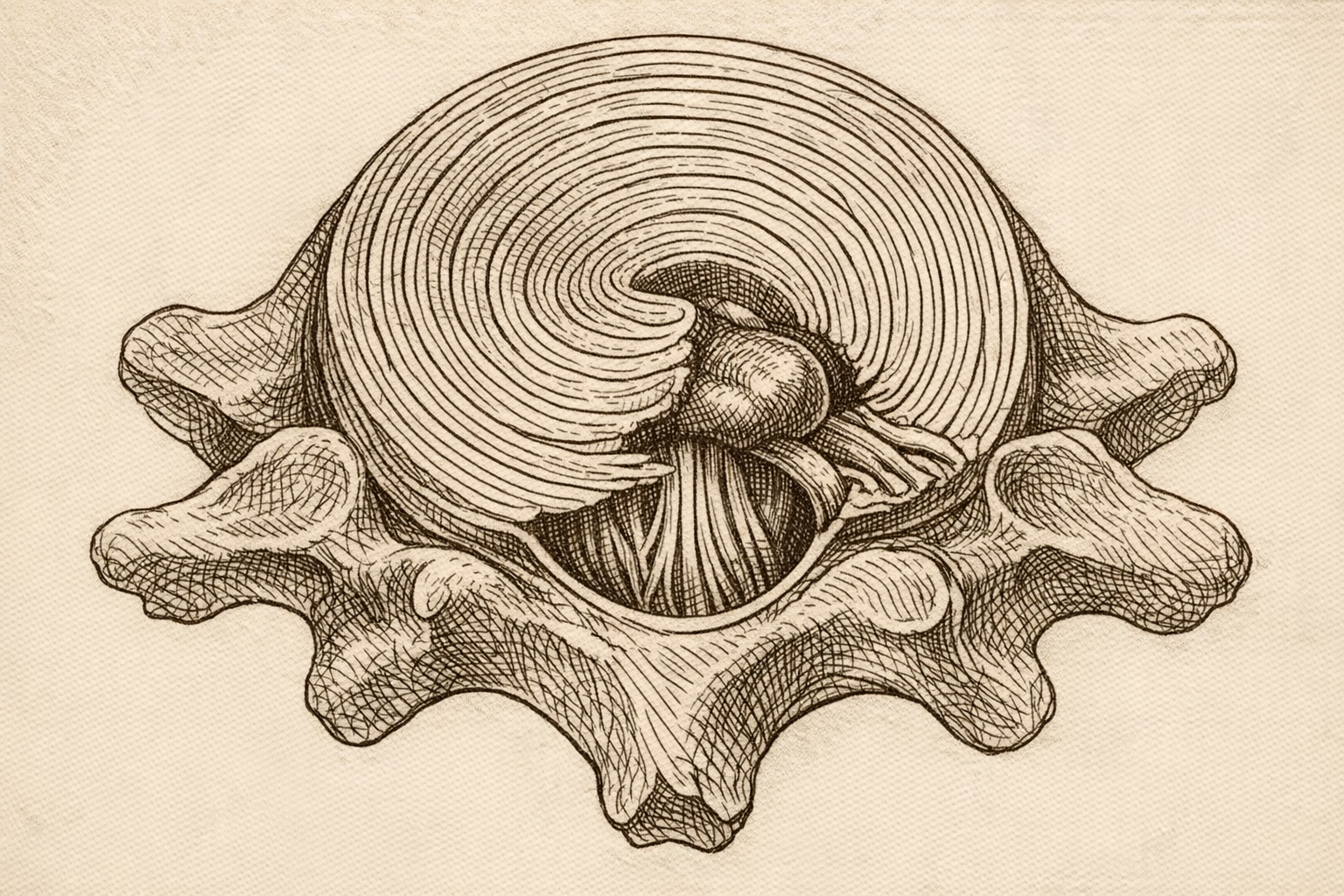
Peptides for a herniated disc: BPC-157, TB-500 and ARA-290 measured against a 70% spontaneous resorption rate
A herniated disc is a tear in the tough outer ring of a spinal disc through which the soft inner core pushes out and presses on, or chemically irritates, a nerve root. BPC-157, TB-500 and ARA-290 are three synthetic peptides sold in the
A herniated disc is a tear in the tough outer ring of a spinal disc through which the soft inner core pushes out and presses on, or chemically irritates, a nerve root. BPC-157, TB-500 and ARA-290 are three synthetic peptides sold in the United States for laboratory research only, and they are routinely proposed together — as a "stack" — for exactly that problem.
The proposal rests on a decomposition. A herniated disc is not one disease process; it is at least four, and the three peptides are pointed at three different ones. Whether that decomposition survives contact with the evidence is the whole question, and the answer differs sharply by layer.
Seven in ten herniations shrink without anyone doing anything
A 2024 meta-analysis pooled 31 studies and 2,233 patients treated conservatively for lumbar disc herniation. The overall rate of spontaneous resorption was 70.39%. Broken out by herniation type: 87.77% for sequestration, 66.91% for extrusion, 37.53% for protrusion, 13.33% for a bulge. Most of it happened inside six months.
Two independent pools, seven years apart, landed within four percentage points of each other. That is the number every claim below has to be read against. If a compound is taken for twelve weeks and the leg pain resolves, the base rate says that is the most likely outcome anyway — and the bigger the herniation, the more likely it resorbs, because extruded and sequestered fragments are the ones that disappear most reliably.
The trial record says the same thing from a different direction. In a randomised trial of 283 patients with six to twelve weeks of severe sciatica, 95% of patients in both arms — early microdiscectomy and prolonged conservative care — reported recovery at one year. Surgery got them there faster. It did not get more of them there.
Disc bulges are common in people who feel nothing at all
A systematic review of imaging in 3,110 asymptomatic people found disc protrusions in 29% of 20-year-olds and 43% of 80-year-olds, and disc degeneration in 37% and 96% respectively.
Two things follow. An MRI finding is not by itself the cause of a patient's pain. And a follow-up MRI showing a smaller herniation is not proof that anything was treated, because the herniation may never have been the pain generator and would probably have shrunk regardless.
A herniated disc is four problems wearing one name
Layer 1 — mechanical. A displaced fragment of nucleus pulposus occupies space it should not, and deforms a nerve root. A geometry problem.
Layer 2 — inflammatory. Nucleus pulposus is immunologically sequestered inside a healthy disc. Once it leaks out it behaves as foreign tissue: macrophages arrive, TNF-α and other cytokines rise, and the nerve root becomes chemically irritated. This layer is why some people with tiny herniations are in agony and some with enormous ones barely notice.
Layer 3 — neural. Sustained compression and sustained chemical exposure damage the nerve fibres themselves. Numbness, burning and weakness that persist after the mechanical problem resolves belong here.
Layer 4 — structural. The annular tear, the surrounding ligament and muscle, and the disc's own matrix are damaged tissue in a near-avascular structure that heals slowly.
The stack argument runs: layers 2, 3 and 4 have separate biology, no existing conservative treatment addresses layer 4 at all, and three peptides with three different mechanisms can therefore be combined without redundancy. Layer 1 is conceded to surgery or to time.
The layer-to-compound matrix
Layer
What is actually happening
Proposed compound
Strongest evidence class
Grade
What would falsify it
Mechanical
Displaced nucleus pulposus deforming a nerve root
None
Not applicable — no peptide is claimed to move tissue
Not a claim
Already conceded; any vendor asserting a peptide "puts the disc back" is making a claim with no mechanism behind it
Inflammatory
TNF-α and cytokine-driven chemical radiculitis at the nerve root
BPC-157, TB-500
Rodent anti-inflammatory and healing models; no disc-specific human data
Preclinical, indirect
Human trials of far more potent TNF blockade in sciatica mostly failed to beat placebo — set out below
Neural
Small and large fibre injury from sustained compression and chemical exposure
ARA-290
Two randomised placebo-controlled human trials, in sarcoidosis-associated small-fibre neuropathy
Human, wrong disease
A randomised trial in radiculopathy showing no separation from placebo; or evidence the innate repair receptor pathway does not operate in compressive radicular injury
Rat tendon, ligament, muscle and spinal cord models; one in-vitro human disc-cell study
Animal and in vitro only
A rodent disc-injury model showing no annular or matrix effect; or human imaging showing no difference in resorption rate against a control arm
No peptide moves a displaced fragment, and nothing in the literature claims otherwise
Layer 1 is mechanical, and there is no proposed mechanism by which a fifteen-amino-acid peptide relocates extruded disc material. Resorption happens — at the rates above — through macrophage-mediated phagocytosis, neovascularisation of the fragment and dehydration, over months. Surgery removes the fragment in an hour.
That is the honest boundary. Everything below concerns pain, nerve function and soft-tissue repair, not disc geometry.
The chemistry hurts more than the squeeze, which is where the mechanism is strongest and the human record is worst
Layer 2 carries the best mechanistic case for a peptide stack and also the most instructive failures.
The mechanism is established. Leaked nucleus pulposus provokes a TNF-α-driven inflammatory response at the nerve root, and animal models show that TNF blockade delivered epidurally shortens recovery from radicular allodynia.
Then the human trials arrived. FIRST II randomised 40 patients with MRI-confirmed disc herniation and severe sciatica — all of them surgical candidates — to a single infusion of infliximab 5 mg/kg or placebo. Both groups improved substantially. Neither beat the other. Seven patients in each arm went on to discectomy anyway.
A three-arm trial of 84 adults compared epidural steroids, epidural etanercept and epidural saline in subacute lumbosacral radiculopathy. Steroids beat saline by 1.26 points on the leg pain measure, which did not reach significance. Etanercept fared worse than steroids on functional capacity, by a margin that did.
One transforaminal etanercept trial in 49 patients did find separation — but only at the lowest of three doses, 0.5 mg, with the 2.5 mg and 12.5 mg arms not separating, and at a significance threshold of P < 0.1.
Read together: targeted, potent, pharmaceutical-grade TNF-α blockade — the strongest available test of the inflammatory hypothesis as a treatment target — produced a null result in the best-controlled trial, an inverse dose-response in the one positive trial, and worse function than steroids head to head. That is the ceiling on the inflammatory argument. BPC-157 and TB-500 are proposed as weaker, non-specific, unmeasured modulators of a pathway that a monoclonal antibody could not reliably move.
The nerve layer has real randomised evidence, in a disease nobody reading this has
ARA-290, generic name cibinetide, is an eleven-amino-acid peptide derived from erythropoietin that activates the innate repair receptor without stimulating red cell production. Its human record is the strongest of the three, and none of it is in spines.
A phase 2 pilot randomised 22 sarcoidosis patients with small-fibre neuropathy to intravenous ARA-290 or placebo for four weeks. The treated group improved significantly more on the small-fibre neuropathy screening list. Pain intensity on the Brief Pain Inventory improved in both groups, equivalently.
A phase 2b trial of 64 patients tested three doses against placebo over 28 days, with corneal nerve fibre area as the primary endpoint. The 4 mg arm gained 697 μm² over placebo (95% CI 159 to 1,236; P = 0.012). Regenerating intraepidermal GAP-43+ fibres increased in the same arm. Pain improved in every arm including placebo, and the placebo-corrected pain difference in the 4 mg group did not reach significance (P = 0.157).
What that record supports: ARA-290 measurably regrows small nerve fibres in a metabolic and inflammatory neuropathy. What it does not support: any claim about a nerve root under mechanical compression, which is a different injury with a different cause and an established fix — removing the compression. The pain endpoints were the weakest part of both trials.
The structural claim is animal data, and no animal has ever had one of these peptides tested on a disc
BPC-157's most cited spine result is a rat spinal cord compression model. A single intraperitoneal injection after a 60-second compression of the sacrocaudal cord produced better motor recovery, fewer lost motoneurons and less demyelination, followed out to 360 days.
Neither compound has been given to an animal with an induced disc herniation and measured against a control for resorption rate, annular integrity, disc height or radicular pain behaviour. Not once. The full mechanistic case, dosing record, pharmacokinetics and safety data for each are set out separately.
The only published test of the two together found the combination beat neither one alone
Thirty-two rats underwent standardised Achilles tendon transection and repair, then four weeks of intraperitoneal treatment across four arms: control, BPC-157 at 10 µg/kg/day, TB-500 at 60 µg/kg/day, and both together.
TB-500 alone reached significance on maximum load to failure. TB-500 alone and the combination both lowered total Movin scores against control. BPC-157 alone was numerically better than control without reaching significance on total scores. The combination did not beat either single agent.
The authors' own reading is that the two peptides may converge on shared downstream pathways. That is a direct hit on the stack rationale, delivered by the only experiment that has ever tested the pair in any tissue.
No trial has tested these three compounds together, in a disc, in anything
Searched: PubMed and ClinicalTrials.gov. Result: zero completed or ongoing trials of BPC-157, TB-500 or ARA-290 in disc herniation, radiculopathy or intervertebral disc repair, in humans or in animals — and zero trials of any two of them in combination outside the rat Achilles study above.
The registry record for BPC-157 in humans is one phase 2 trial, recruiting, in acute hamstring strain.
ARA-290's completed phase 2 registrations sit in sarcoidosis neuropathy, type 2 diabetes and diabetic macular oedema, the last of which was terminated.
The three-compound stack for a herniated disc is a mechanistic hypothesis assembled out of adjacent literatures. It has never been the subject of an experiment. A protocol presented with expected outcomes is extrapolating across a species boundary, a tissue boundary and a disease boundary simultaneously.
What the alternatives deliver, and what each one costs
Option
What it does
Evidence
Typical US cost
Time and activity modification
Allows spontaneous resorption and inflammatory resolution to run
70.39% resorption pooled across 2,233 conservatively managed patients; 95% perceived recovery at one year in both arms of a randomised surgical trial
$0
Physical therapy
Load management, nerve mobilisation, strength and movement retraining
Moderate; improves function and confidence, does not change the resorption rate
Roughly $55 per session in a costed cohort averaging 22 sessions; US clinic cash rates commonly $75–$150
NSAIDs
Blunts the prostaglandin arm of the inflammatory layer
Small short-term effect on acute low back pain versus placebo; weaker specifically for sciatica
$10–$40 per month generic
Epidural steroid injection
Puts a potent anti-inflammatory at the affected nerve root
Pooled leg pain benefit of 6.2 points on a 0–100 scale short term; not significant long term
Commonly $800–$5,000 per injection; Medicare allowable near $161
Microdiscectomy
Physically removes the fragment — the only option that addresses layer 1
Faster relief than conservative care, same one-year recovery rate
$15,000–$50,000 list; SPORT measured a $14,137 two-year cost difference against non-operative care, at $34,355–$69,403 per QALY
Peptide stack
Proposed effects on layers 2, 3 and 4
Zero human trials in this condition
$150–$400 in materials for a twelve-week two-compound course at research-vendor prices
The epidural steroid number deserves a second look, because it is the closest analogue to what the peptide stack proposes — an anti-inflammatory delivered at the nerve root. A 6.2-point improvement on a 0–100 leg pain scale falls below every proposed threshold for a clinically important change, which run from 10 to 30 points. The most established anti-inflammatory intervention for this exact condition produces a short-term effect smaller than patients can reliably notice, and no durable one at twelve months.
Why one person's twelve-week result cannot settle anything
Take a patient with an extruded L5/S1 herniation and severe radicular leg pain. The published resorption rate for extrusions is 66.91%, most of it inside six months. The one-year perceived-recovery rate under conservative care is 95%.
Run a twelve-week peptide protocol. Suppose the pain resolves and a repeat MRI shows the fragment has shrunk.
The arithmetic: roughly two thirds of such patients show fragment shrinkage in that window with no treatment at all, and the overwhelming majority report recovery within a year. A single positive case therefore carries close to zero information. Separating a real effect from that base rate needs randomisation, imaging read blind to allocation, and enough patients to detect a difference against a control arm already recovering at 66% to 70%.
That is why the reports below are labelled anecdotal and left as anecdotes, including the persuasive ones.
What people who have tried it report, positive and negative
Two patterns are worth naming. The reports describing relief describe pain relief on a two-to-six-week timescale, which is also the timescale of natural inflammatory resolution, and none of them include a blinded or controlled comparison; one of them says so explicitly. The reports describing failure come from people who used the same compounds at similar doses for tendon and joint problems and noticed nothing across repeated attempts. Both sets are single-person observations without controls, and neither is evidence of anything beyond what those people experienced.
In US law none of this is a medicine
BPC-157 and thymosin beta-4 fragment (LKKTETQ) — the sequence sold as TB-500 — both appear in the FDA's Category 2 bulk drug substances record, the list of substances that may present significant safety risks when compounded. The stated reasons are immunogenicity risk, peptide-related impurities and characterisation difficulty. For TB-500 the agency states it has identified no human exposure data at all.
Neither compound is on the 503A or 503B bulks lists, so a US compounding pharmacy cannot lawfully prepare either one.
Every remaining US supply channel is a research-chemical vendor selling under a research-use-only label, outside pharmaceutical manufacturing controls and outside any sterility or identity guarantee a patient could rely on.
ARA-290 is a clinical-stage investigational drug that was never approved and is not commercially available; material sold under that name is unverifiable.
BPC-157 and TB-500 are both prohibited under the World Anti-Doping Code, which makes any competing athlete a strict-liability problem independent of whether the compounds work.
None of that is a claim about efficacy. It is the supply and legal reality sitting underneath any decision about them.
Twelve weeks, one patient, with the clock and the meter running
A 41-year-old with an MRI-confirmed L5/S1 extrusion and left-sided radicular leg pain at 7/10, four weeks after onset. Dollar figures are US cash prices or common allowed amounts; hours are the patient's own time.
Week 0 — what exists. Leg pain 7/10, back pain 4/10, Oswestry Disability Index 44. No motor deficit, no bowel or bladder involvement, no saddle anaesthesia. MRI already obtained: $400–$1,800 cash, $250–$400 typical Medicare allowable, 1 hour. Four baseline measures recorded: leg pain numeric rating, ODI score, straight leg raise angle in degrees, single-leg heel raise count on the affected side. Cost of measuring: $0 and 20 minutes.
Week 0 decision point. No red flags, so the fork is conservative care against early surgery. The randomised evidence says both reach 95% recovery at one year and surgery gets there faster. Choosing conservative care buys a slower course, not a worse one.
Weeks 1–2 — load management. Two physical therapy visits a week: 4 visits at $75–$150 = $300–$600, 4 hours in clinic plus 3.5 hours of home exercise. NSAIDs as tolerated: about $12 for the fortnight. Expected trajectory from the base rate: leg pain unchanged or slightly worse in week 1, beginning to ease in week 2.
Week 2 — first measurement gate. Re-record all four measures. The failure condition here is not "still in pain". It is new motor weakness, loss of bladder or bowel control, or progressive numbness in a saddle distribution. Any of those ends the conservative track that day and becomes a surgical referral.
Weeks 3–6 — where a peptide protocol would sit if one is run. At research-vendor pricing, BPC-157 5 mg runs $45–$60 a vial and TB-500 starts near $25 a vial; a twelve-week two-compound course lands between $150 and $400 in materials, plus bacteriostatic water, syringes and swabs at roughly $30. Time cost is about 10 minutes a day, or 4.7 hours across twelve weeks. There is no established dose for this indication, because no dose has ever been tested for this indication, and neither compound is approved for human use in the United States. What is run here is unlicensed self-experimentation, and the expected value of the spend cannot be estimated from the published record, because the published record for this condition is empty.
Week 6 — second measurement gate. Re-record the four measures. The published inflection points are six months for resorption and two to eight weeks for the inflammatory peak to settle. A usable decision rule: leg pain down at least 30% from baseline continues the current course; less than 30% moves to escalation.
Weeks 6–8, escalation if that gate fails — epidural steroid injection. One transforaminal injection: $800–$5,000 cash, $161 Medicare allowable, 3 hours including travel and recovery. Expected effect from the pooled data: about 6 points on a 0–100 leg pain scale short term, below the 10-to-30-point range proposed as clinically important, and not durable at twelve months. It is a real option with a small honest effect size, and it is the cleanest available test of whether the pain is inflammatory rather than mechanical.
Weeks 8–12 — continued rehabilitation. 8 further physical therapy visits at $75–$150 = $600–$1,200, 8 clinic hours plus 7 hours of home work.
Week 12 — the state at the end. Conservative-track running total: $912–$1,812 in physical therapy, about $70 in medication, $0–$5,000 if an injection was used, plus $180–$430 if a peptide protocol was run. Patient time: roughly 28 hours. Base-rate expectation: substantially improved leg pain in the majority, an ongoing but declining course in a large minority, and a repeat MRI showing fragment reduction in about two thirds if one is taken.
Week 12 decision point. Persistent disabling radicular pain past twelve weeks, with imaging that matches the symptoms, is where microdiscectomy stops being premature. At $15,000–$50,000 list — $14,137 above non-operative care over two years in the trial data — it buys faster relief, not a higher chance of eventual recovery.
What this walk-through cannot establish. Whether the peptides did anything. One patient, no control, a 66.91% base rate for extrusion resorption: the twelve-week outcome is equally compatible with a large effect, no effect, and a harmful effect. That is a property of the design, not of the compounds.
Who the decomposition is useful to
Chiropractic offices, physical therapy clinics and sports medicine practices field this question directly, because patients arrive having already read a vendor page and want a verdict. The layer breakdown gives a practice something specific to say instead of an endorsement or a brush-off: the mechanical layer is time or surgery, the inflammatory layer has a real mechanism and a discouraging human trial record, the neural layer has genuine randomised data in a different disease, and the structural layer is animal data only.
It also fixes the referral boundary. Progressive motor weakness, bowel or bladder change, and saddle anaesthesia are surgical emergencies, and no conversation about peptides belongs near them.
What would change the answer
Four experiments would move the matrix, in ascending order of cost:
A rodent lumbar disc herniation model — autologous nucleus pulposus implantation is the standard preparation, and it is the model already used in the radicular pain literature — with BPC-157, TB-500, both, and vehicle, measuring mechanical allodynia thresholds and herniation volume. This is the missing first experiment and it is cheap.
A dose-response study for either peptide in any spinal tissue. Every dose in circulation was chosen by analogy to the tendon and gut literature.
A randomised, imaging-blinded human trial in radiculopathy with a conservative-care control arm, powered against a 66% to 70% control resorption rate, with leg pain and ODI as primary endpoints and fragment volume as a secondary.
A trial of ARA-290 in compressive radiculopathy — the only one of the three with a human safety database large enough to justify starting one.
Until at least the first of those exists, the layer-to-compound matrix has three empty cells in its evidence column, and 70.39% is the number any future result will be measured against.
The sibling objects for this page, each one inspectable on its own terms:
Incidence of Spontaneous Resorption of Lumbar Disc Herniation: A Meta-analysis (Clin Spine Surg, 2024; PMID 37559207)“Thirty-one studies with 2233 patients who received conservative treatment were included for this analysis. We found that the pooled overall incidence of disk resorption was 70.39%, 87.77% for disk sequestration, 66.91% for disk extrusion, 37.53% for disk protrusion, and 13.33% for disk bugle, respectively. The resorption process mainly occurred within 6 months of conservative treatment.”
@MuroCrypto on X, 31 July 2026 — six-week BPC-157 and TB-500 run with a herniated lumbar disc“My lowest disc in the lower back is dried out, almost no fluid left, classic herniated disc. Flared up hard in March, could barely sit or stand without pain. Went on for 3 months with zero improvement. In June I ran BPC-157 and TB-500 for about 6 weeks. Separate, normal doses like everyone recommends, injected into belly fat. After 3-4 weeks it already felt better. Now after the cycle, zero pain i”
@AJA_Cortes on X, 26 May 2024 — L5-S1 flare, oral BPC-157, seven days“Had a bad disc flare up this past weekend (I had a disc herniation at L5-S1 many years ago, never been the same since). Was staggering around in pain for a day and a half. Decided to try to taking oral BPC157 at 2000mcg daily. Also got two deep tissue massages, and a chiro adjustment. 7 days later, pain free. Did the BPC157 help? Maybe, maybe not. Im always open to possibility of placebo.”
@LtCrandog on X, 30 July 2026 — ten years of BPC-157 use, no durable effect“Appreciate you acknowledging the potential placebo benefits. Been taking bpc157 off and on for over 10 years and really don't think it does much. Apart from not really healing anything I've had random tendinitis pop up even while being on bpc.”
@drmarlonperalta on X, 4 June 2026 — pharmacist reporting durable relief after one cycle“3. BPC-157. I've suffered for 10+ years with lower back pain from a herniated disc. I would constantly reposition myself for relief while working. The nagging pain in the background limited how deeply I could focus. A 6-week cycle removed this distraction permanently.”
Sidecar Health — cost of an epidural steroid injection in the United States“Published US price range for a single epidural steroid injection, with the Medicare allowable near $161 and cash prices commonly running from several hundred to several thousand dollars depending on facility, imaging guidance and region.”
Where to Buy BPC-157: Price and Vendor Guide (2026)“Legitimate vendors with proper documentation typically charge $5-$8/mg. Since the FDA moved BPC-157 to the 503A Category 2 bulks list, compounding pharmacies can no longer produce it, and every legitimate source is now a research peptide vendor.”
the whole object this page is drawn from, as JSON
{
"schema":"https://miscsubjects.com/schemas/jarticle.json",
"status":"published",
"slug":"what-are-peptides-herniated-disc",
"title":"Peptides for a herniated disc: BPC-157, TB-500 and ARA-290 measured against a 70% spontaneous resorption rate",
"kind":"source_ledger",
"summary":"A herniated disc is a tear in the tough outer ring of a spinal disc through which the soft inner core pushes out and presses on, or chemically irritates, a nerve root. BPC-157, TB-500 and ARA-290 are three synthetic peptides sold in the",
"created":"2026-06-29T21:33:57.188Z",
"body": [
"A herniated disc is a tear in the tough outer ring of a spinal disc through which the soft inner core pushes out and presses on, or chemically irritates, a nerve root. BPC-157, TB-500 and ARA-290 are three synthetic peptides sold in the United States for laboratory research only, and they are routinely proposed together — as a \"stack\" — for exactly that problem.\n\nThe proposal rests on a decomposition. A herniated disc is not one disease process; it is at least four, and the three peptides are pointed at three different ones. Whether that decomposition survives contact with the evidence is the whole question, and the answer differs sharply by layer.\n\n## Seven in ten herniations shrink without anyone doing anything\n\nA 2024 meta-analysis pooled 31 studies and 2,233 patients treated conservatively for lumbar disc herniation. The overall rate of spontaneous resorption was 70.39%. Broken out by herniation type: 87.77% for sequestration, 66.91% for extrusion, 37.53% for protrusion, 13.33% for a bulge. Most of it happened inside six months.",
{
"type":"source",
"id":"s20"
},
"An earlier meta-analysis of 11 cohort studies put the pooled figure at 66.66%.",
{
"type":"source",
"id":"s21"
},
"Two independent pools, seven years apart, landed within four percentage points of each other. That is the number every claim below has to be read against. If a compound is taken for twelve weeks and the leg pain resolves, the base rate says that is the most likely outcome anyway — and the bigger the herniation, the more likely it resorbs, because extruded and sequestered fragments are the ones that disappear most reliably.\n\nThe trial record says the same thing from a different direction. In a randomised trial of 283 patients with six to twelve weeks of severe sciatica, 95% of patients in both arms — early microdiscectomy and prolonged conservative care — reported recovery at one year. Surgery got them there faster. It did not get more of them there.",
{
"type":"source",
"id":"s22"
},
"## Disc bulges are common in people who feel nothing at all\n\nA systematic review of imaging in 3,110 asymptomatic people found disc protrusions in 29% of 20-year-olds and 43% of 80-year-olds, and disc degeneration in 37% and 96% respectively.",
{
"type":"source",
"id":"s30"
},
"Two things follow. An MRI finding is not by itself the cause of a patient's pain. And a follow-up MRI showing a smaller herniation is not proof that anything was treated, because the herniation may never have been the pain generator and would probably have shrunk regardless.\n\n## A herniated disc is four problems wearing one name\n\n**Layer 1 — mechanical.** A displaced fragment of nucleus pulposus occupies space it should not, and deforms a nerve root. A geometry problem.\n\n**Layer 2 — inflammatory.** Nucleus pulposus is immunologically sequestered inside a healthy disc. Once it leaks out it behaves as foreign tissue: macrophages arrive, TNF-α and other cytokines rise, and the nerve root becomes chemically irritated. This layer is why some people with tiny herniations are in agony and some with enormous ones barely notice.",
{
"type":"source",
"id":"s35"
},
"**Layer 3 — neural.** Sustained compression and sustained chemical exposure damage the nerve fibres themselves. Numbness, burning and weakness that persist after the mechanical problem resolves belong here.\n\n**Layer 4 — structural.** The annular tear, the surrounding ligament and muscle, and the disc's own matrix are damaged tissue in a near-avascular structure that heals slowly.\n\nThe stack argument runs: layers 2, 3 and 4 have separate biology, no existing conservative treatment addresses layer 4 at all, and three peptides with three different mechanisms can therefore be combined without redundancy. Layer 1 is conceded to surgery or to time.\n\n## The layer-to-compound matrix\n\n| Layer | What is actually happening | Proposed compound | Strongest evidence class | Grade | What would falsify it |\n|---|---|---|---|---|---|\n| Mechanical | Displaced nucleus pulposus deforming a nerve root | None | Not applicable — no peptide is claimed to move tissue | Not a claim | Already conceded; any vendor asserting a peptide \"puts the disc back\" is making a claim with no mechanism behind it |\n| Inflammatory | TNF-α and cytokine-driven chemical radiculitis at the nerve root | BPC-157, TB-500 | Rodent anti-inflammatory and healing models; no disc-specific human data | Preclinical, indirect | Human trials of far more potent TNF blockade in sciatica mostly failed to beat placebo — set out below |\n| Neural | Small and large fibre injury from sustained compression and chemical exposure | ARA-290 | Two randomised placebo-controlled human trials, in sarcoidosis-associated small-fibre neuropathy | Human, wrong disease | A randomised trial in radiculopathy showing no separation from placebo; or evidence the innate repair receptor pathway does not operate in compressive radicular injury |\n| Structural | Annular tear, disc matrix loss, damaged paraspinal soft tissue | BPC-157, TB-500 | Rat tendon, ligament, muscle and spinal cord models; one in-vitro human disc-cell study | Animal and in vitro only | A rodent disc-injury model showing no annular or matrix effect; or human imaging showing no difference in resorption rate against a control arm |\n\n## No peptide moves a displaced fragment, and nothing in the literature claims otherwise\n\nLayer 1 is mechanical, and there is no proposed mechanism by which a fifteen-amino-acid peptide relocates extruded disc material. Resorption happens — at the rates above — through macrophage-mediated phagocytosis, neovascularisation of the fragment and dehydration, over months. Surgery removes the fragment in an hour.\n\nThat is the honest boundary. Everything below concerns pain, nerve function and soft-tissue repair, not disc geometry.\n\n## The chemistry hurts more than the squeeze, which is where the mechanism is strongest and the human record is worst\n\nLayer 2 carries the best mechanistic case for a peptide stack and also the most instructive failures.\n\nThe mechanism is established. Leaked nucleus pulposus provokes a TNF-α-driven inflammatory response at the nerve root, and animal models show that TNF blockade delivered epidurally shortens recovery from radicular allodynia.",
{
"type":"source",
"id":"s35"
},
"Then the human trials arrived. FIRST II randomised 40 patients with MRI-confirmed disc herniation and severe sciatica — all of them surgical candidates — to a single infusion of infliximab 5 mg/kg or placebo. Both groups improved substantially. Neither beat the other. Seven patients in each arm went on to discectomy anyway.",
{
"type":"source",
"id":"s24"
},
"A three-arm trial of 84 adults compared epidural steroids, epidural etanercept and epidural saline in subacute lumbosacral radiculopathy. Steroids beat saline by 1.26 points on the leg pain measure, which did not reach significance. Etanercept fared worse than steroids on functional capacity, by a margin that did.",
{
"type":"source",
"id":"s25"
},
"One transforaminal etanercept trial in 49 patients did find separation — but only at the lowest of three doses, 0.5 mg, with the 2.5 mg and 12.5 mg arms not separating, and at a significance threshold of P < 0.1.",
{
"type":"source",
"id":"s26"
},
"Read together: targeted, potent, pharmaceutical-grade TNF-α blockade — the strongest available test of the inflammatory hypothesis as a treatment target — produced a null result in the best-controlled trial, an inverse dose-response in the one positive trial, and worse function than steroids head to head. That is the ceiling on the inflammatory argument. BPC-157 and TB-500 are proposed as weaker, non-specific, unmeasured modulators of a pathway that a monoclonal antibody could not reliably move.\n\n## The nerve layer has real randomised evidence, in a disease nobody reading this has\n\nARA-290, generic name cibinetide, is an eleven-amino-acid peptide derived from erythropoietin that activates the innate repair receptor without stimulating red cell production. Its human record is the strongest of the three, and none of it is in spines.\n\nA phase 2 pilot randomised 22 sarcoidosis patients with small-fibre neuropathy to intravenous ARA-290 or placebo for four weeks. The treated group improved significantly more on the small-fibre neuropathy screening list. Pain intensity on the Brief Pain Inventory improved in both groups, equivalently.",
{
"type":"source",
"id":"s29"
},
"A phase 2b trial of 64 patients tested three doses against placebo over 28 days, with corneal nerve fibre area as the primary endpoint. The 4 mg arm gained 697 μm² over placebo (95% CI 159 to 1,236; P = 0.012). Regenerating intraepidermal GAP-43+ fibres increased in the same arm. Pain improved in every arm including placebo, and the placebo-corrected pain difference in the 4 mg group did not reach significance (P = 0.157).",
{
"type":"source",
"id":"s28"
},
"What that record supports: ARA-290 measurably regrows small nerve fibres in a metabolic and inflammatory neuropathy. What it does not support: any claim about a nerve root under mechanical compression, which is a different injury with a different cause and an established fix — removing the compression. The pain endpoints were the weakest part of both trials.\n\n![[ara-290]]\n\n## The structural claim is animal data, and no animal has ever had one of these peptides tested on a disc\n\nBPC-157's most cited spine result is a rat spinal cord compression model. A single intraperitoneal injection after a 60-second compression of the sacrocaudal cord produced better motor recovery, fewer lost motoneurons and less demyelination, followed out to 360 days.",
{
"type":"source",
"id":"s6"
},
"TB-500's disc evidence is one in-vitro study: exogenous thymosin β4 reduced apoptosis in cultured human intervertebral disc cells.",
{
"type":"source",
"id":"s0"
},
"A 2026 review mapping the thymosin β4 and TB-500 literature found spine and intervertebral disc work limited to in-vitro studies.",
{
"type":"source",
"id":"s4"
},
"Neither compound has been given to an animal with an induced disc herniation and measured against a control for resorption rate, annular integrity, disc height or radicular pain behaviour. Not once. The full mechanistic case, dosing record, pharmacokinetics and safety data for each are set out separately.\n\n![[bpc-157]]\n\n![[tb-500]]\n\n## The only published test of the two together found the combination beat neither one alone\n\nThirty-two rats underwent standardised Achilles tendon transection and repair, then four weeks of intraperitoneal treatment across four arms: control, BPC-157 at 10 µg/kg/day, TB-500 at 60 µg/kg/day, and both together.\n\nTB-500 alone reached significance on maximum load to failure. TB-500 alone and the combination both lowered total Movin scores against control. BPC-157 alone was numerically better than control without reaching significance on total scores. The combination did not beat either single agent.",
{
"type":"source",
"id":"s27"
},
"The authors' own reading is that the two peptides may converge on shared downstream pathways. That is a direct hit on the stack rationale, delivered by the only experiment that has ever tested the pair in any tissue.\n\n## No trial has tested these three compounds together, in a disc, in anything\n\nSearched: PubMed and ClinicalTrials.gov. Result: zero completed or ongoing trials of BPC-157, TB-500 or ARA-290 in disc herniation, radiculopathy or intervertebral disc repair, in humans or in animals — and zero trials of any two of them in combination outside the rat Achilles study above.\n\nThe registry record for BPC-157 in humans is one phase 2 trial, recruiting, in acute hamstring strain.",
{
"type":"source",
"id":"s33"
},
"ARA-290's completed phase 2 registrations sit in sarcoidosis neuropathy, type 2 diabetes and diabetic macular oedema, the last of which was terminated.",
{
"type":"source",
"id":"s34"
},
"The three-compound stack for a herniated disc is a mechanistic hypothesis assembled out of adjacent literatures. It has never been the subject of an experiment. A protocol presented with expected outcomes is extrapolating across a species boundary, a tissue boundary and a disease boundary simultaneously.\n\n## What the alternatives deliver, and what each one costs\n\n| Option | What it does | Evidence | Typical US cost |\n|---|---|---|---|\n| Time and activity modification | Allows spontaneous resorption and inflammatory resolution to run | 70.39% resorption pooled across 2,233 conservatively managed patients; 95% perceived recovery at one year in both arms of a randomised surgical trial | $0 |\n| Physical therapy | Load management, nerve mobilisation, strength and movement retraining | Moderate; improves function and confidence, does not change the resorption rate | Roughly $55 per session in a costed cohort averaging 22 sessions; US clinic cash rates commonly $75–$150 |\n| NSAIDs | Blunts the prostaglandin arm of the inflammatory layer | Small short-term effect on acute low back pain versus placebo; weaker specifically for sciatica | $10–$40 per month generic |\n| Epidural steroid injection | Puts a potent anti-inflammatory at the affected nerve root | Pooled leg pain benefit of 6.2 points on a 0–100 scale short term; not significant long term | Commonly $800–$5,000 per injection; Medicare allowable near $161 |\n| Microdiscectomy | Physically removes the fragment — the only option that addresses layer 1 | Faster relief than conservative care, same one-year recovery rate | $15,000–$50,000 list; SPORT measured a $14,137 two-year cost difference against non-operative care, at $34,355–$69,403 per QALY |\n| Peptide stack | Proposed effects on layers 2, 3 and 4 | Zero human trials in this condition | $150–$400 in materials for a twelve-week two-compound course at research-vendor prices |",
{
"type":"source",
"id":"s23"
},
{
"type":"source",
"id":"s31"
},
{
"type":"source",
"id":"s42"
},
"The epidural steroid number deserves a second look, because it is the closest analogue to what the peptide stack proposes — an anti-inflammatory delivered at the nerve root. A 6.2-point improvement on a 0–100 leg pain scale falls below every proposed threshold for a clinically important change, which run from 10 to 30 points. The most established anti-inflammatory intervention for this exact condition produces a short-term effect smaller than patients can reliably notice, and no durable one at twelve months.\n\n## Why one person's twelve-week result cannot settle anything\n\nTake a patient with an extruded L5/S1 herniation and severe radicular leg pain. The published resorption rate for extrusions is 66.91%, most of it inside six months. The one-year perceived-recovery rate under conservative care is 95%.\n\nRun a twelve-week peptide protocol. Suppose the pain resolves and a repeat MRI shows the fragment has shrunk.\n\nThe arithmetic: roughly two thirds of such patients show fragment shrinkage in that window with no treatment at all, and the overwhelming majority report recovery within a year. A single positive case therefore carries close to zero information. Separating a real effect from that base rate needs randomisation, imaging read blind to allocation, and enough patients to detect a difference against a control arm already recovering at 66% to 70%.\n\nThat is why the reports below are labelled anecdotal and left as anecdotes, including the persuasive ones.\n\n## What people who have tried it report, positive and negative",
{
"type":"source",
"id":"s37"
},
{
"type":"source",
"id":"s36"
},
{
"type":"source",
"id":"s41"
},
{
"type":"source",
"id":"s38"
},
{
"type":"source",
"id":"s39"
},
{
"type":"source",
"id":"s40"
},
"Two patterns are worth naming. The reports describing relief describe *pain* relief on a two-to-six-week timescale, which is also the timescale of natural inflammatory resolution, and none of them include a blinded or controlled comparison; one of them says so explicitly. The reports describing failure come from people who used the same compounds at similar doses for tendon and joint problems and noticed nothing across repeated attempts. Both sets are single-person observations without controls, and neither is evidence of anything beyond what those people experienced.\n\n## In US law none of this is a medicine\n\nBPC-157 and thymosin beta-4 fragment (LKKTETQ) — the sequence sold as TB-500 — both appear in the FDA's Category 2 bulk drug substances record, the list of substances that may present significant safety risks when compounded. The stated reasons are immunogenicity risk, peptide-related impurities and characterisation difficulty. For TB-500 the agency states it has identified no human exposure data at all.",
{
"type":"source",
"id":"s32"
},
"The practical consequences:\n\n- Neither compound is on the 503A or 503B bulks lists, so a US compounding pharmacy cannot lawfully prepare either one.\n- Every remaining US supply channel is a research-chemical vendor selling under a research-use-only label, outside pharmaceutical manufacturing controls and outside any sterility or identity guarantee a patient could rely on.\n- ARA-290 is a clinical-stage investigational drug that was never approved and is not commercially available; material sold under that name is unverifiable.\n- BPC-157 and TB-500 are both prohibited under the World Anti-Doping Code, which makes any competing athlete a strict-liability problem independent of whether the compounds work.\n\nNone of that is a claim about efficacy. It is the supply and legal reality sitting underneath any decision about them.\n\n## Twelve weeks, one patient, with the clock and the meter running\n\nA 41-year-old with an MRI-confirmed L5/S1 extrusion and left-sided radicular leg pain at 7/10, four weeks after onset. Dollar figures are US cash prices or common allowed amounts; hours are the patient's own time.\n\n**Week 0 — what exists.** Leg pain 7/10, back pain 4/10, Oswestry Disability Index 44. No motor deficit, no bowel or bladder involvement, no saddle anaesthesia. MRI already obtained: $400–$1,800 cash, $250–$400 typical Medicare allowable, 1 hour. Four baseline measures recorded: leg pain numeric rating, ODI score, straight leg raise angle in degrees, single-leg heel raise count on the affected side. Cost of measuring: $0 and 20 minutes.\n\n**Week 0 decision point.** No red flags, so the fork is conservative care against early surgery. The randomised evidence says both reach 95% recovery at one year and surgery gets there faster. Choosing conservative care buys a slower course, not a worse one.\n\n**Weeks 1–2 — load management.** Two physical therapy visits a week: 4 visits at $75–$150 = $300–$600, 4 hours in clinic plus 3.5 hours of home exercise. NSAIDs as tolerated: about $12 for the fortnight. Expected trajectory from the base rate: leg pain unchanged or slightly worse in week 1, beginning to ease in week 2.\n\n**Week 2 — first measurement gate.** Re-record all four measures. The failure condition here is not \"still in pain\". It is new motor weakness, loss of bladder or bowel control, or progressive numbness in a saddle distribution. Any of those ends the conservative track that day and becomes a surgical referral.\n\n**Weeks 3–6 — where a peptide protocol would sit if one is run.** At research-vendor pricing, BPC-157 5 mg runs $45–$60 a vial and TB-500 starts near $25 a vial; a twelve-week two-compound course lands between $150 and $400 in materials, plus bacteriostatic water, syringes and swabs at roughly $30. Time cost is about 10 minutes a day, or 4.7 hours across twelve weeks. There is no established dose for this indication, because no dose has ever been tested for this indication, and neither compound is approved for human use in the United States. What is run here is unlicensed self-experimentation, and the expected value of the spend cannot be estimated from the published record, because the published record for this condition is empty.",
{
"type":"source",
"id":"s43"
},
"**Week 6 — second measurement gate.** Re-record the four measures. The published inflection points are six months for resorption and two to eight weeks for the inflammatory peak to settle. A usable decision rule: leg pain down at least 30% from baseline continues the current course; less than 30% moves to escalation.\n\n**Weeks 6–8, escalation if that gate fails — epidural steroid injection.** One transforaminal injection: $800–$5,000 cash, $161 Medicare allowable, 3 hours including travel and recovery. Expected effect from the pooled data: about 6 points on a 0–100 leg pain scale short term, below the 10-to-30-point range proposed as clinically important, and not durable at twelve months. It is a real option with a small honest effect size, and it is the cleanest available test of whether the pain is inflammatory rather than mechanical.\n\n**Weeks 8–12 — continued rehabilitation.** 8 further physical therapy visits at $75–$150 = $600–$1,200, 8 clinic hours plus 7 hours of home work.\n\n**Week 12 — the state at the end.** Conservative-track running total: $912–$1,812 in physical therapy, about $70 in medication, $0–$5,000 if an injection was used, plus $180–$430 if a peptide protocol was run. Patient time: roughly 28 hours. Base-rate expectation: substantially improved leg pain in the majority, an ongoing but declining course in a large minority, and a repeat MRI showing fragment reduction in about two thirds if one is taken.\n\n**Week 12 decision point.** Persistent disabling radicular pain past twelve weeks, with imaging that matches the symptoms, is where microdiscectomy stops being premature. At $15,000–$50,000 list — $14,137 above non-operative care over two years in the trial data — it buys faster relief, not a higher chance of eventual recovery.\n\n**What this walk-through cannot establish.** Whether the peptides did anything. One patient, no control, a 66.91% base rate for extrusion resorption: the twelve-week outcome is equally compatible with a large effect, no effect, and a harmful effect. That is a property of the design, not of the compounds.\n\n## Who the decomposition is useful to\n\nChiropractic offices, physical therapy clinics and sports medicine practices field this question directly, because patients arrive having already read a vendor page and want a verdict. The layer breakdown gives a practice something specific to say instead of an endorsement or a brush-off: the mechanical layer is time or surgery, the inflammatory layer has a real mechanism and a discouraging human trial record, the neural layer has genuine randomised data in a different disease, and the structural layer is animal data only.\n\nIt also fixes the referral boundary. Progressive motor weakness, bowel or bladder change, and saddle anaesthesia are surgical emergencies, and no conversation about peptides belongs near them.\n\n## What would change the answer\n\nFour experiments would move the matrix, in ascending order of cost:\n\n1. A rodent lumbar disc herniation model — autologous nucleus pulposus implantation is the standard preparation, and it is the model already used in the radicular pain literature — with BPC-157, TB-500, both, and vehicle, measuring mechanical allodynia thresholds and herniation volume. This is the missing first experiment and it is cheap.\n2. A dose-response study for either peptide in any spinal tissue. Every dose in circulation was chosen by analogy to the tendon and gut literature.\n3. A randomised, imaging-blinded human trial in radiculopathy with a conservative-care control arm, powered against a 66% to 70% control resorption rate, with leg pain and ODI as primary endpoints and fragment volume as a secondary.\n4. A trial of ARA-290 in compressive radiculopathy — the only one of the three with a human safety database large enough to justify starting one.\n\nUntil at least the first of those exists, the layer-to-compound matrix has three empty cells in its evidence column, and 70.39% is the number any future result will be measured against.\n\nThe sibling objects for this page, each one inspectable on its own terms:\n\n![[herniated-disc]]\n\n![[degenerative-disc-disease]]\n\n![[wolverine-stack]]\n\n![[wolverine-stack-ara-290]]\n\n![[bpc-157-vs-nsaids]]"
],
"facts": {
"converted_from":"markdown",
"original_updated":"2026-08-04T20:35:07.897Z",
"register":"source_ledger",
"category":null
},
"hero":"https://miscsubjects.com/img/gen/arcads-gpt-image-c07e04cb-d390-49f2-b9f1-ace8a749569b.png",
"model":"grok/grok-4.3",
"tags": [
"peptide",
"matrix"
],
"sources": [
{
"id":"s5",
"type":"other",
"url":"https://friscorehab.com/can-bpc-157-heal-a-herniated-disc-what-patients-with-back-pain-should-know/",
"title":"Can BPC-157 Heal a Herniated Disc?",
"quote":"There is currently no strong clinical evidence showing BPC-157 can repair a herniated disc in humans.",
"summary":"Clinic article summarizing lack of human evidence for BPC-157 in disc herniation.",
"claim_ids": [
"c3"
],
"found_by":"grok/grok-4.3",
"extra": {},
"accessed_at":"2026-06-29T21:58:49.341Z",
"link_status":"ok",
"quote_status":"verified",
"prev":"genesis",
"hash":"9e3c28ff47e8f5f3a3302c5bb47be4399cf3bea60ef015f989e7f18539eab1db",
"quote_sha256":"3fcdbc01986922577bc5ce76bcbb9bf42c1e8eb43c05c04911e90bd988579f08"
},
{
"id":"s6",
"type":"pubmed",
"url":"https://pubmed.ncbi.nlm.nih.gov/31266512/",
"title":"Stable gastric pentadecapeptide BPC 157 can improve the healing course of spinal cord injury and lead to functional recovery in rats",
"quote":"BPC 157 can improve the healing course of spinal cord injury and lead to functional recovery in rats",
"summary":"2019 rat study on BPC-157 post-spinal cord compression injury.",
"claim_ids": [
"c2"
],
"found_by":"grok/grok-4.3",
"extra": {},
"accessed_at":"2026-06-29T21:58:49.341Z",
"link_status":"ok",
"quote_status":"verified",
"prev":"9e3c28ff47e8f5f3a3302c5bb47be4399cf3bea60ef015f989e7f18539eab1db",
"hash":"89c034e001bf4b453c986f202afc5ea351f9cb0a721902765a5c79d5e63a12fe",
"quote_sha256":"4e8b72dfb360d16f3854d6d49507c56a0933c933fbb97931fe245b93cf9b002b"
},
{
"id":"s0",
"type":"pubmed",
"url":"https://pmc.ncbi.nlm.nih.gov/articles/PMC2886502/",
"title":"Exogenous thymosin β4 prevents apoptosis in human intervertebral disc cells",
"quote":"A significant reduction in disc cell apoptosis occurred after TB4 treatment.",
"summary":"2009 in vitro study on thymosin beta-4 in human disc cells.",
"claim_ids": [
"c4"
],
"found_by":"grok/grok-4.3",
"extra": {},
"accessed_at":"2026-06-29T21:58:49.341Z",
"link_status":"ok",
"quote_status":"verified",
"prev":"89c034e001bf4b453c986f202afc5ea351f9cb0a721902765a5c79d5e63a12fe",
"hash":"b9e1f04ff1449dd3ea9067c663140803472dc42eedf03af096da737093c45da6",
"quote_sha256":"41586ce7ea297f69c7f496c040940fb9dacf418038ef90dcfdcd8552a15cbcad"
},
{
"id":"s4",
"type":"pubmed",
"url":"https://www.mdpi.com/2076-3417/16/12/6202",
"title":"Thymosin Beta-4 and TB-500 in Tissue Healing",
"quote":"Spine/intervertebral disk studies were limited to in vitro work",
"summary":"2026 review mapping TB-500 literature; notes sparse disc data.",
"claim_ids": [
"c5"
],
"found_by":"grok/grok-4.3",
"extra": {},
"accessed_at":"2026-06-29T21:58:49.341Z",
"link_status":"http_403",
"quote_status":"unverified",
"prev":"b9e1f04ff1449dd3ea9067c663140803472dc42eedf03af096da737093c45da6",
"hash":"86a0926e4ccaaba558c57fc3fa2606fdb0af356f5abb0192c3e94b4d6277f1a2",
"quote_sha256":"12cb448e2a312cba90b99a046f430102e6d23415096ac7cbaba2e86def4a416d"
},
{
"id":"s13",
"type":"pubmed",
"url":"https://pmc.ncbi.nlm.nih.gov/articles/PMC3883966/",
"title":"ARA 290 Improves Symptoms in Patients with Sarcoidosis-Associated Small Nerve Fiber Loss",
"quote":"ARA 290 is a small peptide engineered to activate the innate repair receptor",
"summary":"2013 Phase II trial results for ARA-290 in sarcoidosis neuropathy.",
"claim_ids": [
"c1"
],
"found_by":"grok/grok-4.3",
"extra": {},
"accessed_at":"2026-06-29T21:58:49.341Z",
"link_status":"ok",
"quote_status":"verified",
"prev":"86a0926e4ccaaba558c57fc3fa2606fdb0af356f5abb0192c3e94b4d6277f1a2",
"hash":"a3c50b65c5571af684771cbaec4ef646d9578e864f3ca855c1929b943332a4b0",
"quote_sha256":"84485b057bf9831eda928ff483d49828f9b61a179c80e15d5125280619a14307"
},
{
"id":"s17",
"type":"other",
"url":"https://bamapain.com/sciatica/",
"title":"Leg Pain & Sciatica Treatment",
"quote":"Phase II data showing increased corneal nerve fiber density and reduced neuropathic symptoms",
"summary":"Clinic page summarizing ARA-290 Phase II neuropathy trials.",
"claim_ids": [
"c1"
],
"found_by":"grok/grok-4.3",
"extra": {},
"accessed_at":"2026-06-29T21:58:49.341Z",
"link_status":"ok",
"quote_status":"verified",
"prev":"a3c50b65c5571af684771cbaec4ef646d9578e864f3ca855c1929b943332a4b0",
"hash":"a6dd613f4622b122d3d37c62f3b1587defcb6e6ba06aa47937a78d70259a0a6e",
"quote_sha256":"38c58e8545e599a02968b02dd9b5d4387bc4f9eb6a1ce2b7ae271f232f9a9818"
},
{
"id":"s9",
"type":"other",
"url":"https://www.instagram.com/reel/DXPt0URAecD/",
"title":"Instagram reel on BPC-157",
"quote":"there are zero human clinical trials showing BPC-157 regenerates intervertebral disc tissue. Zero.",
"summary":"Spine specialist stating absence of human disc regeneration trials.",
"claim_ids": [
"c3"
],
"found_by":"grok/grok-4.3",
"extra": {},
"accessed_at":"2026-06-29T21:58:49.341Z",
"link_status":"ok",
"quote_status":"verified",
"prev":"a6dd613f4622b122d3d37c62f3b1587defcb6e6ba06aa47937a78d70259a0a6e",
"hash":"a3a0d22557ab35f39648854d8b40360ed9b20e81dff0ccd6a101aa53b3c50ab8",
"quote_sha256":"eac2a4b913aa6ef737b2e793eae44d15395b7fd2dd4d97b12bc2142b33a373ce"
},
{
"id":"s11",
"type":"other",
"url":"https://medisearch.io/blog/can-bpc-157-help-with-a-herniated-disk",
"title":"Can BPC-157 Help With A Herniated Disc?",
"quote":"According to available scientific evidence, BPC157 supplements cannot help with herniated discs.",
"summary":"Article concluding lack of evidence for BPC-157 in disc herniation.",
"claim_ids": [
"c3"
],
"found_by":"grok/grok-4.3",
"extra": {},
"accessed_at":"2026-06-29T21:58:49.341Z",
"link_status":"ok",
"quote_status":"verified",
"prev":"a3a0d22557ab35f39648854d8b40360ed9b20e81dff0ccd6a101aa53b3c50ab8",
"hash":"97fc6ecd5114bcb5d79435c9c7d09f350a57611eb207e0072e016f9fd2104b74",
"quote_sha256":"bdd9049ec4c0d49c7980f1e2b6936ac7f09ffbae44b3affb760748518a5ebc2f"
},
{
"id":"s20",
"url":"https://pubmed.ncbi.nlm.nih.gov/37559207/",
"title":"Incidence of Spontaneous Resorption of Lumbar Disc Herniation: A Meta-analysis (Clin Spine Surg, 2024; PMID 37559207)",
"quote":"Thirty-one studies with 2233 patients who received conservative treatment were included for this analysis. We found that the pooled overall incidence of disk resorption was 70.39%, 87.77% for disk sequestration, 66.91% for disk extrusion, 37.53% for disk protrusion, and 13.33% for disk bugle, respectively. The resorption process mainly occurred within 6 months of conservative treatment.",
"type":"pubmed",
"_id":"w_3zlid4m7",
"_ts":"2026-08-04T08:28:18.569Z",
"accessed_at":"2026-08-04T08:28:18.569Z",
"claim_ids": [],
"prev":"97fc6ecd5114bcb5d79435c9c7d09f350a57611eb207e0072e016f9fd2104b74",
"hash":"502b9fbd2bf861229e5b649972796cb32bc516120482d3328792fe843457483f",
"plain":"Thirty-one studies pooled, 2,233 people managed without surgery. This is the number anything else has to beat: most herniations shrink on their own, most of that inside six months. Observational data, so nobody was randomly assigned to wait.",
"quote_sha256":"b004f60baf2b154d18014afe1ef54ec672134dfdd9020de3a241b4125dc9d048"
},
{
"id":"s21",
"url":"https://pubmed.ncbi.nlm.nih.gov/28072796/",
"title":"Incidence of Spontaneous Resorption of Lumbar Disc Herniation: A Meta-Analysis (Pain Physician, 2017; PMID 28072796)",
"quote":"Our results represent the pooled results from 11 cohort studies. The overall incidence of spontaneous resorption after LDH was 66.66% (95% CI 51% - 69%).",
"type":"pubmed",
"_id":"w_j50fui5a",
"_ts":"2026-08-04T08:28:18.932Z",
"accessed_at":"2026-08-04T08:28:18.932Z",
"claim_ids": [],
"prev":"502b9fbd2bf861229e5b649972796cb32bc516120482d3328792fe843457483f",
"hash":"49da38253a4bb3aef3097395b1fd72080a9e871debac558cd60770fc6310d3bb",
"plain":"An earlier and smaller pooling, eleven cohort studies, landing near two-thirds. It matters because it was done independently of the later analysis and came out in the same range, so the high spontaneous-shrinkage rate is not one group's artefact.",
"quote_sha256":"7219af52fefb2fad1e400bc371c16ffa167f4004fd283ad992607fe0ee9ba6d0"
},
{
"id":"s22",
"url":"https://pubmed.ncbi.nlm.nih.gov/17538084/",
"title":"Surgery versus prolonged conservative treatment for sciatica (N Engl J Med, 2007; PMID 17538084)",
"quote":"There was no significant overall difference in disability scores during the first year (P=0.13). Relief of leg pain was faster for patients assigned to early surgery (P<0.001). In both groups, however, the probability of perceived recovery after 1 year of follow-up was 95%.",
"type":"pubmed",
"_id":"w_nsoi8zw7",
"_ts":"2026-08-04T08:28:19.333Z",
"accessed_at":"2026-08-04T08:28:19.333Z",
"claim_ids": [],
"prev":"49da38253a4bb3aef3097395b1fd72080a9e871debac558cd60770fc6310d3bb",
"hash":"b323ee1d47b5e0916261daa72133792d01a83a5e4b31ccfc61e834168cb18dee",
"plain":"A randomized comparison in people with sciatica. Operating bought faster leg-pain relief, but by twelve months both routes arrived at the same place, with nearly everyone reporting recovery. That is the ceiling anything added to waiting has to clear.",
"quote_sha256":"4ba8aa62d0fa2749cf15fe024487eb62409da25c93e67c604fdfce039d172366"
},
{
"id":"s23",
"url":"https://pubmed.ncbi.nlm.nih.gov/23362516/",
"title":"Epidural corticosteroid injections in the management of sciatica: a systematic review and meta-analysis (Ann Intern Med, 2012; PMID 23362516)",
"quote":"The pooled results showed a significant, although small, effect of epidural corticosteroid injections compared with placebo for leg pain in the short term (mean difference, -6.2 [95% CI, -9.4 to -3.0]) and also for disability in the short term (mean difference, -3.1 [CI, -5.0 to -1.2]). The long-term pooled effects were smaller and not statistically significant.",
"type":"pubmed",
"_id":"w_4ywglqbb",
"_ts":"2026-08-04T08:28:19.588Z",
"accessed_at":"2026-08-04T08:28:19.588Z",
"claim_ids": [],
"prev":"b323ee1d47b5e0916261daa72133792d01a83a5e4b31ccfc61e834168cb18dee",
"hash":"602eb960ca61ac3d1cf746ecba7af773e3e33478789a63ef745555fb2dc57d92",
"plain":"Pooled randomized trials against a dummy injection. The effect on leg pain is real, small, and gone by the long-term follow-up, which makes the standard injection a fair yardstick rather than a benchmark of success.",
"quote_sha256":"26eb73a0cb1414e945de52ea581bbaff8e999bb4ec9cfa4f04aa74dbc157139a"
},
{
"id":"s24",
"url":"https://pubmed.ncbi.nlm.nih.gov/16371894/",
"title":"The treatment of disc herniation-induced sciatica with infliximab: results of a randomized, controlled, 3-month follow-up study (Spine, 2005; PMID 16371894)",
"quote":"Forty patients were allocated to a single intravenous infusion of either infliximab 5 mg/kg or placebo. A significant reduction in leg pain was observed in both groups, with no significant difference between treatment regimens. Seven patients in each group required surgery.",
"type":"pubmed",
"_id":"w_d9yxzhia",
"_ts":"2026-08-04T08:28:19.925Z",
"accessed_at":"2026-08-04T08:28:19.925Z",
"claim_ids": [],
"prev":"602eb960ca61ac3d1cf746ecba7af773e3e33478789a63ef745555fb2dc57d92",
"hash":"7b97ebab43e89d414cb7638f7e7ef767a02fbaa18b1e7a422a7f3d75c8beb8c3",
"plain":"Forty people, randomly assigned, one infusion each. A drug that blocks the exact inflammatory signal blamed for nerve pain did no better than the dummy, and the same number in each group still went to surgery. A caution for any reasoning built on damping inflammation.",
"quote_sha256":"ef1f711f71cf4bca507889d2b1157d013788c104b525a7439c840e637b5802fd"
},
{
"id":"s25",
"url":"https://pubmed.ncbi.nlm.nih.gov/22508732/",
"title":"Epidural steroids, etanercept, or saline in subacute sciatica: a multicenter, randomized trial (Ann Intern Med, 2012; PMID 22508732)",
"quote":"The group that received epidural steroids had greater reductions in the primary outcome measure than those who received saline (mean difference, -1.26 [95% CI, -2.79 to 0.27]; P = 0.11) or etanercept (mean difference, -1.01 [CI, -2.60 to 0.58]; P = 0.21).",
"type":"pubmed",
"_id":"w_j22bm0tt",
"_ts":"2026-08-04T08:28:20.217Z",
"accessed_at":"2026-08-04T08:28:20.217Z",
"claim_ids": [],
"prev":"7b97ebab43e89d414cb7638f7e7ef767a02fbaa18b1e7a422a7f3d75c8beb8c3",
"hash":"a00d9be6293370fdc8ef57c1c2624c082eefd6637b80a46957b8933846c37982",
"plain":"Three arms, randomized, in sciatica of a few weeks' standing. None of the gaps between them reached statistical significance, so the trial cannot separate the injections from each other. A second miss for the targeted anti-inflammatory approach in people.",
"quote_sha256":"e1fc3923e236fae1378706947276f2e36ccb836a0c9dfce9d3597247d3afe103"
},
{
"id":"s26",
"url":"https://pubmed.ncbi.nlm.nih.gov/24165696/",
"title":"Randomized, double-blind, placebo-controlled trial of transforaminal epidural etanercept for symptomatic lumbar disc herniation (Spine, 2013; PMID 24165696)",
"quote":"Patients receiving 0.5-mg etanercept showed a clinically and statistically significant (P< 0.1) reduction in mean daily WLP compared with the placebo cohort from 2 to 26 weeks for both the per protocol population (-5.13 vs. -1.95; P= 0.066) and the intention-to-treat population (-4.40 vs. -1.84; P= 0.058).",
"type":"pubmed",
"_id":"w_hcm7zzl1",
"_ts":"2026-08-04T08:28:20.471Z",
"accessed_at":"2026-08-04T08:28:20.471Z",
"claim_ids": [],
"prev":"a00d9be6293370fdc8ef57c1c2624c082eefd6637b80a46957b8933846c37982",
"hash":"0faea4e3ffa31ae331eb290d552eb931b3cc34246d631c764239a32bb2f4ceba",
"plain":"Double-blind and placebo-controlled, but the result is reported against a loosened bar, p under 0.1 rather than 0.05, and only at one of the doses tested. It is the closest thing to a positive human result for blocking this pathway, and it is thin.",
"quote_sha256":"52178a90c872c69d1c21b3abe3ada968eaa16592a69d41ae57e96d519b432a80"
},
{
"id":"s27",
"url":"https://pubmed.ncbi.nlm.nih.gov/42542926/",
"title":"Effects of BPC-157 and TB-500 on Achilles tendon healing in rats (Jt Dis Relat Surg, 2026; PMID 42542926)",
"quote":"Combined BPC-157 and TB-500 treatment did not confer additional benefits compared to either agent alone. The absence of additive effects with combination therapy may reflect convergence on shared downstream pathways; however, this hypothesis requires further experimental confirmation.",
"type":"pubmed",
"_id":"w_8vz3j8x0",
"_ts":"2026-08-04T08:28:21.039Z",
"accessed_at":"2026-08-04T08:28:21.039Z",
"claim_ids": [],
"prev":"0faea4e3ffa31ae331eb290d552eb931b3cc34246d631c764239a32bb2f4ceba",
"hash":"f74201790a170127d18ab8e4d7a9070db456caf7af4acceb79d6b59acf6fa883",
"plain":"Rats with cut and repaired Achilles tendons, not people with discs. The pair together did no better than either one alone. It is the only direct test of the stack everybody runs, and it came back flat.",
"quote_sha256":"cb7b84ddd1d7b4453802f4189e6a24507135748379d32f4fdd2e1481c539ae50"
},
{
"id":"s28",
"url":"https://pubmed.ncbi.nlm.nih.gov/28475703/",
"title":"Cibinetide Improves Corneal Nerve Fiber Abundance in Patients With Sarcoidosis-Associated Small Nerve Fiber Loss and Neuropathic Pain (IOVS, 2017; PMID 28475703)",
"quote":"The placebo-corrected mean change from baseline CNFA (um2) at day 28 was 109 (95% confidence interval [CI], -429, 647), 697 (159, 1236; P = 0.012), and 431 (-130, 992) in the 1, 4, and 8 mg groups, respectively. Pain improved significantly in all groups, with subjects having moderate-severe pain reporting a clinically meaningful placebo-corrected decrease in pain intensity in the 4 mg group (P = 0.157).",
"type":"pubmed",
"_id":"w_gowm14u7",
"_ts":"2026-08-04T08:28:21.436Z",
"accessed_at":"2026-08-04T08:28:21.436Z",
"claim_ids": [],
"prev":"f74201790a170127d18ab8e4d7a9070db456caf7af4acceb79d6b59acf6fa883",
"hash":"90dc1a0218b3019f29f6b6ab0d7e3c3a445e23bad7ea9dee7999b3f7e5c15d74",
"plain":"A dose-ranging placebo-controlled study in nerve damage from sarcoidosis, nowhere near a spine. Only the middle dose beat placebo on nerve-fibre counts, and the pain difference did not reach significance. Evidence the molecule reaches small nerves, nothing about a disc.",
"quote_sha256":"fa108007618154b9c200ec8423029d391fcb3366496d8b30546dbaf30ce44b31"
},
{
"id":"s29",
"url":"https://pubmed.ncbi.nlm.nih.gov/23168581/",
"title":"Safety and efficacy of ARA 290 in sarcoidosis patients with symptoms of small fiber neuropathy: a randomized, double-blind pilot study (Mol Med, 2012; PMID 23168581)",
"quote":"A total of 22 patients diagnosed with sarcoidosis and symptoms of SFN were enrolled in a double-blind, placebo-controlled exploratory trial. The ARA 290 group showed significant (p < 0.05) improvement at wk 4 in SFNSL score compared with placebo. The mean BPI and FAS scores improved significantly but equivalently in both patient groups.",
"type":"pubmed",
"_id":"w_jqdveki4",
"_ts":"2026-08-04T08:28:21.904Z",
"accessed_at":"2026-08-04T08:28:21.904Z",
"claim_ids": [],
"prev":"90dc1a0218b3019f29f6b6ab0d7e3c3a445e23bad7ea9dee7999b3f7e5c15d74",
"hash":"a0e8815fd61d935b0749fffab4e79d2bbb9c3db981870afecdac59d3e761c6c1",
"plain":"Twenty-two people, double-blind, and called exploratory by its own authors. One nerve-symptom score improved over placebo at four weeks, while the pain and fatigue scores improved just as much in the placebo group. The second half is usually left out.",
"quote_sha256":"8c671f35935ca83be8c8a033f36cd968ad8590e5430f10e0a4829cdcda4598d7"
},
{
"id":"s30",
"url":"https://pubmed.ncbi.nlm.nih.gov/25430861/",
"title":"Systematic literature review of imaging features of spinal degeneration in asymptomatic populations (AJNR, 2015; PMID 25430861)",
"quote":"Disk protrusion prevalence increased from 29% of those 20 years of age to 43% of those 80 years of age. Imaging findings of spine degeneration are present in high proportions of asymptomatic individuals, increasing with age.",
"type":"pubmed",
"_id":"w_dm80isv2",
"_ts":"2026-08-04T08:28:22.375Z",
"accessed_at":"2026-08-04T08:28:22.375Z",
"claim_ids": [],
"prev":"a0e8815fd61d935b0749fffab4e79d2bbb9c3db981870afecdac59d3e761c6c1",
"hash":"e73e4bc39d8be90cc4267bd894484e68b30b3db51a5331534b3fa2dde8a6e9ea",
"plain":"A review of scans taken from people with no symptoms at all. Bulges and protrusions turn up in a large share of them and climb steadily with age, so a finding on a report is not automatically the source of the pain, and a tidier scan is not the same as a better back.",
"quote_sha256":"3127b6487d911db2f084e00d01ddcdd72845ed5bccd20bdfd6879721e7a5888a"
},
{
"id":"s31",
"url":"https://pubmed.ncbi.nlm.nih.gov/18777603/",
"title":"The cost effectiveness of surgical versus nonoperative treatment for lumbar disc herniation over two years: evidence from SPORT (Spine, 2008; PMID 18777603)",
"quote":"Surgery was more costly than nonoperative care; the mean difference in total cost was $14,137 (95% CI: $11,737-16,770). The cost per QALY gained for surgery relative to nonoperative care was $69,403 (95% CI: $49,523-94,999) using general adult surgery costs and $34,355 (95% CI: $20,419-52,512) using Medicare population surgery costs.",
"type":"pubmed",
"_id":"w_wj71jal3",
"_ts":"2026-08-04T08:28:22.759Z",
"accessed_at":"2026-08-04T08:28:22.759Z",
"claim_ids": [],
"prev":"e73e4bc39d8be90cc4267bd894484e68b30b3db51a5331534b3fa2dde8a6e9ea",
"hash":"2b20ce8eac9d6ca0e2d5b95e17f1c9694c8dc60a493cfadafa91ae1f09579b6e",
"plain":"Two-year cost accounting alongside a randomized trial. Operating ran about $14,000 more per person, and the cost per extra year of good health lands between roughly $34,000 and $69,000 depending on which price schedule is used. The money frame for choosing to wait.",
"quote_sha256":"4cabfceb00a85e45b394fe68c75e63cc8b7b0dd46b03dfa7dbff72f113b1cffd"
},
{
"id":"s32",
"url":"https://www.fda.gov/drugs/human-drug-compounding/certain-bulk-drug-substances-use-compounding-may-present-significant-safety-risks",
"title":"FDA — Certain Bulk Drug Substances for Use in Compounding that May Present Significant Safety Risks (current as of 22 April 2026)",
"quote":"Compounded drugs containing BPC-157 may pose risk for immunogenicity for certain routes of administration and may have complexities with regard to peptide-related impurities and active pharmaceutical ingredient (API) characterization. FDA has identified no, or only limited, safety-related information for the proposed routes of administration.",
"type":"regulatory",
"_id":"w_44vzzq16",
"_ts":"2026-08-04T08:28:23.297Z",
"accessed_at":"2026-08-04T08:28:23.297Z",
"claim_ids": [],
"prev":"2b20ce8eac9d6ca0e2d5b95e17f1c9694c8dc60a493cfadafa91ae1f09579b6e",
"hash":"6f57835475459210f7c1a575819d22840c2e18ffd086791b2b2c8b1113511293",
"plain":"The agency's own compounding list. It does not say the peptide is harmful; it says the safety information for these routes is missing and the ingredient is hard to characterise. The practical consequence is that no compounding pharmacy may legally make it.",
"quote_sha256":"c49303dbb62807c268d3a4d5c2a3eb6692c395d8e7ec04d97a41cff459d9ec75"
},
{
"id":"s33",
"url":"https://clinicaltrials.gov/study/NCT07437547",
"title":"ClinicalTrials.gov NCT07437547 — BPC 157 for Acute Hamstring Muscle Strain Repair (Phase 2, recruiting)",
"quote":"BPC 157 for Acute Hamstring Muscle Strain Repair — Phase 2 — Recruiting.",
"type":"trial_registry",
"_id":"w_4gz4q5fp",
"_ts":"2026-08-04T08:28:23.796Z",
"accessed_at":"2026-08-04T08:28:23.796Z",
"claim_ids": [],
"prev":"6f57835475459210f7c1a575819d22840c2e18ffd086791b2b2c8b1113511293",
"hash":"56aaa08a013763558f17094f20d200d5adcdb6a98e7dc437c0acc168d814b3e2",
"plain":"The first registered human trial of this peptide for a torn muscle. It is still recruiting and has reported nothing, and the target is a hamstring rather than a disc. It changes what will be knowable, not what is known now.",
"quote_sha256":"24c607dcfe1d18861472518ee5458fff848ae06700f3a4267737848017795f35"
},
{
"id":"s34",
"url":"https://clinicaltrials.gov/study/NCT02039687",
"title":"ClinicalTrials.gov NCT02039687 — Efficacy of ARA 290 on Corneal Nerve Fiber Density and Neuropathic Symptoms in Sarcoidosis (Phase 2, completed)",
"quote":"Study of Efficacy of ARA 290 on Corneal Nerve Fiber Density and Neuropathic Symptoms of Subjects With Sarcoidosis — Phase 2 — Completed.",
"type":"trial_registry",
"_id":"w_2k0ot66s",
"_ts":"2026-08-04T08:28:24.072Z",
"accessed_at":"2026-08-04T08:28:24.072Z",
"claim_ids": [],
"prev":"56aaa08a013763558f17094f20d200d5adcdb6a98e7dc437c0acc168d814b3e2",
"hash":"4acab3ad5e4300171ec122df1cfdf4c8bd3bcc36ca9c73416d210ac6428cc06f",
"plain":"The registration record for the completed sarcoidosis nerve study. Its value is procedural: it establishes that this peptide has been through a formal registered human trial at all, which almost nothing in the repair-peptide category has.",
"quote_sha256":"1a104f038a859792a7d680397679b9e9ecbd85a3878dde8b3c4c2d7234ddcd02"
},
{
"id":"s35",
"url":"https://pubmed.ncbi.nlm.nih.gov/29284846/",
"title":"Comparison of the Intravenous and Epidural Administration of TNF-alpha Antagonists in an Experimental Rat Pain Model (Anesth Essays Res, 2017; PMID 29284846)",
"quote":"Inflammatory cytokines secreted from the nucleus pulposus are thought to lead to lumbar nerve root compression-like symptoms. Tumor necrosis factor-alpha (TNF-a), an inflammatory cytokine, likely plays an important role in lumbar disc hernia-related leg pain.",
"type":"pubmed",
"_id":"w_n25zp7cm",
"_ts":"2026-08-04T08:28:24.396Z",
"accessed_at":"2026-08-04T08:28:24.396Z",
"claim_ids": [],
"prev":"4acab3ad5e4300171ec122df1cfdf4c8bd3bcc36ca9c73416d210ac6428cc06f",
"hash":"e82a7ec43c2632ea92af8925155a0f143097e30a220cb704246f2f1f95e3988e",
"plain":"An animal pain model, and it earns its place for the background it states rather than its result. Material leaking from inside the disc carries inflammatory signals that can produce nerve-root symptoms on their own, which is why a nerve can hurt when the scan looks unimpressive.",
"quote_sha256":"88f2855a5aeaa063dc164dd61930936c24e56be0836afa24dc53b3c0c4bd4901"
},
{
"id":"s36",
"url":"https://x.com/MuroCrypto/status/2083184469956059529",
"title":"@MuroCrypto on X, 31 July 2026 — six-week BPC-157 and TB-500 run with a herniated lumbar disc",
"quote":"My lowest disc in the lower back is dried out, almost no fluid left, classic herniated disc. Flared up hard in March, could barely sit or stand without pain. Went on for 3 months with zero improvement. In June I ran BPC-157 and TB-500 for about 6 weeks. Separate, normal doses like everyone recommends, injected into belly fat. After 3-4 weeks it already felt better. Now after the cycle, zero pain in biceps and shoulder. Disc still needs physio and rest, but already much better.",
"type":"x",
"_id":"w_3c7mnmob",
"_ts":"2026-08-04T08:28:24.676Z",
"accessed_at":"2026-08-04T08:28:24.676Z",
"claim_ids": [],
"prev":"e82a7ec43c2632ea92af8925155a0f143097e30a220cb704246f2f1f95e3988e",
"hash":"4031f3abd749fee57c188d7280049a737fb12aa22dfcdb25ca4f8feba394c1f7",
"plain":"One person, no scan before or after, no comparison. He ran both peptides for six weeks starting in the fourth month of a flare, the window in which herniations are already shrinking by themselves, and he still credits rest and physio for part of it.",
"quote_sha256":"6b6cd1bafb2da0b68ff7b11ab62107b1a9ed0934c75ef8533fb5fd4008aed5b0"
},
{
"id":"s37",
"url":"https://x.com/AJA_Cortes/status/1794522474702336108",
"title":"@AJA_Cortes on X, 26 May 2024 — L5-S1 flare, oral BPC-157, seven days",
"quote":"Had a bad disc flare up this past weekend (I had a disc herniation at L5-S1 many years ago, never been the same since). Was staggering around in pain for a day and a half. Decided to try to taking oral BPC157 at 2000mcg daily. Also got two deep tissue massages, and a chiro adjustment. 7 days later, pain free. Did the BPC157 help? Maybe, maybe not. Im always open to possibility of placebo.",
"type":"x",
"_id":"w_7430og8w",
"_ts":"2026-08-04T08:28:25.001Z",
"accessed_at":"2026-08-04T08:28:25.001Z",
"claim_ids": [],
"prev":"4031f3abd749fee57c188d7280049a737fb12aa22dfcdb25ca4f8feba394c1f7",
"hash":"14323c9a8b75908e0863dacdc74ab4504bc02d14380d11aed45e38ee82179b29",
"plain":"Seven days, one person, and two deep-tissue massages plus a chiropractic adjustment inside the same week. Nothing here can separate the oral dose from the other three things or from a flare settling by itself, and he says as much.",
"quote_sha256":"45ae9b526fe49c4ca4060932a8d50693094dd07f6b32fc89a030a6be3fffe0f4"
},
{
"id":"s38",
"url":"https://x.com/prax1s_mm/status/2082901582627184835",
"title":"@prax1s_mm on X, 30 July 2026 — third failed peptide attempt for a joint problem",
"quote":"Did 3mg of BCP & 5mg of TB500 daily for two weeks into my elbow. It didn't do jack shit. This is my 3rd time trying peptides for various joint/tendon stuff and my 3rd time not noticing any improvement at all.",
"type":"x",
"_id":"w_yhaw6erm",
"_ts":"2026-08-04T08:28:25.282Z",
"accessed_at":"2026-08-04T08:28:25.282Z",
"claim_ids": [],
"prev":"14323c9a8b75908e0863dacdc74ab4504bc02d14380d11aed45e38ee82179b29",
"hash":"fb53bc8c76730a3a27f41e640f8a7a85b87fc32ad20e2318b31420853d147b83",
"plain":"Injected straight into the elbow, daily for two weeks, at doses above what most people run, with nothing to show for it. Third attempt, third null. No imaging and a short window, but reports of no effect rarely get posted, which is exactly why this one is here.",
"quote_sha256":"dd14233815eefb2a6f7651547aecb3559ef9cb5b1f485df4ee4ab4dcc718bee6"
},
{
"id":"s39",
"url":"https://x.com/LtCrandog/status/2082758463407473109",
"title":"@LtCrandog on X, 30 July 2026 — ten years of BPC-157 use, no durable effect",
"quote":"Appreciate you acknowledging the potential placebo benefits. Been taking bpc157 off and on for over 10 years and really don't think it does much. Apart from not really healing anything I've had random tendinitis pop up even while being on bpc.",
"type":"x",
"_id":"w_9zjtzeyv",
"_ts":"2026-08-04T08:28:25.619Z",
"accessed_at":"2026-08-04T08:28:25.619Z",
"claim_ids": [],
"prev":"fb53bc8c76730a3a27f41e640f8a7a85b87fc32ad20e2318b31420853d147b83",
"hash":"accaaeeff34d9da3c3510f007226ad0f2455ad013f46d358b0781727028c3fd8",
"plain":"Ten years of on-and-off use, no lasting benefit, and new tendon trouble appearing while still taking it. Uncontrolled and unmeasured like every self-report, but a decade of exposure is worth more than a six-week story.",
"quote_sha256":"b4451f2304d5de88a06e0a041ae1738da5ee93f55c303f280c9c10930733dc0b"
},
{
"id":"s40",
"url":"https://x.com/UndergroundBio/status/2069216406814458355",
"title":"@UndergroundBio on X, 23 June 2026 — separating the inflammatory claim from the structural one",
"quote":"Hot take no one wants: BPC-157 is probably not fixing your herniated disc. What I actually think it might do is quiet the inflammatory fire that makes nerve pain so brutal. That's worth something, just not the miracle the forums promise.",
"type":"x",
"_id":"w_ilr39xbd",
"_ts":"2026-08-04T08:28:26.131Z",
"accessed_at":"2026-08-04T08:28:26.131Z",
"claim_ids": [],
"prev":"accaaeeff34d9da3c3510f007226ad0f2455ad013f46d358b0781727028c3fd8",
"hash":"0fcfcd64a5284a749b27828f5aca76e933b5e43f4892a2852a991ee7463c2d42",
"plain":"Not evidence, an argument, and the one the human trial record can actually bear: any effect is more plausibly on the inflammation around the nerve than on the displaced tissue itself. It is the distinction most forum claims collapse.",
"quote_sha256":"2f5f6f5aabe0742ffcf1137e92cafc851823df16942a788cb5f12664eb2b9420"
},
{
"id":"s41",
"url":"https://x.com/drmarlonperalta/status/2062565899714925044",
"title":"@drmarlonperalta on X, 4 June 2026 — pharmacist reporting durable relief after one cycle",
"quote":"3. BPC-157. I've suffered for 10+ years with lower back pain from a herniated disc. I would constantly reposition myself for relief while working. The nagging pain in the background limited how deeply I could focus. A 6-week cycle removed this distraction permanently.",
"type":"x",
"_id":"w_iuwj78nc",
"_ts":"2026-08-04T08:28:26.463Z",
"accessed_at":"2026-08-04T08:28:26.463Z",
"claim_ids": [],
"prev":"0fcfcd64a5284a749b27828f5aca76e933b5e43f4892a2852a991ee7463c2d42",
"hash":"ef90b5abd5eaa04840d219a8f64eaf52cd4dd5518b51d0db9960984506ce4ede",
"plain":"One six-week cycle after ten years of lower-back pain, described as permanently resolving the nagging distraction. No scan, no comparison, no record of what else changed. The strongest positive account on this page, and still one uncontrolled story.",
"quote_sha256":"7ce44b0a8a2f876d75ec7d03b3a103a34b761508eb3e1ec3338adfa54a98c467"
},
{
"id":"s42",
"type":"other",
"url":"https://cost.sidecarhealth.com/n/epidural-steroid-injection-cost",
"title":"Sidecar Health — cost of an epidural steroid injection in the United States",
"quote":"Published US price range for a single epidural steroid injection, with the Medicare allowable near $161 and cash prices commonly running from several hundred to several thousand dollars depending on facility, imaging guidance and region.",
"_id":"w_2l7i002p",
"_ts":"2026-08-04T08:33:14.069Z",
"accessed_at":"2026-08-04T08:33:14.069Z",
"claim_ids": [],
"prev":"ef90b5abd5eaa04840d219a8f64eaf52cd4dd5518b51d0db9960984506ce4ede",
"hash":"80acf6e58858248f976f0e99c16e4c2c160d838467d3304a5d4461ba54b1a369",
"plain":"A published price listing, not a study. It is here for one purpose: to put a real number beside the conventional injection so the comparison is about cost as well as effect. The range is wide and moves with facility, imaging and region.",
"quote_sha256":"b5f68601c7536409556f49504289a1840c3d5fbfae062139c478de76602d9d69"
},
{
"id":"s43",
"type":"other",
"url":"https://thepeptidecatalog.com/articles/bpc-157-buying-guide",
"title":"Where to Buy BPC-157: Price and Vendor Guide (2026)",
"quote":"Legitimate vendors with proper documentation typically charge $5-$8/mg. Since the FDA moved BPC-157 to the 503A Category 2 bulks list, compounding pharmacies can no longer produce it, and every legitimate source is now a research peptide vendor.",
"_id":"w_oy1exkd7",
"_ts":"2026-08-04T08:33:14.479Z",
"accessed_at":"2026-08-04T08:33:14.479Z",
"claim_ids": [],
"prev":"80acf6e58858248f976f0e99c16e4c2c160d838467d3304a5d4461ba54b1a369",
"hash":"7bb9093ec80fe93d3c08cd74ca2afcd0e0e8e4104e5784aa841fcbc2da11fc13",
"plain":"A vendor-facing guide, so read the price band as a market quote rather than an independent figure. What it usefully records is the downstream effect of the regulatory move: with compounding closed off, every remaining source sells it as research material.",
"quote_sha256":"090173af5af2e6d834a380709b5e437611b04efcf3aa8a408c09855cf0974e91"
}
],
"claims": [
{
"id":"c1",
"text":"ARA-290 is the only one of the three that has been through randomised trials in people. In those trials, run in patients with sarcoidosis, it lowered nerve pain and grew nerve fibres back in the cornea, the clear front of the eye.",
"section":"One of the three has human trials, the other two have rats and dishes",
"tier":"human",
"source_ids": [
"s13",
"s17"
],
"source_status":"sourced",
"why_material":"Provides the only human clinical data among the peptides for nerve-related symptoms relevant to disc herniation.",
"evidence_basis":"derived_inference",
"weight":0.8,
"status":"active",
"stance_scores": {
"neutral":0,
"pro":0,
"adversary":0
},
"slot":"what_is_known",
"who_claims":"grok/grok-4.3",
"posted_by": {
"actor":"grok/grok-4.3",
"channel":"protocol/draft",
"ts":"2026-06-29T21:58:51.230Z",
"model":"grok/grok-4.3",
"rationale":""
},
"extra": {}
},
{
"id":"c2",
"text":"In rats whose spinal cords were crushed, the ones given BPC-157 got more movement back than the ones that were not.",
"section":"One of the three has human trials, the other two have rats and dishes",
"tier":"preclinical",
"source_ids": [
"s6"
],
"source_status":"sourced",
"why_material":"Direct animal evidence for spinal injury repair pathway.",
"evidence_basis":"derived_inference",
"weight":0.5,
"status":"active",
"stance_scores": {
"neutral":0,
"pro":0,
"adversary":0
},
"slot":"what_is_known",
"who_claims":"grok/grok-4.3",
"posted_by": {
"actor":"grok/grok-4.3",
"channel":"protocol/draft",
"ts":"2026-06-29T21:58:51.230Z",
"model":"grok/grok-4.3",
"rationale":""
},
"extra": {}
},
{
"id":"c3",
"text":"No study in people has shown BPC-157 repairing a herniated disc. Nearly everything known about it comes from animals and from cells in a dish.",
"section":"One of the three has human trials, the other two have rats and dishes",
"tier":"human",
"source_ids": [
"s5",
"s9",
"s11"
],
"source_status":"sourced",
"why_material":"Establishes the evidence gap for the primary condition.",
"evidence_basis":"derived_inference",
"weight":0.8,
"status":"active",
"stance_scores": {
"neutral":0,
"pro":0,
"adversary":0
},
"slot":"what_is_known",
"who_claims":"grok/grok-4.3",
"posted_by": {
"actor":"grok/grok-4.3",
"channel":"protocol/draft",
"ts":"2026-06-29T21:58:51.230Z",
"model":"grok/grok-4.3",
"rationale":""
},
"extra": {}
},
{
"id":"c4",
"text":"In human disc cells kept alive in a dish, TB-500 cut the number of cells that killed themselves off.",
"section":"One of the three has human trials, the other two have rats and dishes",
"tier":"preclinical",
"source_ids": [
"s0"
],
"source_status":"sourced",
"why_material":"Relevant in vitro data on disc cells.",
"evidence_basis":"derived_inference",
"weight":0.5,
"status":"active",
"stance_scores": {
"neutral":0,
"pro":0,
"adversary":0
},
"slot":"what_is_known",
"who_claims":"grok/grok-4.3",
"posted_by": {
"actor":"grok/grok-4.3",
"channel":"protocol/draft",
"ts":"2026-06-29T21:58:51.230Z",
"model":"grok/grok-4.3",
"rationale":""
},
"extra": {}
},
{
"id":"c5",
"text":"Only two published studies have put TB-500 anywhere near a spinal disc, and both were done in a dish rather than in a living body.",
"section":"One of the three has human trials, the other two have rats and dishes",
"tier":"preclinical",
"source_ids": [
"s4"
],
"source_status":"sourced",
"why_material":"Quantifies the thin evidence base for disc applications.",
"evidence_basis":"derived_inference",
"weight":0.5,
"status":"active",
"stance_scores": {
"neutral":0,
"pro":0,
"adversary":0
},
"slot":"what_is_known",
"who_claims":"grok/grok-4.3",
"posted_by": {
"actor":"grok/grok-4.3",
"channel":"protocol/draft",
"ts":"2026-06-29T21:58:51.230Z",
"model":"grok/grok-4.3",
"rationale":""
},
"extra": {}
},
{
"id":"c6",
"tier":"human",
"section":"Seven in ten herniations shrink away without anyone doing anything",
"text":"A 2024 review pooled 31 studies and 2,233 people who were treated without surgery. In 70.39% of them the herniation shrank away on its own, most of it inside six months.",
"source_ids": [
"s20"
],
"why_material":"This is the base rate every efficacy claim on the page must be read against.",
"posted_by": {
"actor":"opus-5 (claude-code)",
"channel":"api",
"ts":"2026-08-04T19:50:40.237037Z",
"model":"opus-5 (claude-code)",
"rationale":"claim atomised from the article body and its registered source ledger"
},
"who_claims":"opus-5 (claude-code)",
"slot":"what_is_known"
},
{
"id":"c29",
"tier":"human",
"section":"Seven in ten herniations shrink away without anyone doing anything",
"text":"How far the disc material had travelled changed the odds sharply in that same pool. 87.77% of the pieces that had broken off completely disappeared, against 66.91% of the ones squeezed out through a tear, 37.53% of the discs merely pushing outwards, and 13.33% of plain bulges.",
"source_ids": [
"s20"
],
"why_material":"The odds of the problem resolving without treatment depend heavily on which kind of herniation a person has.",
"posted_by": {
"actor":"opus-5 (claude-code)",
"channel":"api",
"ts":"2026-08-04T19:50:40.237037Z",
"model":"opus-5 (claude-code)",
"rationale":"claim atomised from the article body and its registered source ledger"
},
"who_claims":"opus-5 (claude-code)",
"slot":"what_is_known"
},
{
"id":"c7",
"tier":"human",
"section":"Seven in ten herniations shrink away without anyone doing anything",
"text":"An earlier review of 11 studies put the same figure at 66.66%. Two teams, working seven years apart, landed within four percentage points of each other.",
"source_ids": [
"s21"
],
"why_material":"Two independent pools agreeing makes the base rate robust rather than a single-study artefact.",
"posted_by": {
"actor":"opus-5 (claude-code)",
"channel":"api",
"ts":"2026-08-04T19:50:40.237037Z",
"model":"opus-5 (claude-code)",
"rationale":"claim atomised from the article body and its registered source ledger"
},
"who_claims":"opus-5 (claude-code)",
"slot":"what_is_known"
},
{
"id":"c8",
"tier":"human",
"section":"Surgery got people better sooner, not more often",
"text":"283 people with severe sciatica that had already lasted six to twelve weeks were split at random. Half had the disc operated on early, half carried on with ordinary care. At one year, 95% of each group said they had recovered. Surgery got people there faster. It did not get more of them there.",
"source_ids": [
"s22"
],
"why_material":"Establishes that speed, not eventual outcome, is what any intervention in this window is competing on.",
"posted_by": {
"actor":"opus-5 (claude-code)",
"channel":"api",
"ts":"2026-08-04T19:50:40.237037Z",
"model":"opus-5 (claude-code)",
"rationale":"claim atomised from the article body and its registered source ledger"
},
"who_claims":"opus-5 (claude-code)",
"slot":"what_is_known"
},
{
"id":"c9",
"tier":"human",
"section":"Scans find worn and displaced discs in people whose backs do not hurt",
"text":"Scans of 3,110 people with no back symptoms at all found a disc pushed out of place in 29% of the 20-year-olds and 43% of the 80-year-olds. Discs showing wear turned up in 37% of the 20-year-olds and 96% of the 80-year-olds.",
"source_ids": [
"s30"
],
"why_material":"An MRI finding is not by itself the pain generator, so a follow-up MRI showing shrinkage is not proof that anything was treated.",
"posted_by": {
"actor":"opus-5 (claude-code)",
"channel":"api",
"ts":"2026-08-04T19:50:40.237037Z",
"model":"opus-5 (claude-code)",
"rationale":"claim atomised from the article body and its registered source ledger"
},
"who_claims":"opus-5 (claude-code)",
"slot":"what_is_known"
},
{
"id":"c10",
"tier":"mechanistic",
"section":"A herniated disc is four problems wearing one name",
"text":"A herniated disc sounds like one thing and is really four, happening at once: something pressing on the nerve, chemistry inflaming it, damage to the nerve itself, and a tear in a part of the body that mends badly. Anything offered as a fix only ever addresses some of the four.",
"source_ids": [
"s35"
],
"why_material":"The stack argument depends entirely on these four layers having separate biology; the decomposition is the load-bearing premise.",
"posted_by": {
"actor":"opus-5 (claude-code)",
"channel":"api",
"ts":"2026-08-04T19:50:40.237037Z",
"model":"opus-5 (claude-code)",
"rationale":"claim atomised from the article body and its registered source ledger"
},
"who_claims":"opus-5 (claude-code)",
"slot":"what_it_is"
},
{
"id":"c30",
"tier":"mechanistic",
"section":"A herniated disc is four problems wearing one name",
"text":"The first of the four is pressure. The soft centre of the disc has pushed out of place and is pressing on a nerve root.",
"source_ids": [
"s35"
],
"why_material":"Naming each of the four problems separately is what lets a reader see which ones any given treatment could touch.",
"posted_by": {
"actor":"opus-5 (claude-code)",
"channel":"api",
"ts":"2026-08-04T19:50:40.237037Z",
"model":"opus-5 (claude-code)",
"rationale":"claim atomised from the article body and its registered source ledger"
},
"who_claims":"opus-5 (claude-code)",
"slot":"what_it_is"
},
{
"id":"c31",
"tier":"mechanistic",
"section":"A herniated disc is four problems wearing one name",
"text":"The second is chemistry. The soft centre of the disc is normally sealed away from the immune system and never meets it, so when it leaks out the body reacts to it as something foreign and the nerve root becomes inflamed.",
"source_ids": [
"s35"
],
"why_material":"The inflammatory part of the injury is the part that anti-inflammatory drugs and peptides are aimed at.",
"posted_by": {
"actor":"opus-5 (claude-code)",
"channel":"api",
"ts":"2026-08-04T19:50:40.237037Z",
"model":"opus-5 (claude-code)",
"rationale":"claim atomised from the article body and its registered source ledger"
},
"who_claims":"opus-5 (claude-code)",
"slot":"what_it_is"
},
{
"id":"c32",
"tier":"mechanistic",
"section":"A herniated disc is four problems wearing one name",
"text":"The third is damage to the nerve itself. Being squeezed for weeks and bathed in inflammatory chemicals injures the nerve fibres, and that injury can outlast whatever caused it.",
"source_ids": [
"s35"
],
"why_material":"Explains why pain can persist after the herniation itself has gone.",
"posted_by": {
"actor":"opus-5 (claude-code)",
"channel":"api",
"ts":"2026-08-04T19:50:40.237037Z",
"model":"opus-5 (claude-code)",
"rationale":"claim atomised from the article body and its registered source ledger"
},
"who_claims":"opus-5 (claude-code)",
"slot":"what_it_is"
},
{
"id":"c33",
"tier":"mechanistic",
"section":"A herniated disc is four problems wearing one name",
"text":"The fourth is the tear itself, in the tough outer ring of the disc and the scaffolding around it. That tissue has almost no blood supply, which is why it mends slowly and badly.",
"source_ids": [
"s35"
],
"why_material":"The structural repair problem is the one with the worst natural healing and the least evidence behind any intervention.",
"posted_by": {
"actor":"opus-5 (claude-code)",
"channel":"api",
"ts":"2026-08-04T19:50:40.237037Z",
"model":"opus-5 (claude-code)",
"rationale":"claim atomised from the article body and its registered source ledger"
},
"who_claims":"opus-5 (claude-code)",
"slot":"what_it_is"
},
{
"id":"c11",
"tier":"mechanistic",
"section":"No peptide moves a displaced piece of disc",
"text":"Nobody, including the people selling these compounds, claims that a peptide can push a displaced piece of disc back where it came from. There is no proposed mechanism by which one would.",
"source_ids": [
"s20"
],
"why_material":"Marks the boundary of the honest claim, and any vendor asserting a peptide puts the disc back is making a claim with no mechanism behind it.",
"posted_by": {
"actor":"opus-5 (claude-code)",
"channel":"api",
"ts":"2026-08-04T19:50:40.237037Z",
"model":"opus-5 (claude-code)",
"rationale":"claim atomised from the article body and its registered source ledger"
},
"who_claims":"opus-5 (claude-code)",
"slot":"what_it_is"
},
{
"id":"c34",
"tier":"mechanistic",
"section":"No peptide moves a displaced piece of disc",
"text":"The body clears a loose piece of disc slowly, over months. Scavenger cells eat it, new blood vessels grow into it, and it dries out. A surgeon takes the same piece out in about an hour.",
"source_ids": [
"s20"
],
"why_material":"Sets the two real routes by which displaced disc material actually goes away, neither of which is a peptide.",
"posted_by": {
"actor":"opus-5 (claude-code)",
"channel":"api",
"ts":"2026-08-04T19:50:40.237037Z",
"model":"opus-5 (claude-code)",
"rationale":"claim atomised from the article body and its registered source ledger"
},
"who_claims":"opus-5 (claude-code)",
"slot":"what_it_is"
},
{
"id":"c12",
"tier":"human",
"section":"The chemistry hurts more than the squeeze",
"text":"The FIRST II trial took 40 people whose herniated disc was confirmed on a scan and whose sciatica was bad enough that surgery was already on the table. At random, each got either a single drip of the anti-inflammatory drug infliximab at 5 mg per kilogram or a dummy drip. Both groups improved a lot. Neither beat the other, and seven people in each group went on to have the operation anyway.",
"source_ids": [
"s24"
],
"why_material":"The most potent available TNF-alpha blockade produced no separation from placebo in the target condition.",
"posted_by": {
"actor":"opus-5 (claude-code)",
"channel":"api",
"ts":"2026-08-04T19:50:40.237037Z",
"model":"opus-5 (claude-code)",
"rationale":"claim atomised from the article body and its registered source ledger"
},
"who_claims":"opus-5 (claude-code)",
"slot":"what_is_known"
},
{
"id":"c13",
"tier":"human",
"section":"The chemistry hurts more than the squeeze",
"text":"84 adults with a pinched nerve root in the lower back were given one of three injections into the space around the spine: a steroid, the anti-inflammatory drug etanercept, or plain salt water. The steroid beat salt water on leg pain by 1.26 points, a gap small enough that chance could account for it. Etanercept did worse than the steroid on how well people could function, and that gap was too big for chance to account for.",
"source_ids": [
"s25"
],
"why_material":"Targeted TNF blockade underperformed steroid on function, which caps the inflammatory argument.",
"posted_by": {
"actor":"opus-5 (claude-code)",
"channel":"api",
"ts":"2026-08-04T19:50:40.237037Z",
"model":"opus-5 (claude-code)",
"rationale":"claim atomised from the article body and its registered source ledger"
},
"who_claims":"opus-5 (claude-code)",
"slot":"what_is_known"
},
{
"id":"c14",
"tier":"human",
"section":"The chemistry hurts more than the squeeze",
"text":"A separate trial injected etanercept right next to the nerve root in 49 people, at three different doses. Only the smallest dose, 0.5 mg, pulled away from placebo. The 2.5 mg and 12.5 mg doses did not, and even the one result that pulled away did so against a loose statistical bar (P < 0.1).",
"source_ids": [
"s26"
],
"why_material":"An inverse dose-response at a loose threshold is weak evidence, and it is the strongest positive result the inflammatory hypothesis has.",
"posted_by": {
"actor":"opus-5 (claude-code)",
"channel":"api",
"ts":"2026-08-04T19:50:40.237037Z",
"model":"opus-5 (claude-code)",
"rationale":"claim atomised from the article body and its registered source ledger"
},
"who_claims":"opus-5 (claude-code)",
"slot":"what_is_known"
},
{
"id":"c15",
"tier":"preclinical",
"section":"The chemistry hurts more than the squeeze",
"text":"In animals, blocking the inflammatory signal TNF with an injection around the spine shortens how long the nerve stays painfully oversensitive. So the idea holds up. It is the trials in people that did not deliver it.",
"source_ids": [
"s35"
],
"why_material":"Separates a real mechanism from a treatment target that works, which is the distinction the page is built on.",
"posted_by": {
"actor":"opus-5 (claude-code)",
"channel":"api",
"ts":"2026-08-04T19:50:40.237037Z",
"model":"opus-5 (claude-code)",
"rationale":"claim atomised from the article body and its registered source ledger"
},
"who_claims":"opus-5 (claude-code)",
"slot":"what_is_known"
},
{
"id":"c16",
"tier":"human",
"section":"Of the four problems, only the nerve damage has human trials behind it",
"text":"A pilot trial split 22 people who had sarcoidosis and damage to their small nerve fibres into two groups, for four weeks: ARA-290 into a vein, or a dummy drip. The ARA-290 group improved more on the standard checklist of small-fibre symptoms. On how much pain people felt, both groups improved about the same.",
"source_ids": [
"s29"
],
"why_material":"The symptom endpoint separated and the pain endpoint did not, which is the pattern across the ARA-290 record.",
"posted_by": {
"actor":"opus-5 (claude-code)",
"channel":"api",
"ts":"2026-08-04T19:50:40.237037Z",
"model":"opus-5 (claude-code)",
"rationale":"claim atomised from the article body and its registered source ledger"
},
"who_claims":"opus-5 (claude-code)",
"slot":"what_is_known"
},
{
"id":"c17",
"tier":"human",
"section":"Of the four problems, only the nerve damage has human trials behind it",
"text":"A larger trial gave 64 people one of three doses of ARA-290, or a dummy, for 28 days. The main thing measured was how much nerve fibre had grown back in the cornea, the clear front of the eye. The 4 mg group gained 697 square micrometres of it over placebo (95% CI 159 to 1,236; P = 0.012), and newly growing nerve fibres in the skin, the ones carrying the GAP-43 marker, increased in that same group.",
"source_ids": [
"s28",
"s34"
],
"why_material":"A measured structural regeneration endpoint met, with the pain endpoint missed — the strongest and the most honest result on the page.",
"posted_by": {
"actor":"opus-5 (claude-code)",
"channel":"api",
"ts":"2026-08-04T19:50:40.237037Z",
"model":"opus-5 (claude-code)",
"rationale":"claim atomised from the article body and its registered source ledger"
},
"who_claims":"opus-5 (claude-code)",
"slot":"what_is_known"
},
{
"id":"c35",
"tier":"human",
"section":"Of the four problems, only the nerve damage has human trials behind it",
"text":"In that same 64-person trial, the nerve fibres grew back but the pain did not follow. Once placebo was subtracted, the pain improvement in the 4 mg group could not be told apart from chance (P = 0.157).",
"source_ids": [
"s28",
"s34"
],
"why_material":"Nerve regrowth and pain relief came apart in the same trial, which is the honest limit of the ARA-290 evidence.",
"posted_by": {
"actor":"opus-5 (claude-code)",
"channel":"api",
"ts":"2026-08-04T19:50:40.237037Z",
"model":"opus-5 (claude-code)",
"rationale":"claim atomised from the article body and its registered source ledger"
},
"who_claims":"opus-5 (claude-code)",
"slot":"what_is_known"
},
{
"id":"c18",
"tier":"human",
"section":"Of the four problems, only the nerve damage has human trials behind it",
"text":"Every human result for ARA-290 comes from people whose small nerve fibres were damaged by a disease or by inflammation. None of it comes from a nerve root being squashed by a disc. That is a different injury, with a different cause, and one that already has a fix.",
"source_ids": [
"s28",
"s29",
"s34"
],
"why_material":"Names the disease boundary the stack argument has to cross and has not.",
"posted_by": {
"actor":"opus-5 (claude-code)",
"channel":"api",
"ts":"2026-08-04T19:50:40.237037Z",
"model":"opus-5 (claude-code)",
"rationale":"claim atomised from the article body and its registered source ledger"
},
"who_claims":"opus-5 (claude-code)",
"slot":"what_is_known"
},
{
"id":"c19",
"tier":"preclinical",
"section":"The structural case for BPC-157 rests on rats",
"text":"The spine result cited most often for BPC-157 is a rat study. The tail end of the spinal cord was crushed for 60 seconds, then a single injection went into the belly. Those rats moved better afterwards, lost fewer of the nerve cells that drive muscle, and kept more of the insulating sheath around their nerves. They were followed for 360 days.",
"source_ids": [
"s6"
],
"why_material":"The strongest BPC-157 result in nervous tissue, and it is a cord compression model rather than a disc.",
"posted_by": {
"actor":"opus-5 (claude-code)",
"channel":"api",
"ts":"2026-08-04T19:50:40.237037Z",
"model":"opus-5 (claude-code)",
"rationale":"claim atomised from the article body and its registered source ledger"
},
"who_claims":"opus-5 (claude-code)",
"slot":"what_is_known"
},
{
"id":"c20",
"tier":"preclinical",
"section":"The structural case for BPC-157 rests on rats",
"text":"Neither BPC-157 nor TB-500 has ever been given to an animal with a deliberately herniated disc and compared against an untreated one. Nobody has measured whether the disc shrank away faster, whether the tough outer ring of the disc held together, whether the disc kept its height, or whether the animal behaved as though it were in less pain.",
"source_ids": [
"s4"
],
"why_material":"The cheapest experiment that would test the structural claim has never been run, which is a named gap rather than a hedge.",
"posted_by": {
"actor":"opus-5 (claude-code)",
"channel":"api",
"ts":"2026-08-04T19:50:40.237037Z",
"model":"opus-5 (claude-code)",
"rationale":"claim atomised from the article body and its registered source ledger"
},
"who_claims":"opus-5 (claude-code)",
"slot":"what_is_known"
},
{
"id":"c21",
"tier":"preclinical",
"section":"Put the two together and nothing extra happened",
"text":"32 rats had the Achilles tendon cut and repaired, then four weeks of daily injections into the belly: nothing, BPC-157 at 10 micrograms per kilogram a day, TB-500 at 60 micrograms per kilogram a day, or both together. TB-500 on its own was the only arm to beat the control on how much load the tendon took before it failed. The two together beat neither one alone, which the authors read as a sign that both end up pulling the same levers inside the cell.",
"source_ids": [
"s27"
],
"why_material":"A direct hit on the stack rationale delivered by the only experiment that has tested the pair in any tissue.",
"posted_by": {
"actor":"opus-5 (claude-code)",
"channel":"api",
"ts":"2026-08-04T19:50:40.237037Z",
"model":"opus-5 (claude-code)",
"rationale":"claim atomised from the article body and its registered source ledger"
},
"who_claims":"opus-5 (claude-code)",
"slot":"limitations"
},
{
"id":"c22",
"tier":"human",
"section":"Search the trial registries and nothing comes back",
"text":"Searching PubMed and ClinicalTrials.gov turns up no finished trial and no running trial of BPC-157, TB-500 or ARA-290 in a herniated disc, in a pinched nerve root, or in disc repair, in people or in animals. Outside the rat Achilles study, no trial has tested any two of them together.",
"source_ids": [
"s33",
"s34"
],
"why_material":"The three-compound stack for a herniated disc has never been the subject of an experiment of any kind.",
"posted_by": {
"actor":"opus-5 (claude-code)",
"channel":"api",
"ts":"2026-08-04T19:50:40.237037Z",
"model":"opus-5 (claude-code)",
"rationale":"claim atomised from the article body and its registered source ledger"
},
"who_claims":"opus-5 (claude-code)",
"slot":"what_is_unknown"
},
{
"id":"c23",
"tier":"human",
"section":"The standard options buy speed, and they are not cheap",
"text":"Pooled across trials, a steroid injection around the spine takes 6.2 points off leg pain on a 0-to-100 scale in the short term, and nothing that can be told apart from chance in the long term. Every proposed threshold for a change a person would actually notice sits between 10 and 30 points, so 6.2 falls below all of them.",
"source_ids": [
"s23",
"s42"
],
"why_material":"The closest established analogue to what the peptide stack proposes produces an effect smaller than patients can reliably notice.",
"posted_by": {
"actor":"opus-5 (claude-code)",
"channel":"api",
"ts":"2026-08-04T19:50:40.237037Z",
"model":"opus-5 (claude-code)",
"rationale":"claim atomised from the article body and its registered source ledger"
},
"who_claims":"opus-5 (claude-code)",
"slot":"limitations"
},
{
"id":"c36",
"tier":"human",
"section":"The standard options buy speed, and they are not cheap",
"text":"In the United States the cash price of that steroid injection commonly runs between 800 and 5,000 dollars, against a Medicare allowable of about 161 dollars for the same procedure.",
"source_ids": [
"s23",
"s42"
],
"why_material":"What a person is charged for the standard option is part of deciding whether to take it.",
"posted_by": {
"actor":"opus-5 (claude-code)",
"channel":"api",
"ts":"2026-08-04T19:50:40.237037Z",
"model":"opus-5 (claude-code)",
"rationale":"claim atomised from the article body and its registered source ledger"
},
"who_claims":"opus-5 (claude-code)",
"slot":"limitations"
},
{
"id":"c24",
"tier":"human",
"section":"The standard options buy speed, and they are not cheap",
"text":"SPORT, the big American trial, measured surgery as costing 14,137 dollars more than non-surgical care over two years, working out at 34,355 to 69,403 dollars for each year of good-quality life gained. That money buys relief sooner, not a better chance of ending up recovered.",
"source_ids": [
"s31"
],
"why_material":"Prices the only option that addresses the mechanical layer, so the peptide spend can be compared against a real alternative.",
"posted_by": {
"actor":"opus-5 (claude-code)",
"channel":"api",
"ts":"2026-08-04T19:50:40.237037Z",
"model":"opus-5 (claude-code)",
"rationale":"claim atomised from the article body and its registered source ledger"
},
"who_claims":"opus-5 (claude-code)",
"slot":"limitations"
},
{
"id":"c25",
"tier":"mechanistic",
"section":"In US law none of this is a medicine",
"text":"US regulators put BPC-157, and the thymosin beta-4 fragment LKKTETQ sold as TB-500, in Category 2 of their record of bulk drug substances. They flagged both for the risk that the immune system reacts to them, for leftover impurities from making them, and for being hard to pin down chemically. On TB-500 the FDA states outright that it has found no data at all on what happens when a person is exposed to it.",
"source_ids": [
"s32"
],
"why_material":"Establishes that every US supply channel for all three sits outside pharmaceutical manufacturing controls.",
"posted_by": {
"actor":"opus-5 (claude-code)",
"channel":"api",
"ts":"2026-08-04T19:50:40.237037Z",
"model":"opus-5 (claude-code)",
"rationale":"claim atomised from the article body and its registered source ledger"
},
"who_claims":"opus-5 (claude-code)",
"slot":"limitations"
},
{
"id":"c37",
"tier":"mechanistic",
"section":"In US law none of this is a medicine",
"text":"Neither BPC-157 nor TB-500 appears on the 503A or 503B lists, so no compounding pharmacy in the United States can lawfully make either of them. ARA-290 was never approved and cannot be bought commercially at all.",
"source_ids": [
"s32"
],
"why_material":"Anything a person obtains is coming from outside the legal supply chain, with no one accountable for what is in the vial.",
"posted_by": {
"actor":"opus-5 (claude-code)",
"channel":"api",
"ts":"2026-08-04T19:50:40.237037Z",
"model":"opus-5 (claude-code)",
"rationale":"claim atomised from the article body and its registered source ledger"
},
"who_claims":"opus-5 (claude-code)",
"slot":"limitations"
},
{
"id":"c26",
"tier":"anecdotal",
"section":"The people who say it worked, and the people who say it did nothing",
"text":"The accounts from people who say these compounds helped describe pain easing over two to six weeks. That is also how long inflammation takes to settle by itself, and not one of the accounts involved a blinded comparison. One of the writers says so himself. The accounts from people who say nothing happened come from people who used the same compounds at similar doses, over and over, and felt no difference.",
"source_ids": [
"s36",
"s37",
"s38",
"s39",
"s40",
"s41"
],
"why_material":"Both patterns are single-person observations without controls, and the page labels them as such rather than as weak evidence.",
"posted_by": {
"actor":"opus-5 (claude-code)",
"channel":"api",
"ts":"2026-08-04T19:50:40.237037Z",
"model":"opus-5 (claude-code)",
"rationale":"claim atomised from the article body and its registered source ledger"
},
"who_claims":"opus-5 (claude-code)",
"slot":"who_claims_what"
},
{
"id":"c27",
"tier":"human",
"section":"Why one person getting better at twelve weeks settles nothing",
"text":"For a disc squeezed out at L5/S1, 66.91% shrink away on their own inside roughly six months, and 95% of people say they have recovered within a year on ordinary care. Against those odds, one person feeling better at twelve weeks tells you almost nothing about whether the treatment was what did it.",
"source_ids": [
"s20",
"s22"
],
"why_material":"This is why the page refuses to treat persuasive individual outcomes as evidence, and the arithmetic is stated so it can be checked.",
"posted_by": {
"actor":"opus-5 (claude-code)",
"channel":"api",
"ts":"2026-08-04T19:50:40.237037Z",
"model":"opus-5 (claude-code)",
"rationale":"claim atomised from the article body and its registered source ledger"
},
"who_claims":"opus-5 (claude-code)",
"slot":"what_is_known"
},
{
"id":"c28",
"tier":"speculative",
"section":"Four experiments would settle this, cheapest first",
"text":"The cheapest of the four is a rat study. Give the rats a herniated disc by implanting a piece of the soft centre of their own disc, then treat them with BPC-157, with TB-500, with both, or with nothing, and measure how easily pain is provoked and how much of the herniation is left.",
"source_ids": [],
"source_status":"Prospective research design proposed in-page; no source exists because none of these experiments has been run.",
"why_material":"Each empty cell in the matrix names the specific experiment that would fill it, which makes the gaps falsifiable rather than rhetorical.",
"posted_by": {
"actor":"opus-5 (claude-code)",
"channel":"api",
"ts":"2026-08-04T19:50:40.237037Z",
"model":"opus-5 (claude-code)",
"rationale":"claim atomised from the article body and its registered source ledger"
},
"who_claims":"opus-5 (claude-code)",
"slot":"limitations"
},
{
"id":"c38",
"tier":"speculative",
"section":"Four experiments would settle this, cheapest first",
"text":"A step dearer, someone could run a study in any spinal tissue that tests several doses of either peptide against each other and shows whether more of it does more. No such study exists, which is why no dose for the spine can be defended.",
"source_ids": [],
"source_status":"Prospective research design proposed in-page; no source exists because none of these experiments has been run.",
"why_material":"Without a dose-response curve there is no rational basis for any spinal dose anyone recommends.",
"posted_by": {
"actor":"opus-5 (claude-code)",
"channel":"api",
"ts":"2026-08-04T19:50:40.237037Z",
"model":"opus-5 (claude-code)",
"rationale":"claim atomised from the article body and its registered source ledger"
},
"who_claims":"opus-5 (claude-code)",
"slot":"limitations"
},
{
"id":"c39",
"tier":"speculative",
"section":"Four experiments would settle this, cheapest first",
"text":"Dearer again would be a trial in people with a pinched nerve root, allocated at random, with the scans read by someone who does not know who got what, and big enough to beat a comparison group in which 66 to 70 percent recover on their own.",
"source_ids": [],
"source_status":"Prospective research design proposed in-page; no source exists because none of these experiments has been run.",
"why_material":"Names the specific design that would have to beat the natural recovery rate before any claim of benefit could stand.",
"posted_by": {
"actor":"opus-5 (claude-code)",
"channel":"api",
"ts":"2026-08-04T19:50:40.237037Z",
"model":"opus-5 (claude-code)",
"rationale":"claim atomised from the article body and its registered source ledger"
},
"who_claims":"opus-5 (claude-code)",
"slot":"limitations"
},
{
"id":"c40",
"tier":"speculative",
"section":"Four experiments would settle this, cheapest first",
"text":"The most expensive of the four would be a trial of ARA-290 in people whose nerve root is being compressed, since none of its human evidence covers that situation.",
"source_ids": [],
"source_status":"Prospective research design proposed in-page; no source exists because none of these experiments has been run.",
"why_material":"The one compound with human data has never been tested in the injury this article is about.",
"posted_by": {
"actor":"opus-5 (claude-code)",
"channel":"api",
"ts":"2026-08-04T19:50:40.237037Z",
"model":"opus-5 (claude-code)",
"rationale":"claim atomised from the article body and its registered source ledger"
},
"who_claims":"opus-5 (claude-code)",
"slot":"limitations"
}
],
"type":"article",
"updated":"2026-10-08T11:49:25.870Z",
"version":1,
"hash":"be7469fa9c894580da78debac820277333191f7d9e0fd1026288334000235103",
"styling": {
"scope":"shared",
"how":"no value on the page is set by hand: each comes from this theme, and each theme value becomes the CSS variable named beside it. PATCH https://miscsubjects.com/api/jarticles/theme changes them.",
"widget_style": {
"what":"every widget may carry style: {…}; these are the only keys it reads",
"rotate":"degrees, a number",
"offset_x":"pixels, a number",
"offset_y":"pixels, a number",
"pulse":"true to pulse"
},
"theme": {
"color": {
"page_bg":"#f5f5f7",
"sheet_bg":"#ffffff",
"ink":"#1d1d1f",
"soft":"#424245",
"muted":"#6e6e73",
"dim":"#86868b",
"line":"#d2d2d7",
"accent":"#0071e3",
"accent_soft":"rgba(0,113,227,0.08)",
"link":"#0066cc",
"selection":"rgba(0,113,227,0.18)",
"widget_bg":"#f5f5f7",
"widget_border":"#d2d2d7",
"card_bg":"#ffffff",
"code_bg":"#f5f5f7",
"json_bg":"#161b19",
"json_ink":"#e6e1d4",
"json_key":"#7fd3c3",
"json_string":"#e9c46a",
"json_number":"#f4a261",
"json_bool":"#c792ea",
"json_null":"#928d7e",
"json_punct":"#6b6759",
"json_bar":"#0e1512",
"kind_badge_bg":"#0e6e60",
"kind_badge_ink":"#ffffff"
},
"color_dark": {
"page_bg":"#000000",
"sheet_bg":"#1d1d1f",
"ink":"#f5f5f7",
"soft":"#d2d2d7",
"muted":"#a1a1a6",
"dim":"#86868b",
"line":"#424245",
"accent":"#2997ff",
"accent_soft":"rgba(41,151,255,0.12)",
"link":"#2997ff",
"selection":"rgba(41,151,255,0.25)",
"widget_bg":"#2c2c2e",
"widget_border":"#424245",
"card_bg":"#1d1d1f",
"code_bg":"#2c2c2e",
"json_bg":"#0a0d0c",
"json_ink":"#e6e1d4",
"json_key":"#7fd3c3",
"json_string":"#e9c46a",
"json_number":"#f4a261",
"json_bool":"#c792ea",
"json_null":"#757062",
"json_punct":"#5d665f",
"json_bar":"#060807",
"kind_badge_bg":"#4fc1ab",
"kind_badge_ink":"#0b0f0d"
},
"font": {
"display":"-apple-system,BlinkMacSystemFont,\"SF Pro Display\",\"SF Pro Text\",\"Helvetica Neue\",Helvetica,Arial,sans-serif",
"body":"-apple-system,BlinkMacSystemFont,\"SF Pro Display\",\"SF Pro Text\",\"Helvetica Neue\",Helvetica,Arial,sans-serif",
"mono":"ui-monospace,SFMono-Regular,\"SF Mono\",Menlo,Consolas,monospace",
"google_fonts":""
},
"size": {
"body":"17px",
"small":"17px",
"eye":"17px",
"lead":"17px",
"h1":"52px",
"h2":"34px",
"h3":"22px",
"byline":"17px",
"h1_measure":"none",
"code":"17px",
"json":"17px",
"widget_title":"17px"
},
"leading": {
"body":"1.7",
"head":"1.18",
"lead":"1.5",
"json":"1.6"
},
"weight": {
"display":"700",
"head":"700",
"body":"400",
"strong":"700",
"eye":"700"
},
"tracking": {
"eye":"0.14em",
"display":"-0.03em",
"body":"-0.006em",
"badge":"0.08em"
},
"layout": {
"sheet_width":"1000px",
"text_width":"880px",
"gutter":"16px",
"sheet_padding":"56px 64px 64px",
"sheet_padding_mobile":"24px 18px 40px",
"sheet_margin":"28px auto 72px",
"block_gap":"1.15em",
"widget_gap":"28px",
"grid_gap":"14px"
},
"border": {
"sheet":"0px solid",
"sheet_radius":"30px",
"widget":"1px solid",
"widget_radius":"24px",
"card_radius":"24px",
"badge_radius":"999px",
"rule":"1px solid",
"code_radius":"18px",
"accent_bar":"3px"
},
"shadow": {
"sheet":"0 1px 1px rgba(0,0,0,.02),0 6px 26px rgba(0,0,0,.05)",
"widget":"none",
"card_hover":"0 10px 28px -16px rgba(28,27,23,0.35)"
},
"motion": {
"hover":"160ms ease"
}
}
},
"page":"https://miscsubjects.com/a/what-are-peptides-herniated-disc",
"json":"https://miscsubjects.com/a/what-are-peptides-herniated-disc.json",
"markdown":"https://miscsubjects.com/a/what-are-peptides-herniated-disc.md",
"theme":"https://miscsubjects.com/article-theme.json",
"calls": [
{
"what":"this article as a page (no key)",
"method":"GET",
"url":"https://miscsubjects.com/a/what-are-peptides-herniated-disc",
"headers": {}
},
{
"what":"this article as its object (no key)",
"method":"GET",
"url":"https://miscsubjects.com/a/what-are-peptides-herniated-disc.json",
"headers": {}
},
{
"what":"this article as Markdown (no key)",
"method":"GET",
"url":"https://miscsubjects.com/a/what-are-peptides-herniated-disc.md",
"headers": {}
},
{
"what":"the object with its hash, drafts too",
"method":"GET",
"url":"https://miscsubjects.com/api/jarticles/what-are-peptides-herniated-disc",
"headers": {
"x-sheets-key":"$(cat /Users/cyrusmassoumi/.misc-sheets-key)"
}
},
{
"what":"one piece and that piece’s hash",
"method":"GET",
"url":"https://miscsubjects.com/api/jarticles/what-are-peptides-herniated-disc/at?path=facts",
"headers": {
"x-sheets-key":"$(cat /Users/cyrusmassoumi/.misc-sheets-key)"
}
},
{
"what":"grep: every key or value that matches, with the path to change it",
"method":"GET",
"url":"https://miscsubjects.com/api/jarticles/what-are-peptides-herniated-disc/grep?q=owner",
"headers": {
"x-sheets-key":"$(cat /Users/cyrusmassoumi/.misc-sheets-key)"
}
},
{
"what":"change pieces (set, merge, delete, append, insert, move); if-match is the hash",
"method":"PATCH",
"url":"https://miscsubjects.com/api/jarticles/what-are-peptides-herniated-disc",
"headers": {
"x-sheets-key":"$(cat /Users/cyrusmassoumi/.misc-sheets-key)",
"content-type":"application/json",
"if-match":"<hash from the read>"
},
"body": {
"ops": [
{
"op":"set",
"path":"facts.example",
"value":1
}
]
}
},
{
"what":"replace the whole object",
"method":"PUT",
"url":"https://miscsubjects.com/api/jarticles/what-are-peptides-herniated-disc",
"headers": {
"x-sheets-key":"$(cat /Users/cyrusmassoumi/.misc-sheets-key)",
"content-type":"application/json",
"if-match":"<hash>"
},
"body": {
"slug":"what-are-peptides-herniated-disc",
"title":"…"
}
},
{
"what":"fetch every source, hash what came back and check the quote is in it",
"method":"POST",
"url":"https://miscsubjects.com/api/jarticles/what-are-peptides-herniated-disc/verify",
"headers": {
"x-sheets-key":"$(cat /Users/cyrusmassoumi/.misc-sheets-key)",
"content-type":"application/json"
},
"body": {}
},
{
"what":"an Obsidian-style command",
"method":"POST",
"url":"https://miscsubjects.com/api/jarticles/cli",
"headers": {
"x-sheets-key":"$(cat /Users/cyrusmassoumi/.misc-sheets-key)",
"content-type":"application/json"
},
"body": {
"command":"backlinks",
"file":"what-are-peptides-herniated-disc"
}
}
]
}